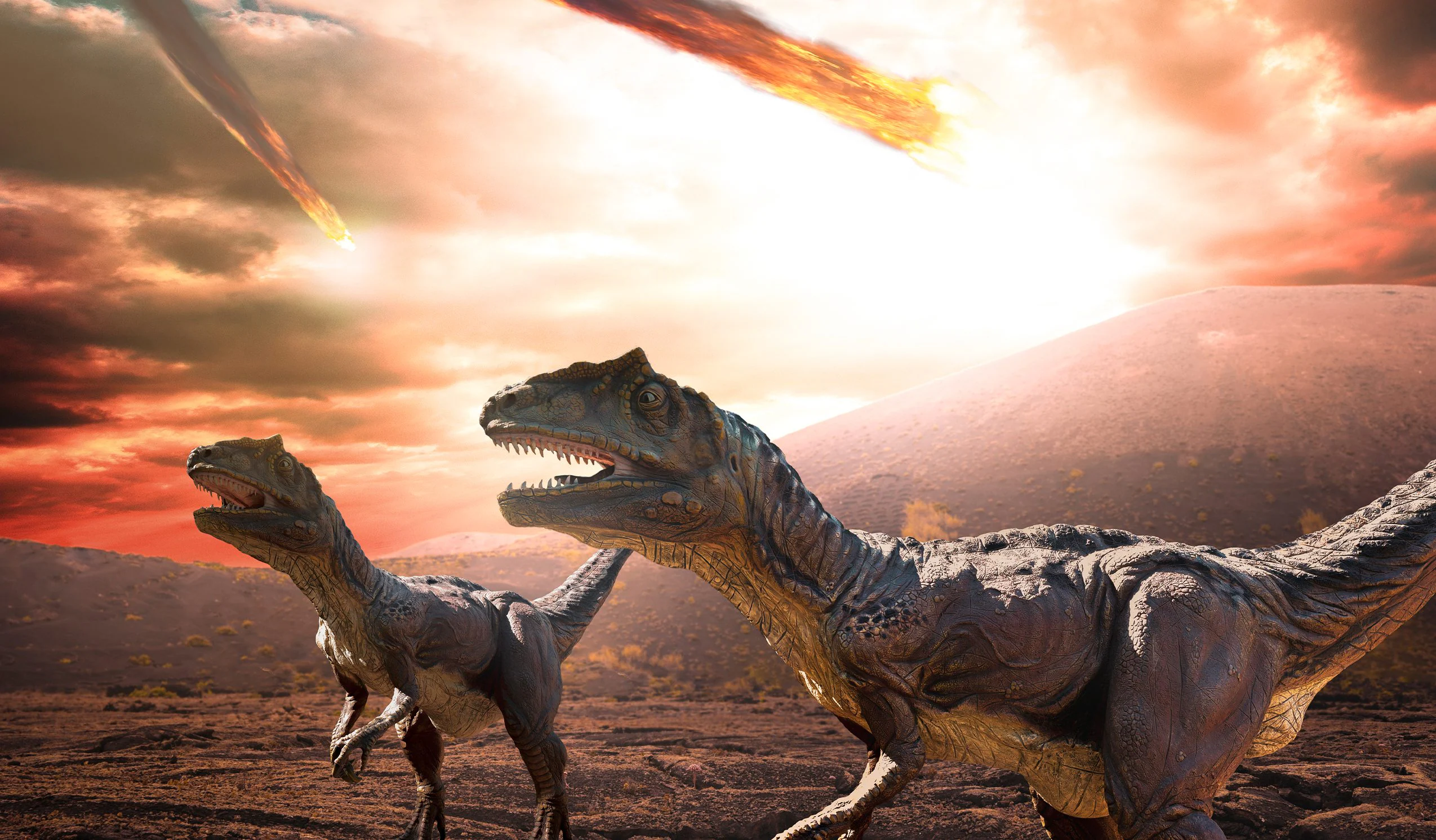
Sixty-six million years agoa gigantic asteroid with an estimated diameter between 10 and 15 km it traveled through space at a speed of approx 64,000 km/huntil crashing into the earth’s surface in what is now the Yucatán Peninsula, in Mexico. The impact unleashed an energy equivalent to billions of atomic bombs, creating the famous Chicxulub crater and triggering a chain reaction that wiped out the 75% from the living species on the planet, putting an end to the rule of the non-avian dinosaurs. Despite the enormous size of the crater, wide beyond 180kmand decades of field research, the nature and origin of this celestial body have long remained shrouded in mystery. The study published in the prestigious journal provides an answer Science Advancesconducted by an international team of geochemists, including researchers from the Vrije Universiteit Brussel and the University of British Columbia, who managed to reconstruct the chemical identikit of the asteroid.
The asteroid signature in nickel isotopes
In recent years, chemical analyzes conducted on the global geological layer of the boundary Cretaceous-Paleogene (K-Pg) – that thin layer of clay rich in iridium present throughout the world – had already suggested nature carbonaceous of the asteroid. However, distinguish between the different subfamilies of meteorites and trace their exact astronomical origin it has always been a complex challenge due to the alteration of the rocks over the millennia. Recent research led by the geochemist Georgy V. Makhatadze have marked a turning point thanks to the very high precision analysis of variations in the stable isotopes of nickel present in the microscopic debris – spherules and impact dust – that fell back to Earth after the collision.
The nickel it is the key element: being in fact made of a metal siderophile (similar to iron), abundant in asteroids but scarce in the earth’s crust – therefore not subject to environmental contamination – can be considered a reliable indicator. The isotopic proportions of nickel therefore unambiguously reflect the chemical-physical conditions of the region of the Solar System where the body condensed beyond 4.5 billion years ago. By comparing the isotopic signature of the K-Pg samples with those of known meteorites, the researchers narrowed down the field to an extraordinarily rare class: a carbonaceous chondrite of type CO, belonging to the group Ornans. These are primordial rocks, rich in refractory inclusions and small chondrules, formed in the external, frozen and undisturbed regions of the Solar system primordialwell beyond the orbit of Jupiter.
The role of sulfur and fine dust in the extinction of the dinosaurs
Class identification CO brings with it an unexpected scientific implication. Unlike others carbonaceous chondritesCO-type meteorites contain significantly lower amounts of volatile elements such as waterfall, carbon, zinc and above all sulfur.
As explained by the professor Philippe Claeysgeologist and co-author of the study:
A CO-type asteroid contains much less volatile elements than other classes of meteorites found on Earth so far. This data does not call into question the general theory on extinction, but it makes it less plausible that the sulfur contained in the impactor had a decisive role in triggering the catastrophe.
If the contribution of sulfur provided by the asteroid was probably more limited than previously assumed, what caused the drastic drop in temperatures and the blocking of photosynthesis on the planet were caused by the enormous quantities of silica dust and other very fine debris vaporized by the impact and thrown into the atmosphere at stratospheric altitudes, where they would have shielded solar radiation for years.
The dinosaurs were unlucky
The CO-type carbonaceous chondrites they represent an infinitesimal fraction of the meteorites received or analyzed on our planet. Most of the large asteroid impacts recorded in the last 500 million years were in fact caused by siliceous asteroids of type Scoming from the main band, and closer, between Mars And Jupiter.
Professor Claeys underlined the extraordinary exceptionality of the event:
Being hit by such a rare “bullet” from such remote regions of the Solar System highlights how unlucky the dinosaurs were.
The catastrophe that occurred 66 million years ago is therefore revealed not only as one of the most devastating events in geological history, but as the outcome of a very rare cosmic coincidence.
