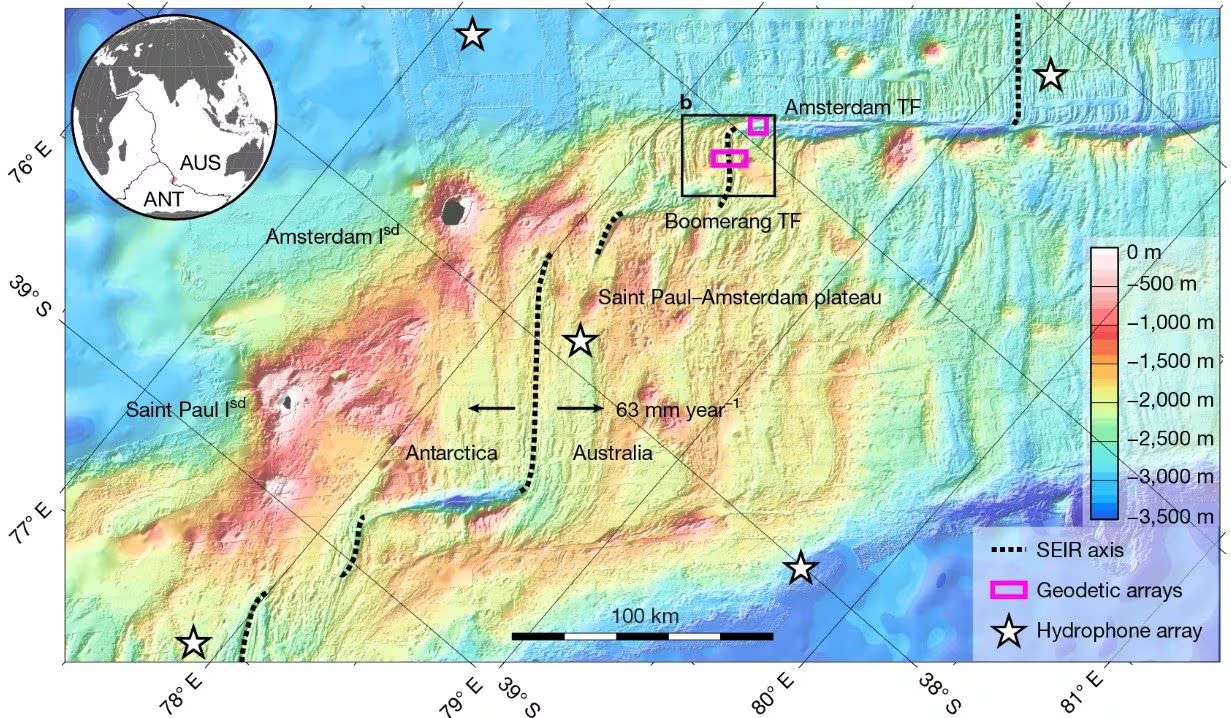
A team of researchers was able to observe for the first timein real time, the training of new earth crust on the ocean floor. The event took place along the oceanic ridge south-eastern which crosses theIndian Ocean and which separates the Antarctic plate from the Australian plate. The scholars were able to observe it thanks to special instruments installed on the seabed a few months earlier. From the fractures that extend along the axis of the ridge have escaped 160 million cubic meters of lava in sixteen days. An eruption of enormous magnitude that occurs along the ridges approximately every 40 years and that produced one sinking of 4.2 m along the crest of the ridge. The observations, which are very important for better understanding this complex geological process, are reported in the study by the Center National de la Recherche Scientifique (CNRS) of Brest, France, published in the journal Nature.
What happened along the ridge in the Indian Ocean: the new oceanic crust
Our oceans are crossed seamlessly by a system of mid-ocean ridges approximately in length 65,000 km; these underwater reliefs constitute the boundaries between lithospheric plates that move away from each other. On their summit extends a deep depression up to 50 km wide: the rift valley. Along this depression, the stresses of relaxation open fissures from which magma emerges and rises from the underlying Earth’s mantle. On the surface the lava expands laterally, cools and solidifies, forming new oceanic crust; the same pushes outwards the older crust present on the sides of the ridge, which over time will end up sinking in correspondence with the oceanic trenches.
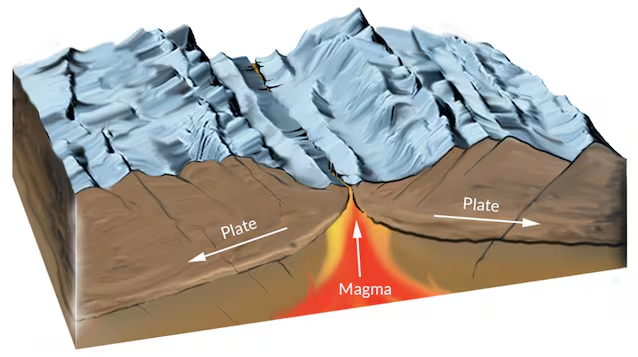
This mechanism by which the ocean floor expands and which generates approx two-thirds of the earth’s crust it has been known since the 1960s, but until now the formation of new crust on the seabed had never been observed. What made this possible was the installation on the ocean floor in February 2024 of advanced monitoring tools which allow us to intercept the sound waves generated by earthquakes and measure the movements of the earth’s crust. The researchers’ objective was to measure the very slow deformations that occur over time along the ridge due to the movement of the plates and they did not expect the enormous event that took place only two months after the installation of the instruments. On April 26, 2024, 160 million cubic meters of lava they flowed out of the rift valley over the course of sixteen days. The instruments recorded the earthquakes that accompanied the eruption and made readings on the seabed horizontal movements of 2-4 m. One was measured at the rift valley sinking of 4.2 mdue to the emptying of the magmatic reservoir present under the ridge.
The importance of observation: what the eruption reveals about seabed expansion
Despite decades of studies relating to plate tectonics, even today not all the details of the mechanisms affecting lithospheric plates are known. For example, we know that the Antarctic plate and the Australian plate along the ridge of the Indian Ocean they move away from each other about 6 cm per year. This data could suggest a very slow and gradual expansion of the seabed. In reality, the event observed testifies that theseabed expansion is not continuousbut it happens suddenly.
The relaxation efforts caused by the moving away of the plates at the ridge “stretch” the lithosphere, which becomes thinner and accumulates tension even for decades. Then suddenly these massive eruptions occur which can last hours, but even months depending on the speed at which the magma rises and its quantity. The displacement that was recorded during this eruption was enormously faster of the few theoretically predicted annual centimeters.
Additionally, stress relief generated faults along which shallow earthquakes occurred, but the instruments revealed that the seismic activity was much less intense than might have been expected. All this new data shows how our knowledge on the subject is still limited and makes a fundamental contribution to our understanding of tectonic processes.
