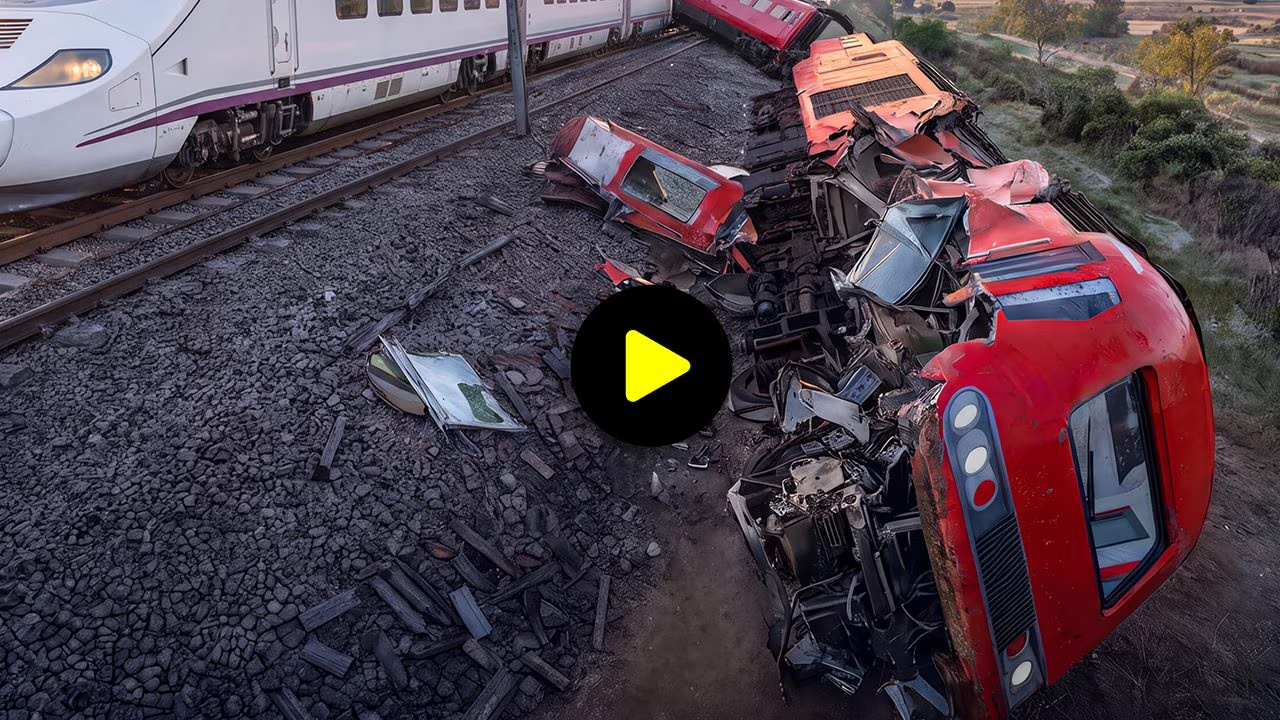
In Spain the collision between two trains has already caused more than 68 victims. Among the most accredited hypotheses, an error from the control room.
The train ad high speed Renfe which was carrying 397 passengers suddenly finds itself faced with another of Iryostopped on the tracks with 147 people on board: the crash is inevitable. The impact is extremely violent, convoys of both trains derail and fall from the embankment. Unfortunately the toll has already risen to 68 victimsalthough this number is constantly updated. The tragic clash occurred in Castile-La Mancha, between the towns of Los Yebenes and Urda (Toledo). Nine Italians were also among those involved in the accident. But how was it possible? Whose responsibility is it? Let’s try to answer these questions by analyzing the official statements released so far.
The reconstruction of the accident
The clash occurred near the municipality of Urda, in the province of Toledo, al kilometer 118 of the Madrid-Seville high-speed line. It is one of the busiest railway corridors in Spain. The first train in this story is theIryo number 6076a convoy of the 109 series. There are on board 147 passengers. Just before 9am the main security system, the LZBgoes haywire on a 63 km long stretch due to a communication failure between some computers on the network.
The called reserve system comes into operation BSL – which we will see in detail later. For now what we need to know is that this predicts one stop automatic of all trains in the area, including Iryo. In the following minutes the control room gradually gives the order to restart. The Iryo, however, remains stuck on the track between Mora and Urda. Why? There is no official confirmation on this: it is possible that he simply had not yet received the green light from the control room, but this is only a hypothesis. But this is where the second train comes in. Behind the Iryo comes the AVE Of Renfe number 2080a series 103 train, with 397 passengers.
The AVE train driver finds a signal red and, given the failure of the main security system, he radios the Atocha Control Center for permission to overcome it. And here is the crucial point: according to government sources also cited by El País, the control center inexplicably gave the authorizationeven though the Iryo was still there, still.
The AVE then sets off again and travels 25 kilometers at a speed of up to 200 km/h. Suddenly, however, the Iryo train finds itself in front of it. He can’t do anything, he tries to brake but doesn’t have time: the authorities confirm that at those speeds at least 4 km of free track would be needed. The AVE hits the Iryo. The impact is extremely violent: two Iryo carriages end up down the embankment and a third goes off the tracks. But the impact also derails the train coming from behind: the first AVE carriage also leaves the tracks. The number of victims, as we have seen, is very high and the same goes for the number of wounded.
But how do safety systems work along the line? And why didn’t they avoid the disaster?
The safety of the railway line
The first system is the LZBwhich we can imagine as a kind of co-pilot automatic. Its task is conceptually simple: it knows where the train in front is and, if the driver does not slow down in time, it brakes the train itself. That morning, however, this LZB broke down and it is in these cases that a reserve system called BSL comes into operation. The first step, as we said, is stop of the trains. After being given the go-ahead from the control room, the driver should drive at reduced speed relying on the light signals along the line, which indicate whether the section ahead is clear. It’s like driving in the fog: you go slowly and rely on the signs and directions from the control center. In this mode, therefore, safety depends much more on people.
As we have seen, however, the AVE not only receives the green light to pass after the red signal, but does not even moderate its speed because the control center operator tells it to resume driving. gear normal. Among other things, another train also appears to have received the erroneous order to resume “normal travel”: on that train, however, it was the engineer who highlighted the error, saying that the protocol requires “running on sight”.
So why was the AVE allowed to proceed at normal speed even though the Iryo was still stopped on the track? Was this actually human error from the control room?
The possible cause: human error?
To answer we need to understand how this control room works. In Spain traffic is managed by Regulation and Control Centresoperating 24 hours a day, every day of the year. Inside there are traffic regulators, who have integrated management, supervision and control systems, and who can speak via radio with the drivers. Under normal conditions their work is largely of supervision. As we have seen, if a train gets too close to the one in front, the automatic LZB system will brake it.
When that system breaks down, however, as in this case, things change. The human role becomes central: it is the control center that tells the driver whether he can move forward or not. And that’s exactly what would have happened this morning. According to El Español, the AVE train driver found a red signal and asked the Atocha Control Center for authorization to pass it. According to the investigators’ initial hypotheses, reported by El País, an Atocha operator he gave the order to continue by mistakeeven though the Iryo still occupied the track and the signal was red. The reasons behind this error are not currently known even to investigators.
There is also another reason why this news has shocked Spain so much. Along the same lines, nine months ago, there had already been a tragedy, the January 18, 2026. In that case the accident occurred near Adamuzin the province of Córdoba, a high-speed train derailed and a second train hit it, derailing in turn. They died 46 peopleincluding the driver of the Renfe train, and 292 they remained wounds. The causes, however, were completely different. In Adamuz the problem was the infrastructure: according to the preliminary investigation by the Guardia Civil, the breakage of the track was probably due to a welding defective. So two accidents on the same line a few months apart but with two different dynamics. It’s normal for people to be afraid. And precisely for this reason it is right to ask one last question…
Should we be afraid of traveling by train?
The answer is actually no, the train remains one of the safest means of transport we have. If we analyze data from the European Railway Agency (ERA), the risk of death for a rail passenger is about a third compared to buses and coaches and approximately 28 times less and for those traveling by car. So accidents are very rarebut when they happen they involve many people at once. On the roads there are many more victims, but they are spread across thousands of individual accidents that rarely make the headlines.
Finally, in safety engineering every accident becomes a lesson. Adamuz’s investigations have already uncovered procedural and maintenance problems. Urda’s will have to clarify how the backup procedures work when the automatic system fails. And it is worth mentioning that the line is in the process of migrating to theERTMSa more modern technology that facilitates interoperability with the rest of Europe
