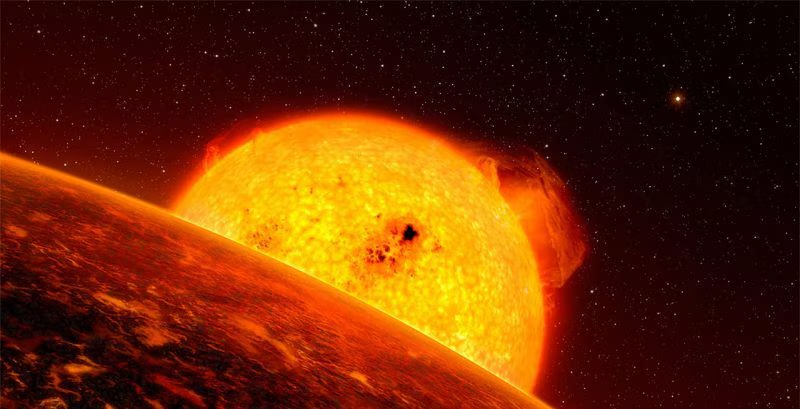
Earth could don’t be swallowed by the Sun in about 5 billion years, when our star will enter a new phase of life and expand to reach the stars outer layers theEarth orbit. The results of new research published in the scientific journal Astronomy & Astrophysics they put under discussion what has been demonstrated by the majority of studies published in the last twenty years, suggesting that the future history of our planet could be more complex than previously thought.
The authors of the research have in fact reconsidered this conclusion by using in their work more updated numerical models, which describe more accurately the dynamics of the gravitational interactions between the Earth and the Sun and, more particularly, when the latter will have developed into a red giant (currently our star is a white dwarf). The critical point of the whole issue concerns the tidal interactions that the two bodies mutually exert on each other. Although they are currently negligible, when the Sun expands to become a red giant they will tidal effects in fact they will tend to steal energy to Earth’s orbit, slowing down our planet and slowly pushing it towards the star.
The expansion of the Sun to Earth’s orbit
The Sun currently has a radius of 700 thousand km, about a little less than double the distance of the Earth from the Moon which is 384 thousand km. The star will take about 5 billion years to run out of hydrogen in the nucleus and start turning into a red giant. The expansion phase, however, will not be sudden as in an explosion, but it will be slow growth that will last hundreds of millions of years.
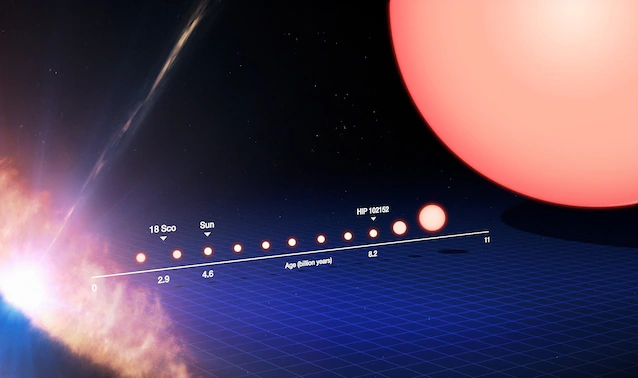
Starting the new combustion phase, the Sun will expand for balance the enormous heat increase generated in the inner shells of its core. At this moment, in fact, the total luminosity of the Sun will be approximately 100 times larger than the current onebut this energy will be distributed over a larger surface area. Astrophysicists have calculated that in this phase the Sun will expand until it reaches approximately the Earth’s orbit, at 1.5 million km from the gravitational center of the star.
But this will not be the maximum size of the Sun. After about a billion years, our star will enter a new phase called AGB (Asymptotic Giant Branch), i.e. becoming an asymptotic giant star, during which it will expand again until go beyond Earth’s orbitat a maximum possible distance of approximately 1.5 AU (the metric definition of an astronomical unit, abbreviated to AU, which corresponds to the current Earth-Sun distance).
The key detail of this long and tumultuous process is that the Sun will lose significant amounts of mass. When the Sun enters the red giant phase it will begin to emit a stellar wind much more intense than the current one, with the loss of mass which will be relatively slow even if continuous and irreversible. This is where the could factor comes into play save the Earth.
Will the Sun be able to swallow planet Earth?
The Sun, expanding enormously to enter the red giant phase, will undergo a very high slowing of rotation of its outermost layers (due to the law of conservation of angular momentum). The outer shells of matter will have a longer and longer rotation period, until the tidal bulge produced by the Earth on the Sun lags behind the Earth’s revolution around the star. This back bulge will exercise a continuous gravitational attraction on the Earth in a direction opposite to its orbital motion.
In other words, our planet will literally suffer a slow brakinglosing orbital energy and starting to spiral towards the Sun. According to the authors of the research, however, thanks to the increase in the mass loss of the Sun in its red giant phase, the Terra will survive.
This is because, by losing mass, gravitational attraction that the Sun will exert on the Earth will decrease progressively. Our planet will therefore move slightly – but continuously – towards a more external orbit, with the distance from the solar center which will increase as the years go by. Furthermore, moving away from the Sun, the tidal effects suffered by the Earth will be smaller. The results of the new numerical model used in the study indicate that tidal forces will therefore be less efficient in pulling the Earth towards the Sun than classical models suggested. The authors point out, however, that the problem is not yet solved.
In fact, another big unknown remains: how much material will leak really the Sun in the red giant phase. It is precisely this amount of ejected mass that could make the difference between the survival of our planet and its possible and definitive swallowing.
The same mechanism will also occur for the subsequent phase of the Sun’s life as an asymptotic giant. During this stage, the Sun will lose mass much faster than in the red giant phase, again allowing Earth to escape to a more distant orbit. In short, depending on how much mass will be expelled from the star in the intermediate phase of life (this is the even most uncertain variable in the models), the final destiny of the Earth could be written in a completely different way.
The Earth may survive the Sun, but the Earth’s biosphere and oceans cannot
While the Earth may not be physically swallowed up, however, it would be a planet that has been effectively sterile for billions of years. The terrestrial biosphere, in fact, is destined to be completely shocked long before the Earth risks being swallowed up by the Sun. Even if today the Sun appears stable (at least from the point of view of terrestrial climatology), in its core hydrogen is continuously transformed into helium. This makes the nucleus increasingly denser and hotter, gradually increasing the rate of nuclear reactions.
What happens, therefore, is a slow but continuous increase in solar brightness. In about a billion years the Sun will become about 10% brighter than today. It may seem like a small thing, but it’s a huge change for the Earth’s climate. With more solar radiation, the evaporation of the oceans will also increase, and more water vapor in the atmosphere also means a more intense greenhouse effect (vapour is a powerful greenhouse gas) which will increase the temperature and evaporation effect even more.
The pressure of the water vapor will increase more and more (a bit like what happens when you boil water in a pot with a lid) causing it to expand and reach the upper atmosphere, where the Sun’s ultraviolet radiation will break the H₂O molecules into free hydrogen and oxygen. Hydrogen, however, being very light, will be slowly dispersed into space. In short, over hundreds of millions of years the oceans will eventually dry up almost completely.
With the increase in temperature and (at least initially) rainfall, the erosion of the rocks will also increase, which will increase the process of CO₂ sequestration caused by leaching. This means that, lacking atmospheric carbon, plants will no longer be able to photosynthesize. Without vegetation, ecosystems will collapse and all complex organisms will become extinct. According to some estimates, the last living organisms that may remain in the Earth’s distant future will be thermophilic bacteria and the microorganisms that live underground.
