A recent study published in the journal PNAS by an international research team led by Yosuke Nagahata has reconstructed the complete evolutionary tree of animal blood cellsfrom their appearance to their diversification into modern species. Research suggests that the genetic program of immune cells and blood cells did not arise from scratch with the appearance of complex organisms, but derives from reuse and from specialization of a genetic toolkit already present in the unicellular organisms (the holozoans), which lived hundreds of millions of years ago.
Transcriptomics: analyzing gene expression to reconstruct the past
To understand where our blood cells come from, researchers carried out acomparative transcriptomic analysis. This technique does not analyze the DNA (genome), which is static and identical in all the cells of an organism, but studies the transcriptomeor theset of actively transcribed messenger RNA molecules. Basically, what is actually “copied” from the DNA for use.
In evolutionary biology, studying the transcriptome is crucial because the identity and function of a cell depend on it which genes are actually expressed. By comparing gene expression profiles and the activity of transcription factors (proteins that regulate the activation of genes) between different species it is possible to establish theevolutionary homologyi.e. the similarity between apparently distant cell lines. This allows you to trace a phylogenetic tree of cellssimilar to our family tree, discovering how and when they separated over time.
To map this evolutionary path, the study analyzed the transcriptomic data of a vast selection of organisms (vertebrates, invertebrates, simple marine organisms and holozoans) e compared the molecular signatures of different cell linesincluding macrophages (phagocytic cells), mast cells and killer cells (responsible for innate immune responses), T and B lymphocytes (immunity cells), erythrocytes and thrombocytes (specialized in oxygen transport and coagulation).
The origin of blood cells: ancestral macrophages and the Fos factor
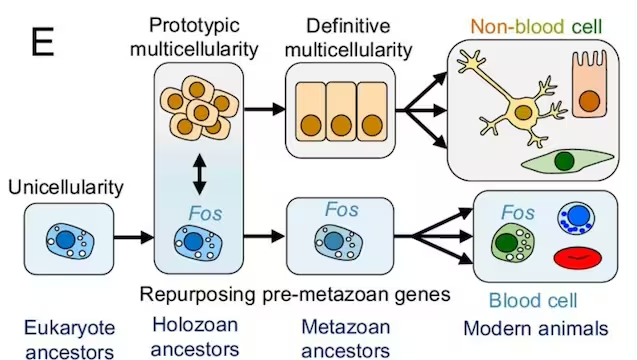
The evolutionary history of blood cells begins at the origin of metazoansthe first animals. The study shows that the first ever blood cells were phagocytes similar to macrophages, cells of our immune system that are responsible for incorporating and neutralizing any dangers for our organism, derived directly from the biological characteristics of unicellular ancestors. Their job was to patrol the fabrics and defend the body from bacteria and viruses.
At the molecular level, all of this is controlled by transcription factorsamong which the gene stands out Phos as one of the main ones. To confirm this connection, the researchers overexpressed the gene Phos in the unicellular organism Capsaspora owczarzaki: that is, they forced the cell to read this genetic “recipe” in a continuous cycle, producing ahuge amount of the protein Phos. This inhibited the aggregation of the cells keeping them in one state amoeboid and isolated, simulating the migratory behavior of animal macrophages. Simply put, a high concentration of this protein drove various individuals to Capsaspora to “wander” individually, instead of sticking together as they normally would, thus supporting the hypothesis of the involvement of this transcription factor.
The first division: defense against parasites
With the appearance of bilaterally symmetric animals, the body of organisms became more complex, organizing itself along a mirror axis with one half on the left and one on the right, like most modern animals. This new complexity has placed a new selective pressure on the immune system: the threat of multicellular parasites. Against them, simple phagocytosis by macrophages was not sufficient.
Thus the separation between the macrophage lineage and one occurred new specialized line of ancestral mast cells. These have acquired the ability to synthesize protease (enzymes that degrade proteins) contained in granules to target parasites. Traces of this first division are still visible in modern invertebrates: the crystal cells of the fly Drosophila or the morula cells of sea squirts share the same genetic signature and function as the mast cells that protect mammals.
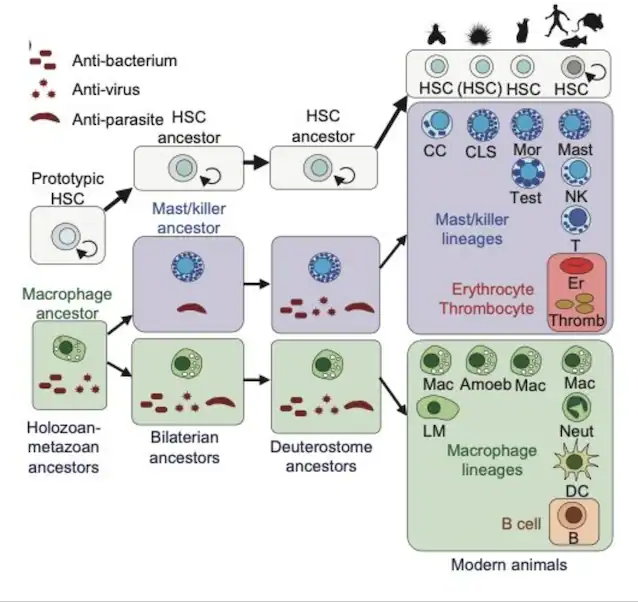
Another surprise concerns i red blood cells (erythrocytes) and platelets which, in vertebrates, appear to have arisen later, budding directly from ancestral mast cells. Researchers have discovered that the evolutionary lineage of our blood was not divided from the beginning between “cells for breathing” and “cells for defense”. This means that the oxygen transport system in the blood is asubsequent evolutioncreated by modifying and specializing structures that initially served exclusively for the immune response.
What remains to be discovered?
Like every great breakthrough in science, this model also has its limitations and represents only the beginning of a new line of research. The authors of the study themselves point out that the genetic networks hypothesized for organisms such as sea urchins or tunicates will have to be confirmed in the future by experimental validations directed in the laboratory.
Furthermore, it is likely that they exist other genetic factors key in the evolution of blood that this research has not yet identified. Finally, it remains to be clarified precisely how and when theacquired immunitythat is, that ultra-specialized defense that allows us to produce specific antibodies. The road to reconstruct the entire history of our blood is still long, but this study has finally positioned the first, fundamental pieces of the puzzle.
Sources
Y. Nagahata, Y. Nishimura, R. Kaitani, J. C. K. Leong, I. Oda-Ishii, H. Kohtsuka, S. Abe, T. Ishida, M. Carmona-Rivas, S. R. Najle, E. Casacuberta, K. Ikuta, T. Miura, M. Ogasawara, N. Irie, Y. Satou, I. Ruiz-Trillo, & H. Kawamoto, Animals have expanded the evolutionary legacy of unicellular ancestors in blood cells, Proc. Natl. Acad. Sci. USA 123 (23) e2528110123, https://doi.org/10.1073/pnas.2528110123 (2026).
