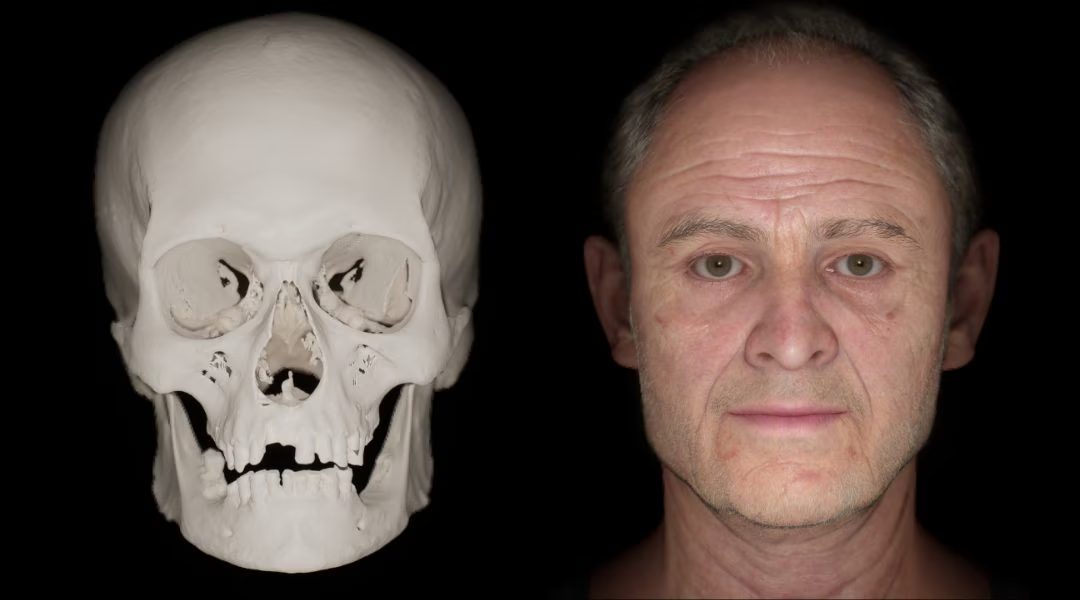
A man who lived in11th century England ideally returns to look at us through a digital facial reconstruction. The cultural institution English Heritage presented the face of the so-called “Conquest Man”“the man of conquest“, an individual buried in St Peter’s Church in Barton-upon-Humber, Lincolnshire, then owned by one of the knights of William the Conqueror (1028-1087). The name derives from how this very important historical period for the history of the country is known in England the victory of the Normans over the Anglo-Saxons. The individual’s appearance was reconstructed through the so-called Manchester methoda forensic technique that reconstructs facial features starting from muscle positions on the skull and their insertions.
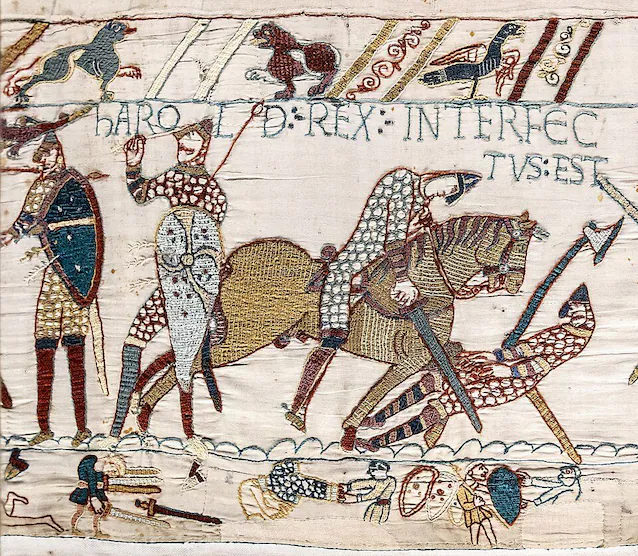
In the 1066William, Duke of Normandy, landed on the island and defeated the Battle of Hastings the Anglo-Saxon king Harold (1022/1023-1066). From this moment on the Norman conquest of Englandwhich changed its face forever, starting the historical process that would lead to the formation of the kingdom of England as we know it.
The man found in Barton-upon-Humber had a robust and muscular buildhe was just over tall one and a half metres and died between 50 and 60 years old. The skeleton shows signs of different fractures healed. The reconstructed face, by choice of English Heritage, has been represented with i graying hair and wrinklesto indicate what this person might have looked like at the age of death, rather advanced for the time. The eye color was chosen because the most common in the area of origin of man, central-eastern England.
He was placed in one coffin made from an oak felled around the 1079with his arms bent, his head resting on a cushion of grass and supported laterally by two pieces of locally sourced plaster. They were placed next to the body three sticks of apple woodobjects that are associated with a Scandinavian funeral tradition. The burial, therefore, presents elements attributable to a context now profoundly influenced by the Norman conquest, but also to traditions of Scandinavian origin. The Normans should not be confused with the Norse. The Normans of Normandy were in fact none other than the descendants of those Norse who had settled centuries earlier in northern France. It was essentially one warrior elite already Frenchized and converted to Christianity for some timewhich had very little to share with its Scandinavian cousins.
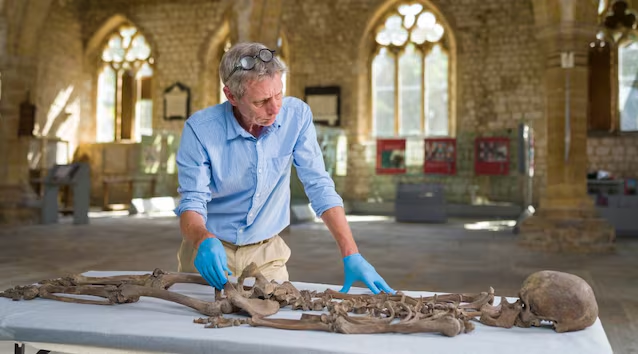
The research on the human remains combined osteological analysis, ancient DNA and isotopic analysis, before arriving at the digital reconstruction of the face carried out by FaceLab from the John Moores University of Liverpool. The findings point to a history characterized by diverse influences. The DNA shows a consistent component of ancestry from continental Europe; the oxygen values detected in a tooth are compatible with a period spent during adolescence in a cold environment, while those of strontium are more compatible with the Barton-on-Humber area.
The data therefore do not allow us to simply classify man as “Saxon” or “Norman”. According to English Heritage, he may have been originally from the region or arrived there after spending part of his life elsewhere. However, his burial testifies to the presence of different traditions and influences in the local community, in a dynamic and changing context such as medieval England.
In a context where actual ethnic origins they mattered less of the way in which one wanted to be perceived by others, the story of a man of Saxon origin who lived for a certain time in Scandinavia and was buried with Scandinavian traditions is very fascinating. Facial reconstruction offers this an individual image of a profound phase political and cultural transformations: not that of a sovereign or a protagonist of the chronicles, but of an ordinary person lived through the conquest of 1066 and buried, a few years later, within the new Norman world.
