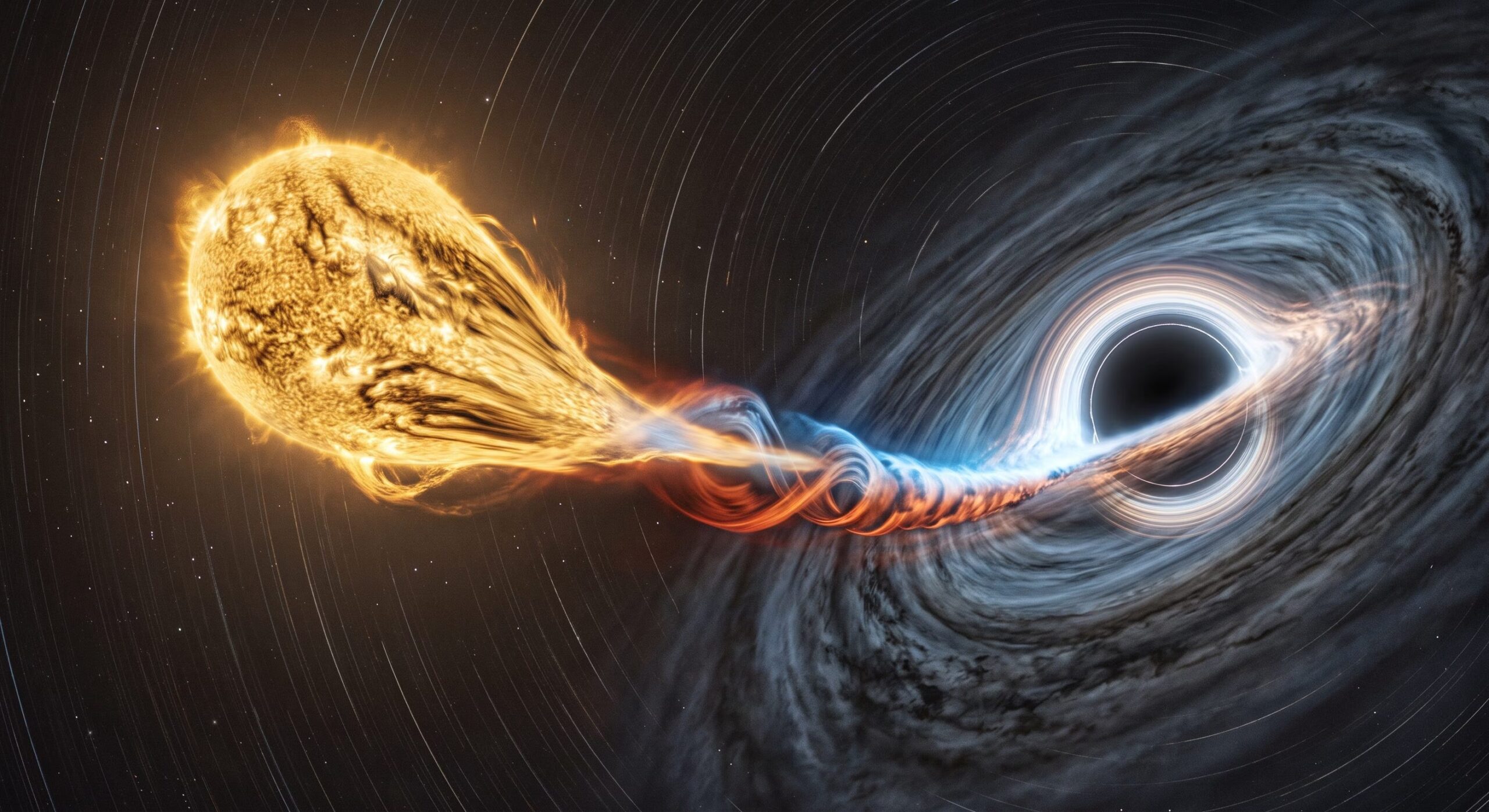
It was discovered fastest star never observed in our galaxy, the Milky Way: is called S301darts to 25,000 km/s (to be clear, it is about 100,000 times faster than an airliner) and its discovery, published in Nature, was obtained using data from the Very Large Telescope Interferometer of ESO, the European Southern Observatory.
To find it, astronomers had to scrutinize the most mysterious point of our galaxy for decades: the surroundings of the black hole Sagittarius A*at the center of the Milky Way. S301, by the way, yes come closer to Sagittarius A* more than any other star observed so far, up to one distance similar to that between Saturn and the Sun.
Precisely because of its proximity to Sagittarius A*, S301 is the first star we know of that could be used to directly measure the rotation of a black hole.
A star in the Milky Way that travels one hundred thousand times faster than an airliner
Let’s start with the numbers, because with S301 they are really difficult to imagine. At the point of its orbit closest to the black hole, the star travels at approx 25 thousand kilometers per secondabout 8% of the speed of light (which is around 300,000 km/s): for comparison, this star is 100,000 times faster than a commercial airliner. This is what earns it the record as the fastest star in the Milky Way.
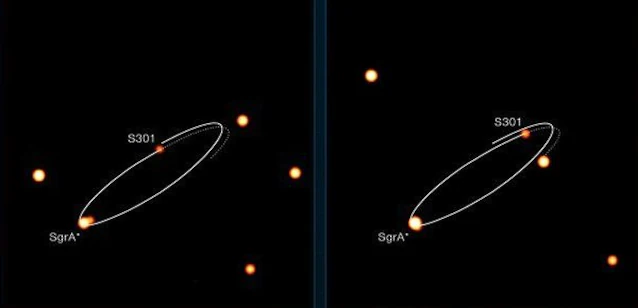
What makes it so fast is the very narrow orbit which runs around Sagittarius A*, the supermassive black hole at the center of our galaxy. S301 goes around it in just 8.7 years old (a very short time for such a nearby star) and at the moment of maximum approach comes to a distance comparable to that between Saturn and the Sun. No other known star has ever come so close to this black hole.
Going more specifically, S301 is one main sequence starwith a mass about one and a half times that of the Sun and a radius between 1.4 and 1.6 times that of the sun. The problem is that it is very weak: appears to us two billion times dimmer of Betelgeuse, the orange star of the constellation Orion.
Astronomers hypothesize that S301 was part of a system binary, that is made up of two gravitationally bound stars, which was disintegrated by the tidal forces of Sagittarius A*: she was trapped by the gravity of the black hole, while her companion was thrown away at such a speed as to exit, in all likelihood, from the galaxy.
And there’s a reason why this star matters so much: passing so close to the black hole, S301 is the first star we know of that is capable of making us measure ourselves directly there rotation of Sagittarius A*.
Like most objects in the universe, astronomers predict that Sagittarius A* rotates. As INAF reports, according to Einstein’s theory of general relativity, a rotating black hole drags spacetime with it and deforms it, influencing the orbits of surrounding stars. The effect is most pronounced for objects orbiting close to rapidly rotating black holes. The authors of the study, thanks to the discovery of this star, hope to be able to measure, within the next ten years, the rotation of the black holefundamental for characterizing the physical models that describe these “exotic” objects.
How they discovered S301 near the black hole
Finding the star s301, an object two billion times fainter than Betelgeuse (also glued to a black hole) it wasn’t easy at all. The credit goes to the VLTI, the Very Large Telescope Interferometer at ESO, located at the Paranal Observatory in Chile, equipped with the Gravity+ instrument. The VLTI combines the light from four eight-meter telescopes to create a “virtual” telescope, with a resolution space fifteen times higher than that of a single telescope from eight meters. As Frank Eisenhauer recalls, principal investigator of Gravity+, this is the only place in the world where you can make observations like this, because no other observatory has four eight-meter telescopes working together like this.
In reality, the first look on the new star S301 dates back to spring 2023: since then, the team has continued to follow it to reconstruct its orbit. Astronomers then managed to reconstruct orbital history of S301 up to 2017finding that the last approach to the central black hole dates back to early 2023
The next observations, with Gravity+ and with the Micado instrument which will be mounted on ESO’s Extremely Large Telescope, will be decisive for following S301 over the next decade, in view of its next flyby scheduled for 2031. Observing at least two complete orbits would allow us to trace their path with such precision as to measure, for the first time, there rotation (or spin in jargon) of Sagittarius A*.
