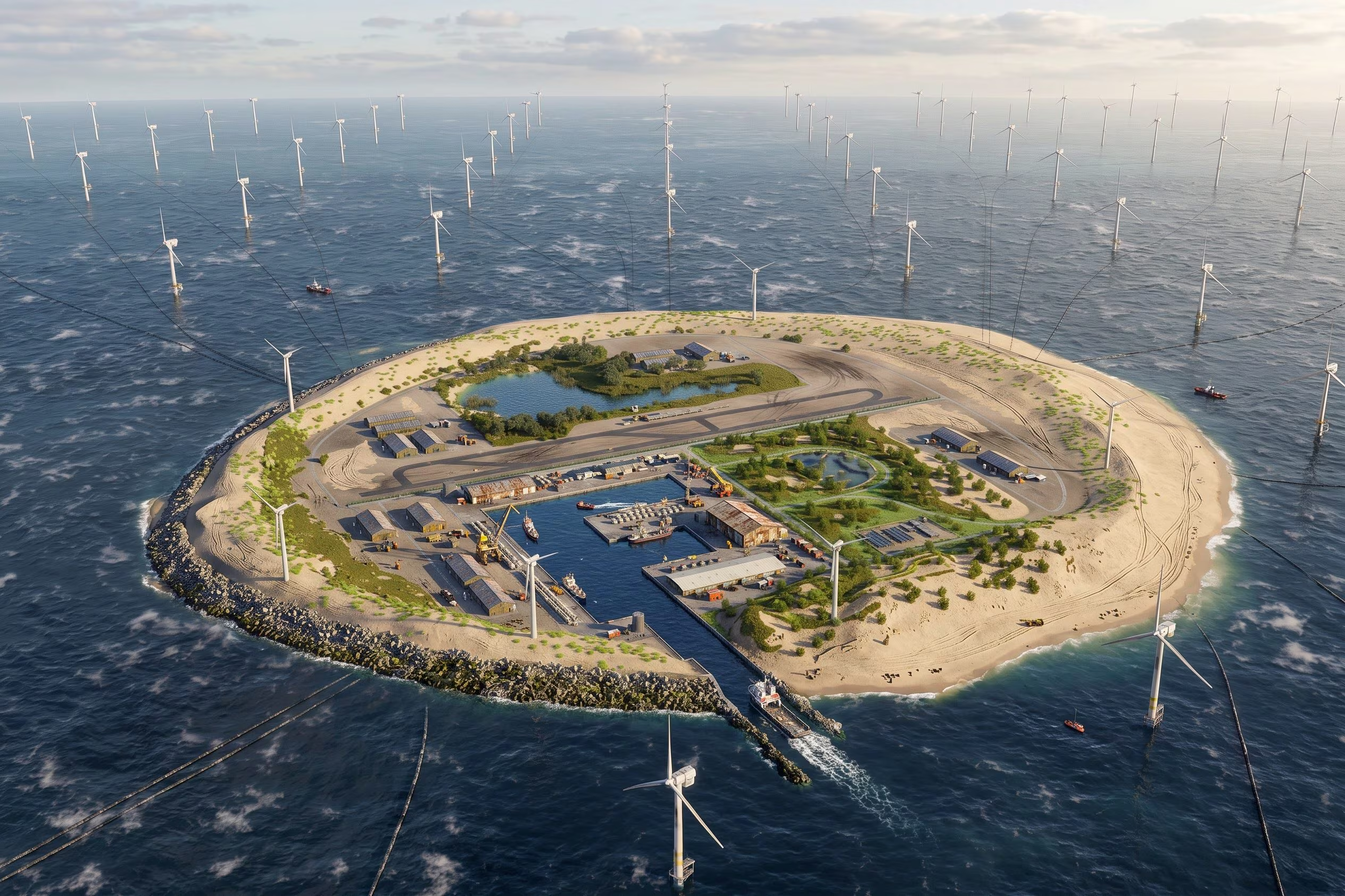
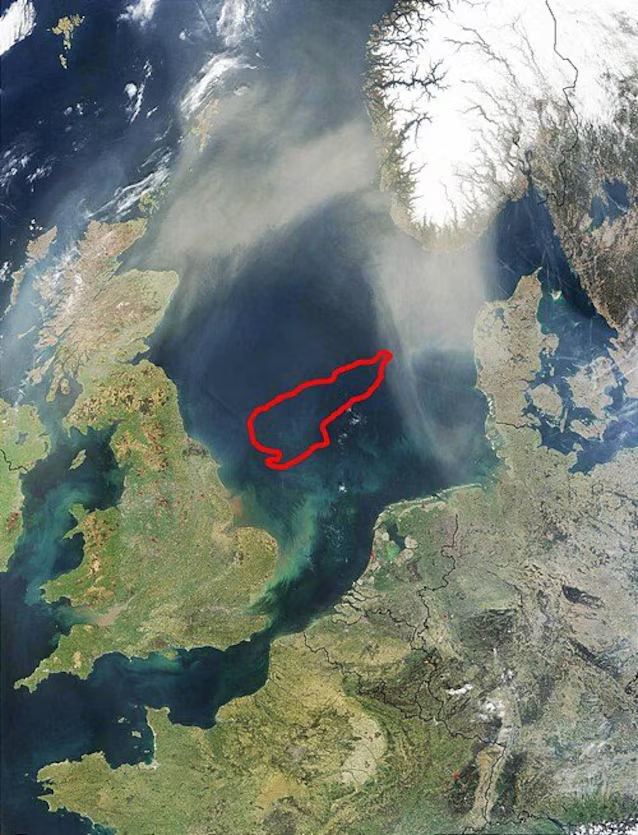
In the heart of North Seaapproximately 80km off the peninsula of Jutland, Denmarkone of the most ambitious infrastructure projects ever conceived in Europe is taking shape. Is called North Sea Energy Island and it is an artificial energy island designed to collect and distribute electricity generated by hundreds of wind turbines offshore.
The project, carried out in collaboration with several European countries, should be operational no earlier than 2036 and represents a concrete step towards European climate neutrality: by 2040, in fact, the infrastructure should reach a capacity of up to 10 GWcapable of satisfying the energy needs of approximately 10 million European families.
The project, however, is not without obstacles: delays, rising costs and unprecedented technical complexities constantly test its feasibility. Let’s see in detail what it is, what the numbers are at stake and what impacts – positive and negative – can be expected.
Description of the maxi project: it could become the largest energy hub
The project involves the construction of an artificial island that will perform the function of offshore power plant. In its initial phase – which should have been completed by 2033, then postponed to at least 2036 – the island is expected to reach a capacity of 3 GWwhich you can expand to 10 GW by 2040. To understand the power, 10 GW corresponds to the production needed to power approximately 10 million European families.
The project envisages that the entire infrastructure will be developed on a minimum surface area of 120,000 square meters (about 18 football pitches) and will be surrounded by hundreds of wind turbines. From a technical point of view, the island should act as a “hub” to collect the energy produced by the surrounding wind farms and distribute it via high voltage submarine cables to Denmark, Germany, the Netherlands, Norway, Belgium and the United Kingdom. It must be said, however, that also due to the continuous delays (with the project officially postponed by at least 3 years, from 2033 to 2036) and the increase in costs of approx 50 billion Danish crowns (around 6.7 billion euros), the collaboration with Belgium now seems to have run aground.
In addition to electric transmission, however, the project will also integrate technologies Power-to-X: Part of the green energy will be used directly on the island to produce green hydrogen via electrolysis, intended to power maritime transport and aviation.
Socio-economic impact: approximately 30 billion euros of investment
For the realization of this immense project, an estimated total investment of more than is expected 210 billion Danish crowns (about 28-30 billion euros), making it, in fact, the largest construction project in Danish history. Of this amount, around 10 billion euros will only be used for the construction of the island and its piers, while the rest will cover the costs of wind farms and interconnections.
One of the first advantages in carrying out such a complex project is certainly that towards the job market. Thousands of jobs are expected to be created during the construction phase and hundreds of specialized positions for long-term management and maintenance.
In addition to the purely employment value, the Power Hub is to be considered, not without reason, a true pillar of European energy sovereignty. Once completed, in fact, the dependence on fossil fuel imports will be reduced.
CO emissions2 reduced by approximately 1.9 million tonnes per year
The primary objective of the project is decarbonization. In fact, for every GW of wind energy produced, CO emissions can be reduced2 of approx 1.9 million tons per year. With a capacity of 10 GW, the island would be able to avoid the release into the atmosphere of almost 20 million tons of carbon dioxide every year, accelerating Europe’s goal of becoming the first climate-neutral continent by 2050.
However, such an enormous undertaking brings with it a whole series of enormous ecological challenges. The construction of the artificial structure, in fact, and the installation of the submarine cables will have a direct impact on the seabed and marine fauna. In order to reduce this impact, and the effects resulting from it, the project is characterized by the inclusion of monitoring protocols during the works and studies to transform the island’s protective barriers into artificial coral reefs that can promote local biodiversity. Integrating hydrogen production directly at sea also reduces the need for heavy infrastructure on land, further preserving coastal areas and terrestrial ecosystems.
