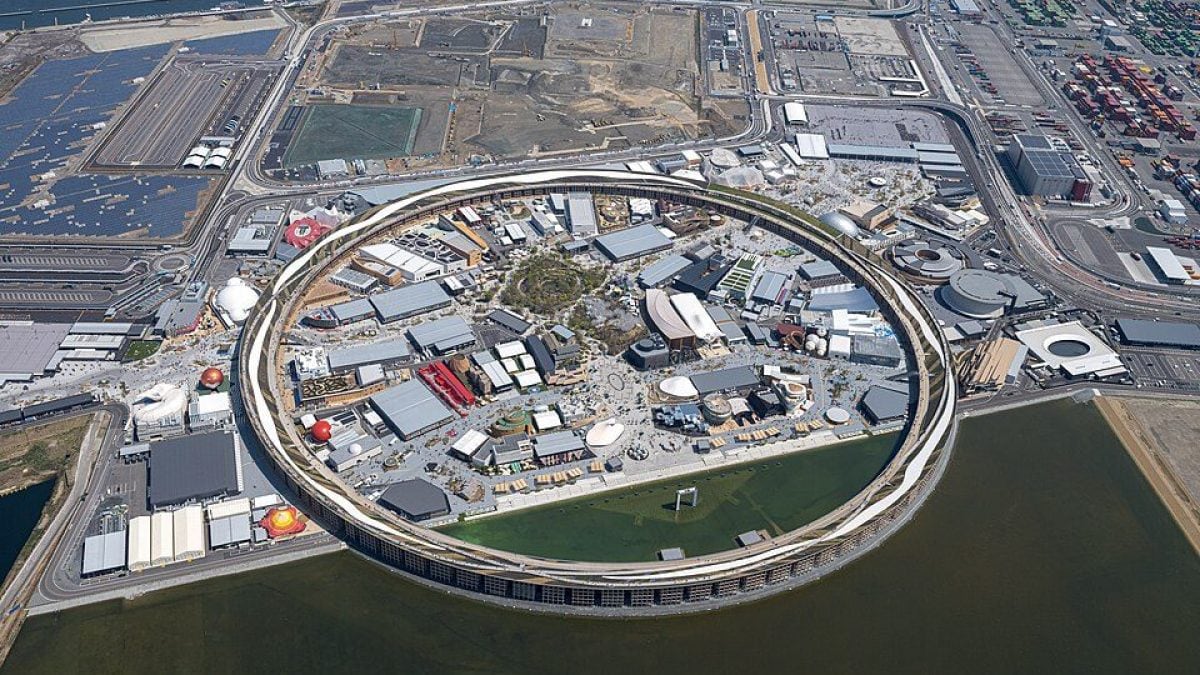
The Grand Ring of the city of Osaka, Japan, is one of the most interesting engineering challenges of recent years. Designed by architect Sou Fujimoto on the occasion of the Yumeshima Expo in 2025, it is the structure that officially holds the world record for largest wooden ever mademade with over 27,000 cubic meters mainly of Japanese cedar and cypress with a skilful combination of age-old Japanese jointing techniques with the most modern structural calculation standards.
How the project was carried out: the characteristics
The entire structure develops on a surface that measures overall 61,035.55 m²with a circumference of approx 2 kilometers. The Grand Ring must be considered a real one multifunctional infrastructure. The upper part acts, in fact, as a panoramic walkway (Green Roof)expertly covered with vegetation, which allows visitors to walk around the entire perimeter and therefore be able to enjoy a beautiful view of the sea and the entire exhibition site. The external diameter reaches 675 meters, while the internal diameter reaches 615 meters. As regards the materials used, the designers’ choice was to use wood mainly from sustainable forests cedar (Sugi) And Japanese cypress (Hinoki). The choice of wood not only has a purely symbolic value, but has its own functionality: the material, in fact, offers an excellent strength-to-weight ratio, a characteristic of fundamental importance for a structure of this size located on an artificial island.
Let’s try to understand, together, how this island will actually be built. The project consists of the installation of 23 giant reinforced concrete caissonsprefabricated on the ground, which act as a protective perimeter. These are towed, placed on a previously leveled seabed and filled with sand to create a gravity based structure. Within this protected enclosure, a reclamation of the basin will be carried out and filled with dredged sand to form a solid platform that will reach 7 meters above sea level. Above this structure that emerges from the water, electrical infrastructures will be built, such as, for example, high voltage substations (HVAC/HVDC) and transformers, which will be connected using submarine cables coming from the surrounding wind farms. The island therefore acts as a real hub that collects energy, converting it into HVDC to reduce transmission losses and subsequently sending it to the mainland via interconnectors. Stability is guaranteed by the weight of the caissons, while protection from extreme events is ensured by an external artificial reef. It is, in essence, a maritime reclamation work surrounded by a concrete “seawall” that houses an offshore power plant.
The main objective and function of this structure was to facilitate the circulation of visitors, protecting them from the sun and rain, while simultaneously providing an elevated panoramic walkway (the Green Roof) from which to admire the entire exhibition site. From an architectural point of view, it served to give a sense of unity and cohesion (“Unity in Diversity”) to very different national pavilions, establishing a common horizon.
Returning to the dimensions of the structure, the height is between 12 and 20 meterswhile the width of the section is 30 meters, while, from the point of view of the quantities of wood used, we know that between solid and laminated wood, they were used well 20,000 tons wooden.
Wood engineering: the Nuki technique
As we have already had the opportunity to anticipate in the previous paragraph, the structure was built with the use of ancient Japanese engineering techniques, used in past centuries and still perfectly valid today. First of all the technique called Nuki. This method involves the insertion of horizontal beams through holes drilled in the vertical pillars, creating a network of joints that does not require the massive use of bolts or chemical adhesives.
From a structural point of view, the technique is characterized by a particular load distribution. The pillars are in fact arranged in such a way as to create a rigid but flexible frame system, capable of absorbing vibrations.
Since the Grand Ring is located in a high seismic risk area, the engineering of the Grand Ring exploits the natural elasticity of wood combined with the Nuki technique. In the event of an earthquake, in fact, the joints allow micro-movements that dissipate kinetic energy, avoiding the fragile collapse typical of excessively rigid structures.
Given the nature of Yumeshima (the island on which the work stands), it was necessary to use special foundations to reduce the risk of soil liquefaction by distributing the weight of the structure evenly across a reinforced base plate.
Sustainability, functionality and engineering challenges
It seems obvious that such a particular infrastructure brings with it a series of engineering challenges of great value. First of all the resistance to horizontal loads due to wind. In fact, being located on the coast, the Ring must resist typhoon winds. The aerodynamic section and visual permeability of the structure help reduce wind pressure (wind load).
To guarantee durability during the six months of the event, it is necessary to treat the wood with water-repellent and fire-retardant nanotechnological finishes, without however altering the natural breathability of the wood fibre.
At the end of the World’s Fair, the structure was designed to be dismantled and in fact, to date, the structure is in the advanced dismantling phase, although only a small section of approximately 200 meters (about 10% of the total circumference) will remain on the site as a “permanent monument” in memory of the event. The timber can be reused in other building projects, following the principles of reversible architecture and minimizing the residual environmental impact.
