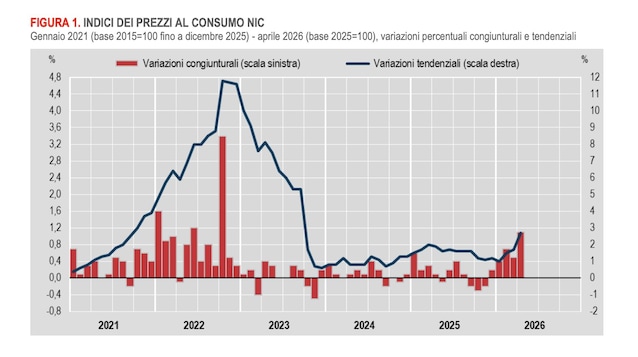
In April 2026, Istat reported a rise in inflation in Italy, with an increase of 2.7% on an annual basis and an increase in1.1% on a monthly basis, with prices rising not only for energy, but also for basic necessities: such high trend increases have not been recorded since the end of 2023, while the monthly acceleration reaches peaks not seen since 2022.
According to various consumer associations, geopolitical tensions linked to the war in Iran and the closure of the Strait of Hormuz have contributed to the rise in energy prices. The crisis situation in one of the most strategic maritime passages in the world for the trade of oil and natural gas has triggered a surge in energy goods, with the heating oil which recorded a +38.1% (reaching peaks of 38.4% in some surveys) and the diesel fuel for transport which rose by 23%.
The energy increases have had a cascade effect on the rest: on the costs of agricultural fertilizers, electricity for industrial machinery and fuel for the trucks that move goods. The increase in production and logistics costs is inevitably having an impact on the final consumer.
How much the Hormuz crisis costs us: increases in goods and services
As stated on the Istat website, “the cyclical change in the general index is mainly affected by the increase in the prices of unregulated energy products (+5.4%), unprocessed foodstuffs (+2.0%), transport-related services (+1.7%) and recreational, cultural and personal care services (+1.4%) – effects only partially offset by the decrease in the prices of regulated energy products (-0.3%).
In practice, Istat tells us that the general increase in inflation in this single month (what technicians call “cyclical variation”, i.e. the comparison between March and April 2026), it was pushed upwards by four categories of daily expenses:
- Unregulated energy (+5.4%): these are mainly the fuels we fill up with (petrol, diesel, LPG) and some energy supplies (electricity and gas) whose prices directly follow market trends;
- Unprocessed foods (+2.0%): fresh food, what we buy at the counter or in the fruit and vegetable section and which has not undergone industrial transformations. We are talking about vegetables, fruit, meat and fresh fish;
- Transport related services (+1.7%): the cost of tickets for travel, such as flights, ferries, trains and buses;
- Recreational, cultural and personal care services (+1.4%): includes expenses for leisure, holiday packages, hotel rooms, restaurants, but also body services such as hairdressers.
There is only one item in decline, that of regulated energy sources (-0.3%): these are always electricity and gas bills, for those who benefit from the “Vulnerability Protection Service” (reserved for the elderly, disabled or people in disadvantaged conditions), where the rates are established by the authorities. In summary: refueling, buying fresh produce at the supermarket, traveling or booking a holiday cost much more than the previous month, and these increases were only partially offset by the slight drop in bills for vulnerable customers.
Concrete increases: analyzes of UNC and Codacons data
According to the calculations ofNational Consumers Union (UNC), the average increase for an Italian family is 731 euros per year moreof which 198 euros relating to the products in the shopping cart (185 euros only for food products)
The Codacons projections (consumer protection association) outline an even more severe scenario, estimating an average annual burden of 893 euros. The burden grows proportionally for larger families: for a couple with two children the estimates for the overall increase in the cost of living range from 1,024 euros per annum (UNC) until well 1,233 euros (Codacons). Below is the processing of UNC:
| Spending divisions | Average family | Couple with 2 children | Couple with 1 child | Annual inflation April |
|---|---|---|---|---|
| Food products and non-alcoholic drinks | 185 | 269 | 236 | +2.9 |
| Alcoholic drinks, tobacco and drugs | 14 | 18 | 19 | +2.7 |
| Clothing and footwear | 12 | 22 | 17 | +1.0 |
| Housing, water, electricity, gas and other fuels | 204 | 221 | 219 | +5.1 |
| Furnishings, appliances for domestic use and current home maintenance | 21 | 29 | 25 | +1.5 |
| Healthcare | 14 | 17 | 17 | +1.0 |
| Transport | 136 | 223 | 207 | +3.8 |
| Information and communication | -19 | -28 | -26 | -2.2 |
| Recreation, sport and culture | 14 | 24 | 20 | +1.1 |
| Education services | 4 | 10 | 6 | +1.7 |
| Restaurant services and accommodation services | 54 | 95 | 76 | +2.8 |
| Financial and insurance services | 35 | 52 | 49 | +4.0 |
| Personal assistance, social protection and various goods and services | 56 | 74 | 75 | +3.5 |
| TOTAL ANNUAL PRICE INCREASE | 731 | 1024 | 940 | +2.7 |
| SHOPPING CART | 198 | 286 | 252 | +2.3 |
Calculations and estimates carried out by the main consumer associations starting from the definitive Istat data of April 2026 indicate significant variations in everyday products. These are the numbers Assoutients and of Consumer training and research center (Crc) relating to the price increases of the last two months:
- fresh tomatoes record price increases ranging from 28.5% up to a peak of 33.6%
- aubergines +28.5%
- peas +27.3%
- fennel +23.5%
- strawberries +17.4%
- asparagus at +16.1%
- fresh green beans +14.1%
- cauliflower and broccoli between +12.1% and +13.4%
- poponi and melons +10.6%
- watermelons and watermelons +10.5%
- mandarins or clementines +10.0%
- grapes +9.0%
- peppers between +4.3% and +8.9%
- oranges +8.5%
- beef and eggs +8.3%
- nuts +4.4%
- plantain bananas +3.6%
- carrots and turnips +2.9%
With the increases in jet fuel prices have gone up airline ticket prices: intercontinental routes cost 20.0% more in April, while European continental connections rise by 17.2%. THE water transport internal services rose by 14.8%, the sharing and vehicle rental sector rose by 8.7% and passenger ferries by +6.0%. As compared to technology and digital productsblank storage media increased by 21.6 percent, computing and communications components by 19.6 percent and devices by 11.7 percent. Personal computers and entertainment software saw a +16.2%.
The average price of petrol on the Italian road network, meanwhile, has risen (1.943 euros/litre as of 20 May) in the last two weeks, while that of diesel (1.977 euros/litre) has fallen. Before the outbreak of the war, a liter of petrol cost around 1.67 euros. Next May 22nd the last extension to the cut in excise duties on fuel will expire, ordered by the government last March 18th and extended so far with a cost of 1.3 billion euros for the State: if the cut is not extended again, petrol will go back to costing over 2 euros per litre, diesel 2.2: according to Codacons, this would correspond to around 3 euros more per tank for petrol and +12.2 euros per tank of diesel.
The parallels with the 2022 crisis and future predictions
The current dynamics present analogies with the crisis triggered by the outbreak of war in Ukraine in 2022. As highlighted by the UNC, if it is true that trend inflation of 2.7% has not been recorded since September 2023, it is above all the monthly acceleration (+1.1%) that marks a negative record that has not occurred since October 2022. Consumer associations warn that the Iran Effect is producing similar shocks: when an important source of energy is blocked, the problem spreads throughout the economy, showing how vulnerable families and businesses are to crises international.
While headline inflation jumped to 2.7%, so-called “core inflation” (calculated excluding energy and fresh food) actually fell to 1.6% (compared to 1.9% the previous month). This data indicates that the price increase is not structural or linked to a boom in demand, but is a “supply shock” caused almost entirely by the increase in energy prices (+9.6% for the free market) and agricultural raw materials. In fact, goods have undergone a strong acceleration (+3.1%), while services are slowing down (+2.4%).
Codacons has calculated that the total macroeconomic impact of these price increases could cost Italy 23 billion euros per year.
