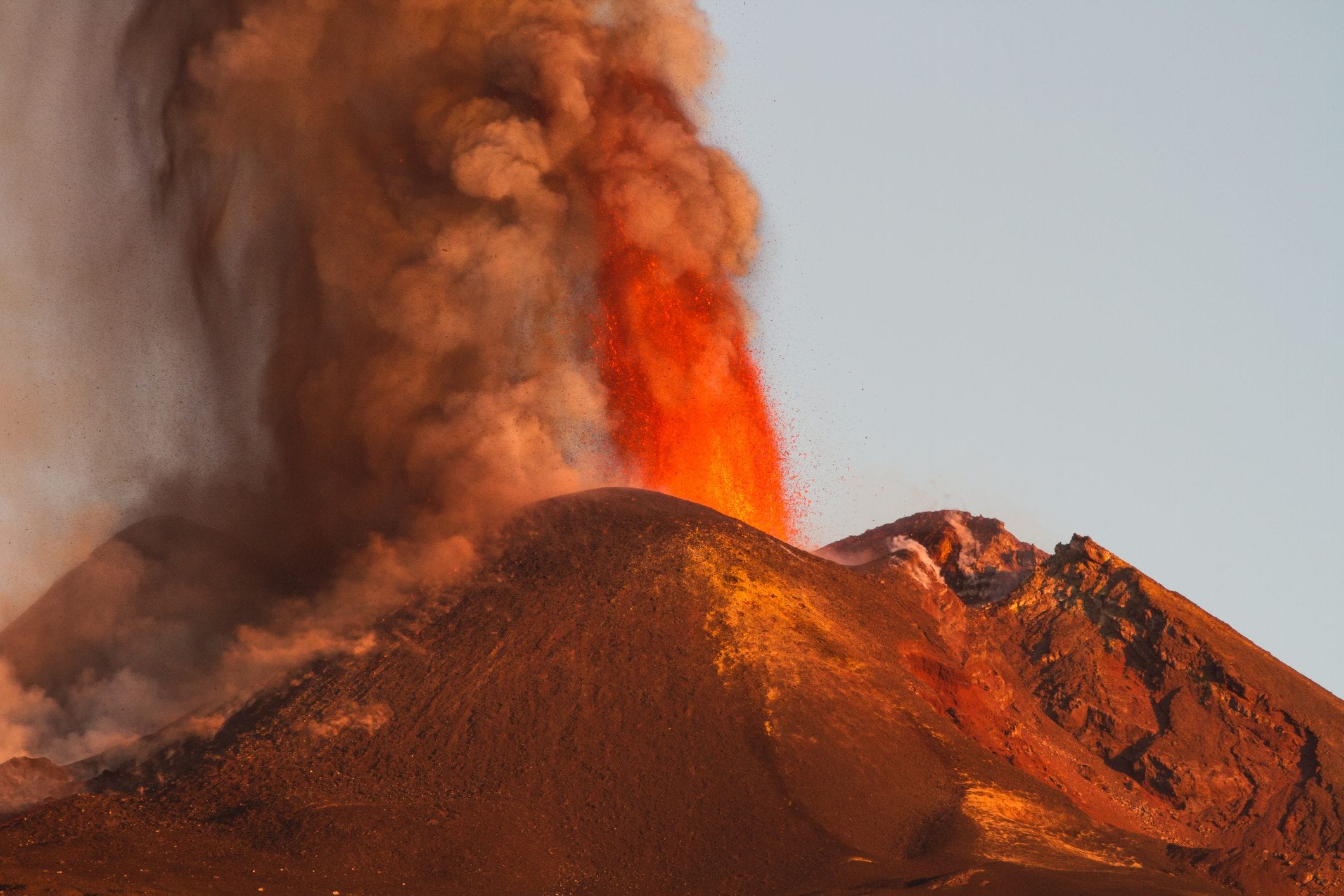
The researchers developed a tool called “Jerk”, capable of detect weak signals generated by rising magma before a volcanic eruption. The instrument has already been successfully tested for a decade at the Piton de la Fournaise volcano on the island of Réunion, of which it has expected most eruptions with a few hours to a few minutes’ notice. Scientists from the Institut de Physique du Globe de Paris (IPGP) and the GFZ Helmholtz Center for Geosciences in Potsdam, Germany, developed this signal detector, describing it in a new study published in the journal Nature Communications. Now it will also be tested on other volcanoes, starting with Etna, with the hope that it can become a effective early warning system to predict volcanic eruptions.
How the Jerk Tool works and how it was tested on volcanoes
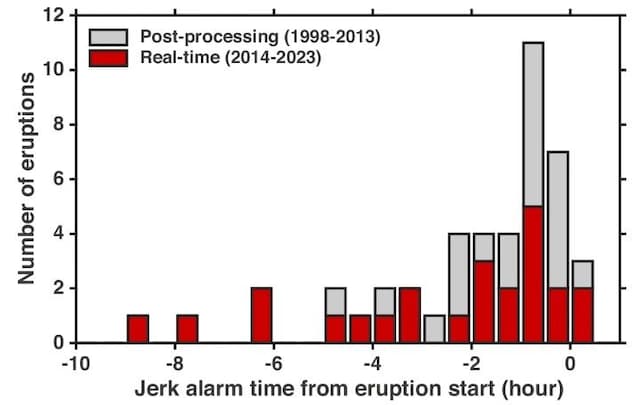
The “Jerk” signal detector is a broadband seismometer able to detect minimal ground movementsfor example the opening of small fractures, due to the rise of magma deep beneath a volcano. These faint signals can reveal in real time the early stages of volcanic activity. The tool has already been tested between 2014 and 2023 at the Piton de la Fournaise volcano on the Island of Réunion, one of the most active and monitored in the world. “Jerk” succeeded successfully predict 92% of eruptions of the volcano occurred in this time interval, with a warning ranging from a few minutes to 8 hours compared to the moment in which the magma reached the surface. Only in 14% of cases the expected eruption did not occur, but a deep intrusion of magma still occurred (this is called “aborted eruptions”). The “Jerk” alarms were confirmed by other parameters involved in monitoring, which constitute the so-called precursor phenomenafor example seismicity, ground deformation and variation in gas emissions from the ground.
How it could change eruption forecasts and tests on Etna
Much progress has been made in eruption prediction in recent years, but it still remains very difficult precisely identify the moment in which the eruption will occur and its exact modalities. The volcano monitoring however, it has often made it possible to predict the approach of an eruption thanks to the analysis of the precursor phenomena. However, the complex interpretation of these signals can lead to false alarms and consequently to inconvenience for the evacuated population and to the waste of economic resources to carry out the evacuations. The goal is therefore make forecasts more precise and reliable and “Jerk”, with its ability to directly and in real time detect physical signals associated with the movement of magma, could become a effective early warning tool for many volcanoes. The instrument will be tested on other volcanoes, starting withEtna. Here, the “POS4dyke” project plans for the installation of a network of broadband seismometers in 2026, in collaboration with INGV. At the same time, the “SAFAtor” projectwhich has as its object the study of the use of fiber optic cables in improving early warning systems for earthquakes and volcanic eruptions.
