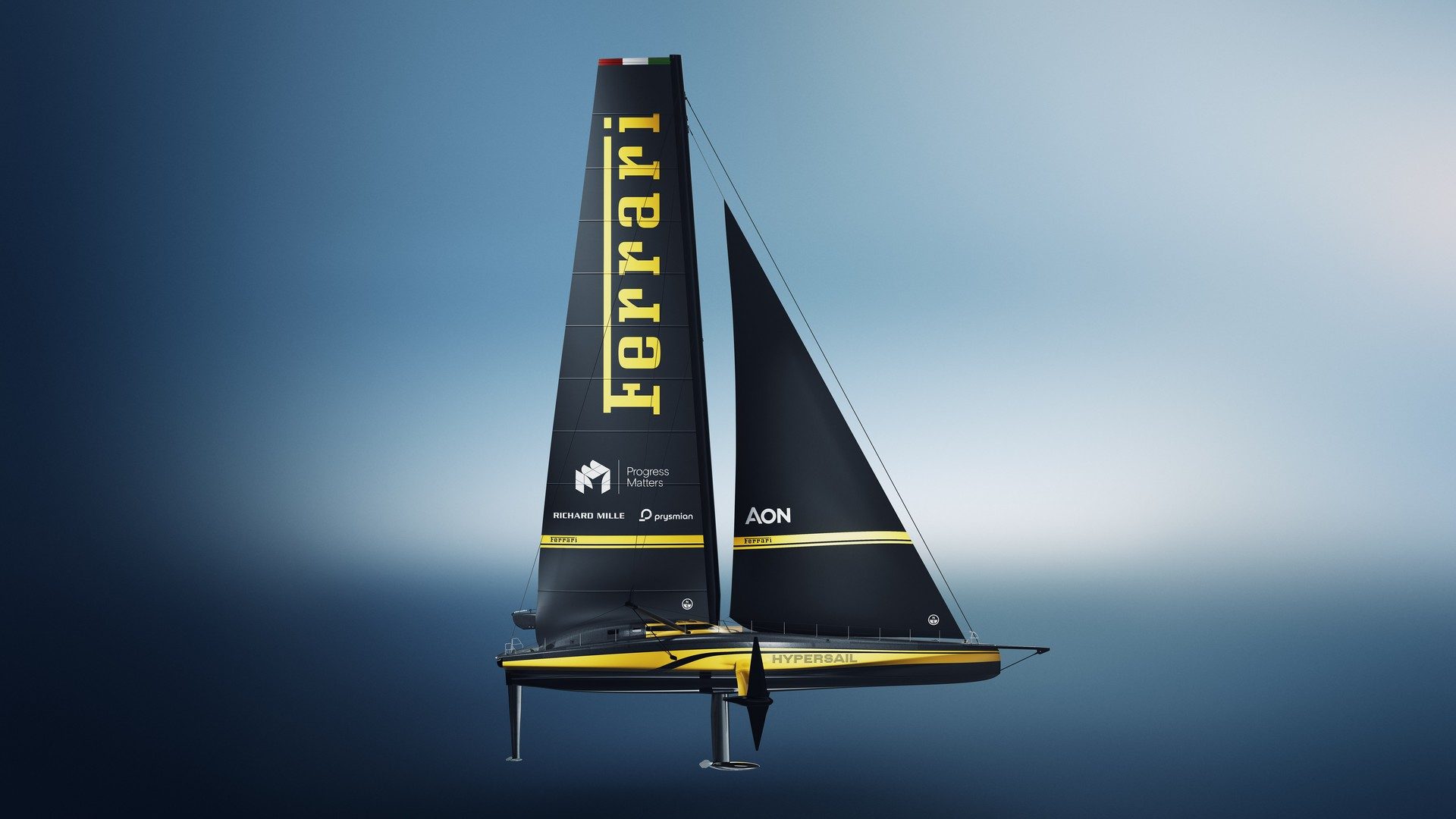
A 30 meter ocean racing prototype (100 feet) designed to literally fly over water thanks to foildesigned to challenge world records and powered entirely by renewable energy. Is called Ferrari Hypersailand it is one of the most ambitious engineering projects that the Prancing Horse has ever undertaken away from asphalt tracks. On the occasion of Milan Design Week 2026Ferrari has unveiled the livery of this ocean-going monohull showing the final “outfit” of the sailboat before its launch, expected within the year. This time the famous red gives way to an equally iconic colour. In fact, the one who reigns supreme is the Yellow Flythe historic “second soul” of the Maranello company. From 22 to 26 April, the project is visible at the Ferrari Flagship Store in Milan and through a sculptural installation on the terrace of HIGHLINE Milanoverlooking Piazza del Duomo.
The livery with the Yellow Fly: the story of a colour
The livery unveiled at Design Week combines two precise colors, both of which are not random. The dominant material is the carbonwhich has been renamed in its new color variant Hypersail Grey. This is not just an aesthetic choice but is the direct expression of the physical properties of the material that constitutes the entire structure of the boat: lightness And performance.
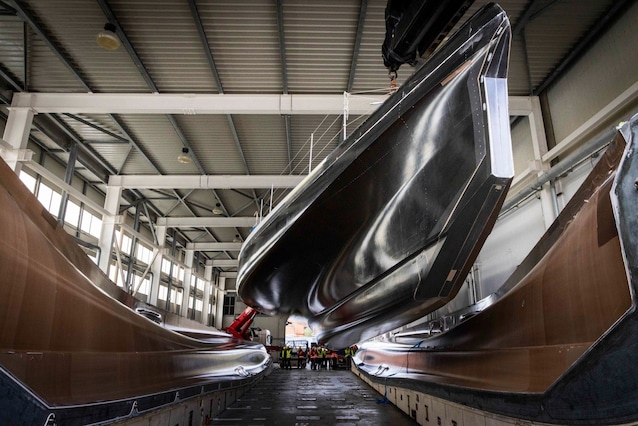
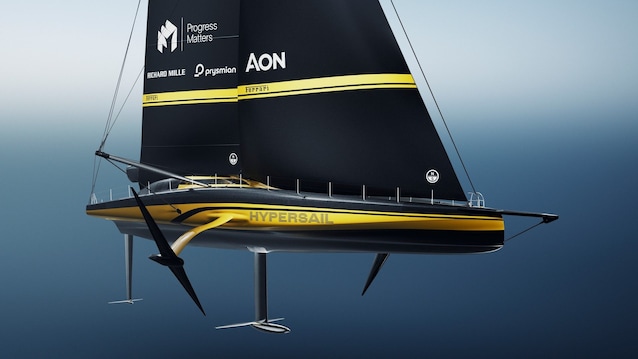
On this gray base the Yellow Flywhich the Ferrari Design Studio chose as the main color of the livery and applied it to the cabinto the foil and at lines of the wall. The choice has a precise history. Yellow is historically the second soul of Ferrari after red: it was born from the intuition of Breschi flamewidow of the driver Luigi Musso (known for his unmistakable yellow helmet) and friend of Enzo Ferrari. The color was first adopted on a 275 GTBthe first yellow Ferrari in history. In the case of Hypersail, the double meaning of the name fits perfectly, “fly” as the historical color and “fly” as the flight of the monohull on foils.
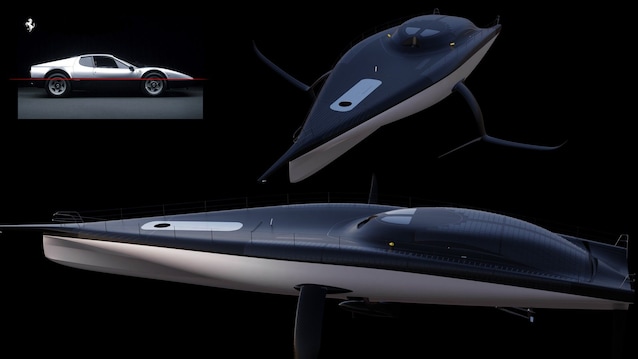
The contrast between Grigio Hypersail and Giallo Fly explicitly recalls the 512 BBthe first example of an “integrated” livery in Ferrari history. The logo appears on the sail Long F by Ferrari, which gives continuity to a coherent visual presence that began on the 2023/2024 F1 single-seaters and continued on the Daytona SP3 donated at auction at Pebble Beach.
Design as a consequence of function
The Ferrari Design Studio, led by Flavio Manzoniworked in symbiosis with Guillaume Verdier (famous designer of foiling sailing ships) and the engineering team from day one as co-authors of the shape. The tapered silhouette of Hypersail recalls the purity of the proportions of the Ferrari Monza SP1/SP2while the exterior of the coachroof – the structure that emerges from the blanket – evokes the architecture of 499P winner of the WEC championship in 2025.
An emblematic case of this integration are i solar panelsintegrated into the deck and sides in positions determined by an advanced study of the solar exposure that the vessel will have during ocean navigation. These panels are walkableequipped with specific grip and mounted with technical fastening systems that guarantee the crew maximum freedom of movement.
As he explains Matteo LanzavecchiaHead of Vehicle Engineering Ferrari and Chief Technology Officer of Hypersail: «The flight of the vessel is made possible by a sophisticated control system that inherits the know-how developed on Ferrari cars, powered by energy recovered from renewable sources such as windThe Sun and the movement”. In practice, Ferrari has applied the same technological philosophy that makes the hybrid work to a 30-meter ocean-going boat.
What is Ferrari Hypersail
The project Ferrari Hypersail was born in 2024 from the meeting between Ferrari and Giovanni Soldinithe most successful Italian ocean navigator ever, and now it continues with the entry of Enrico Voltolini in the role of Team Principal. The revolutionary idea behind it was to design a 100-foot (30-meter) monohull equipped with foiling technology, capable of literally lifting off and flying on the waves of the open ocean. More than just a boat, Hypersail is a real “floating laboratory” where engineering, design and research come together. The objective is to transfer the excellent know-how developed in the nautical world to the nautical world motorsports. It is no coincidence that the Ferrari engineering team applied to this hull the same aerodynamic principles, the same control systems and the same development philosophy that led the Ferrari 499P to triumph three times at the legendary 24 Hours of Le Mans.
The lines of the vessel challenge the force of the open sea with innovative engineering solutions designed to minimize hydrodynamic resistance and reach speeds never seen before on a monohull of this category.
The monohull has a three-point support system with i foil and one canting keel equipped with flapsa solution never seen in ocean sailing. These appendages work just like aircraft wings, adjusting the flaps, the onboard computer and sailors control lift to ensure stability and absorb violent high-speed impacts. Making the complex hydraulics of these components work requires a lot of energy which Hypersail has decided to generate without the aid of combustion engines, exploiting advanced solar, wind and kinetic energy collection and storage systems. This ensures total self-sufficiency to sail around the world zero emissions.
Above the deck, the wind-powered “engine” is a double sail which creates a perfect and symmetrical wing profile and optimizes aerodynamic flows and cancels turbulence.
