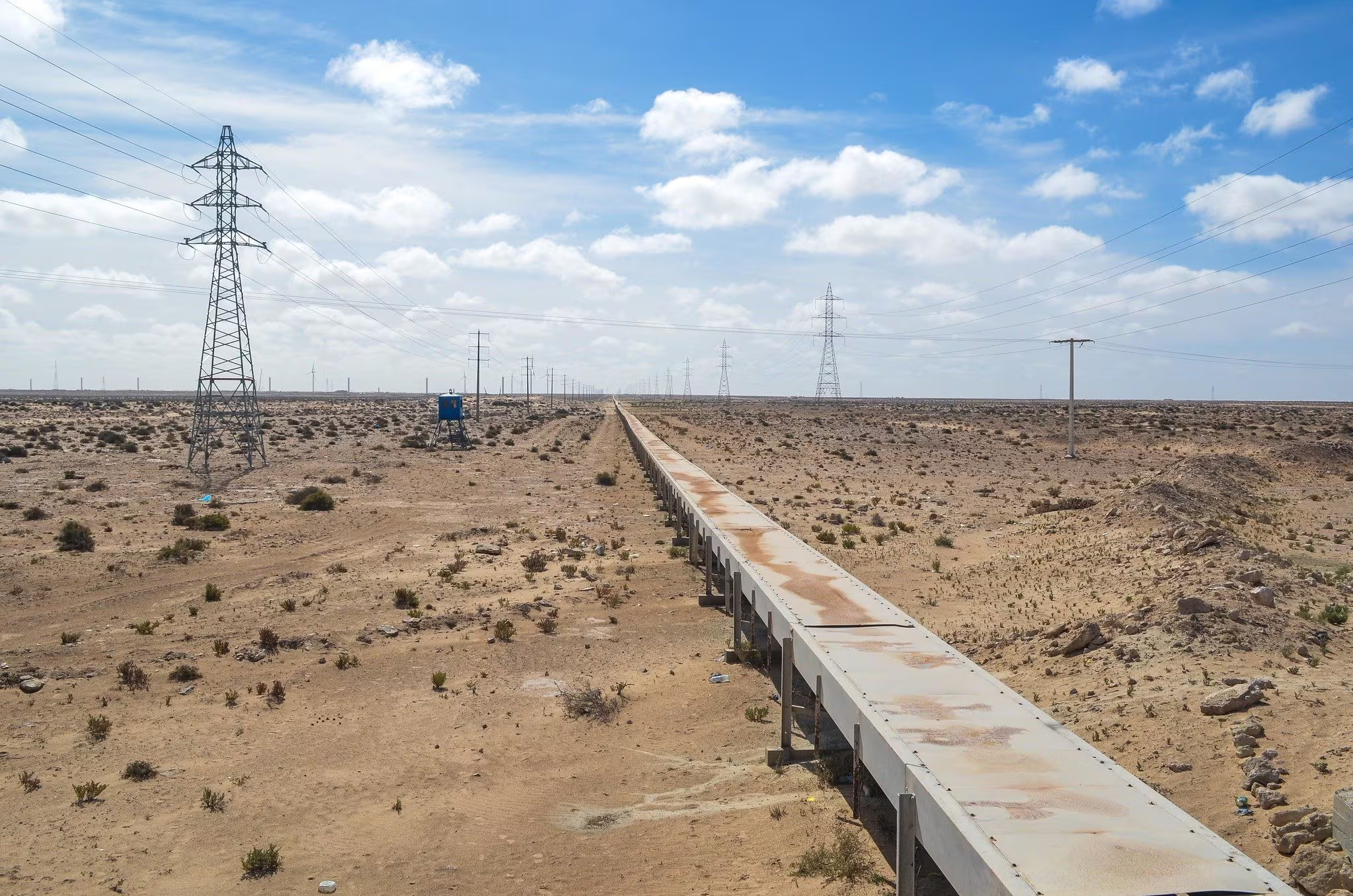
In Western Sahara, a system of 11 conveyor belts connects the Bou Craa phosphate mine to the Atlantic coast. The plant extends for almost 100 km and handles thousands of tons of phosphates, leaving trails of dust visible even from space.
In Western Sahara, a system of conveyor belts stretches for about 100 kilometers across the desert, connecting the phosphate mine of Bou Craa to the Atlantic coast, near El Aaiún. Considering the longest conveyor belt system in the worldthe system allows us to move enormous quantities of phosphate rock without resorting to road transport. Its dimensions are such that even the trails of white dust scattered by the wind along the route are visible from spaceas documented by NASA satellite images.
What the world’s longest conveyor belt in Boucraa looks like
The complex of Bou Craa cross the desert to almost 100 kilometersa distance that earns him the world record for the longest conveyor belt system in the world. In fact, it is not a single continuous belt: the system is divided into 11 sections connected to each othereach several kilometers long, which allow the material to be transferred from the mine to the coast. According to the technical data of the project, the system exceeds a height difference of over 200 metres. The individual sections are driven by electric motors and coordinated by a centralized control system, which regulates their operation and allows the material to be transferred from one section to the next. The belts, reinforced with steel cables to withstand high mechanical stress, run on thousands of support rollers. The entire infrastructure is designed to operate in a particularly hostile environmentcharacterized by significant temperature variations, wind and sand.
How it works and how much phosphate it transports across the Sahara
The plant was designed to handle approximately 2,000 tons of phosphate rock per hourtransferring the material extracted from the Bou Craa mine to coastal plants, where it is processed and prepared for export. Phosphates are in fact a fundamental raw material for the production of agricultural fertilizers. The tapes would reach a speed of 16.2 km/h. At this speed, a load would take just over 6 hours to cover the entire distance between the mine and the coast, without considering any slowdowns or interruptions in transport.
One of the most interesting features from an engineering point of view concerns the system maintenancecomposed of 113,000 rollswith motorized inspection vehicles along the different sections. These vehicles, equipped with acoustic probes, identify any anomalies in the functioning of the components and allow damaged rollers to be replaced without interrupting transport. A particularly effective solution for an infrastructure of this size, in which accessibility and operational continuity are among the main technical challenges. Transport by belts also allows you to limit the use of large fleets of trucks to move material across the desert.
