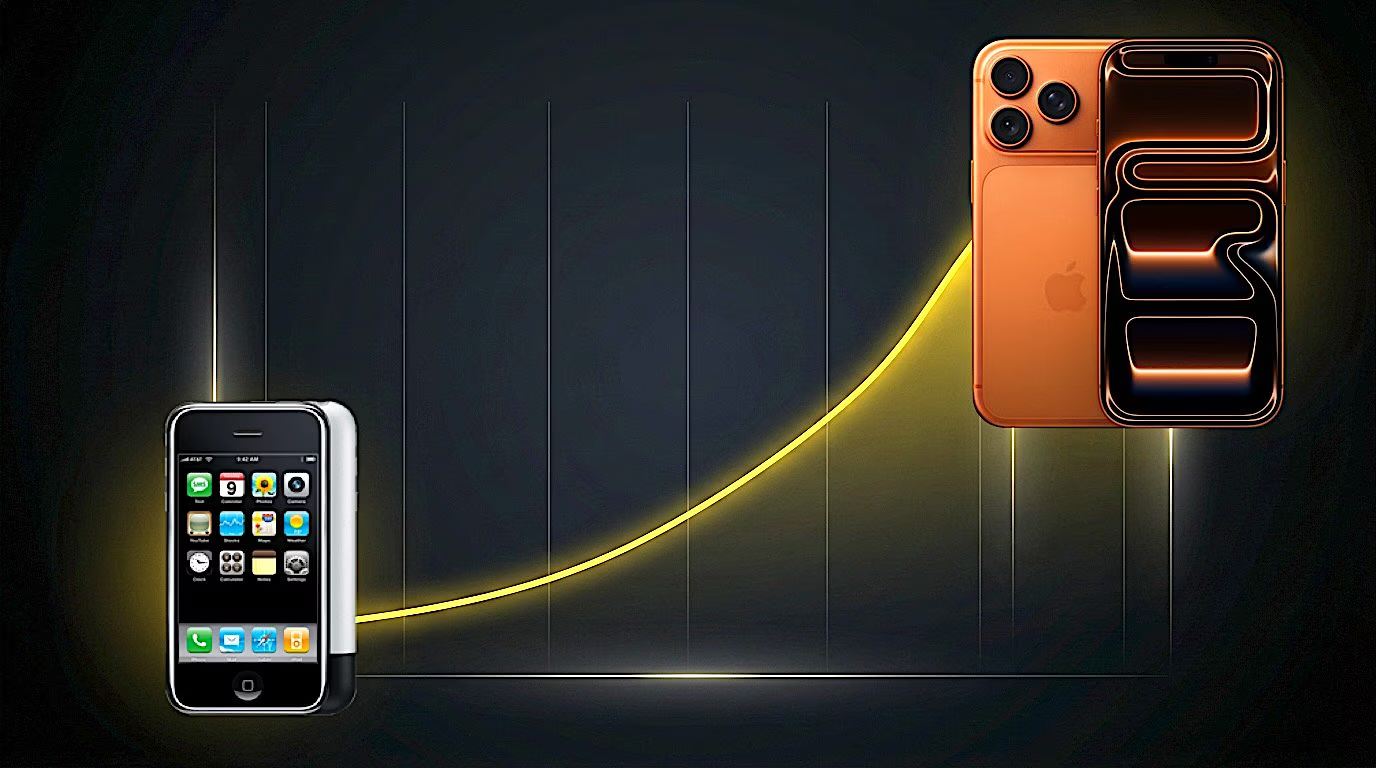
Almost 20 years have passed since Apple raised the curtain on the first iPhone, changing the fate of the mobile phone market forever. In the’“Surprise and shine” event broadcast from Cupertino today, Wednesday 9 September at 7.00pm (Italian time)Apple has unveiled the new ones iPhone 18 Pro, iPhone 18 Pro Max (some key features) and also his first foldable iPhonecalled iPhone Duocompatible with Apple Pencil. The new Apple Watch Series 12 and Apple Watch Ultra 4 were also presented during the event.
The three new iPhones have starting prices of, respectively, $1,199 (1,489 euros), $1,299 (1,639 euros) e $1,999 (2,369 euros). It may actually seem like a lot of money when compared to $499 necessary to get the first iPhone in 2007 (and in part they are). But direct comparisons between prices from different years can be misleading, because it does not take into account theinflationthat is, the general increase in prices over time which reduces the purchasing power of money. One way to measure it is to use the consumer price index, an indicator that follows how the prices of a set of goods and services purchased by families change over time.
There is also another reasoning to be done. If in 2007 Apple presented only one iPhone modeltoday the Cupertino giant (as well as many other smartphone manufacturers) does not limit itself to placing just one model on the market: it generally includes in its price list a “basic” modelto which he then adds dei Pro models and, as in the case of this year, even an Ultra model. All of this makes comparing iPhone prices over time a little more complex. In any case, let’s see how the price of the iPhone has changed from 2007 to today.
The features of Apple’s new iPhone Duo
Before reviewing theevolution of iPhone prices over the years, from 2007 to todaysurely many of you will be curious to discover the main features of iPhone Duo and also of iPhone 18 Pro And iPhone 18 Pro Max.
Let’s start with the strong point, iPhone Duo. The device It has a foldable screen which is, for obvious reasons, the widest ever seen on an iPhone. The internal screen is a 7.6-inch Super Retina XDR made of 10 ultra-thin layers to which a special nanotexture has been applied which mitigates reflections. The FaceTime camera is embedded behind the display and this means that it remains invisible until it is called up. The external Super Retina XDR display is 5.4 inches. This allows the device to have continuity in the lines, which makes the foldable aesthetically beautiful.
On the photographic front there is a 48 MP Fusion ultra-wide angle sensora 48 MP fusion main camera, a 12 MP front camera and the aforementioned FaceTime camera behind the display. The beating heart of this model is an A20 Pro chip with two 16-core Neural Engines, which allows it to tackle the most demanding AI workloads. The declared autonomy is 31 hours (on the external display) and up to 44 hours on the external display.
Going “classic”, that is iPhone 18 Pro And iPhone 18 Pro Max. The most interesting innovation of these new smartphones is certainly the 48MP Fusion main camera with variable aperture. This means that, by now being able to open the diaphragm, it will be possible to let a greater quantity of light reach the sensor, which will allow you to obtain better photos and videos even at night, as well as a better depth of field, with a more natural bokeh effect. Apple has also done an excellent job on the autonomy side, to the point that on the largest model, iPhone 18 Pro Max (equipped with a larger battery), autonomy reaches peaks of 43 hours of video playback. Also on these models there is the A20 Pro chip, capable of guaranteeing excellent performance, also to fully support the heaviest workloads due to AI. On the aesthetic front, the device essentially retains the same design as the previous generation, but introduces new colors – Burgundy, Glacier, Silver and Black – and features a Dynamic Island (the area of the screen that houses the front sensor and Face ID and which dynamically adapts to show up to three different pieces of information), which is smaller than the previous generation.
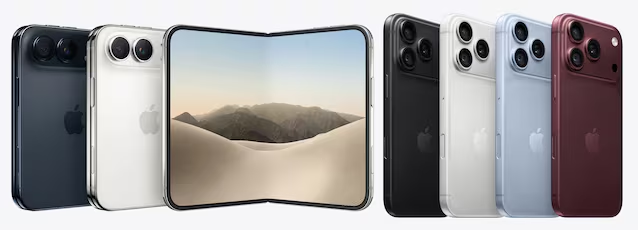
From $499 for the first iPhone to $1,199 for the iPhone 18 Pro and $1,999 for the iPhone Duo
2007
Applying the criterion that we introduced in the introduction, i $499 of first iPhone of 2007 correspond to more than $780 today. The result therefore changes a lot compared to the simple comparison between 499 and 799 dollars: the iPhone 17 (the latest “basic” model available, given that this year Apple has postponed the “basic” iPhone 18 to the first part of 2027) costs more, but the real distance between the two devices is much smaller than it might seem at first glance.
To correctly read the evolution of prices, it is also necessary to consider the way in which iPhones were sold in the USA in past years, up to 2017. For models from the second generation up to the iPhone 6, the prices indicated assumed the signing of a two-year contract with an operator. Furthermore, the comparison concerns the US prices of the basic models and does not take into account the differences present in the various international markets.
2008-2012
In 2008 theiPhone 3G it started from $199equivalent to about 300 dollars considering inflation. In 2009 theiPhone 3GS it still had a starting price of $199equal to approximately $301 current. THE’iPhone 4 of 2010 was expensive $199which become approx $296 when adjusted for inflation. The following year, theiPhone 4S always started from $199equivalent to approximately $287. In 2012, however, theiPhone 5 maintained the same nominal price as $199which correspond to approximately $282.
2013-2015
Reviewing the models presented in 2013, that is iPhone 5S and 5Cwe see that the first one started from $199while the second gives 99. Adjusted for inflation, the prices of these amount to approximately 277 and 138 dollars. In 2014 theiPhone 6 it started from $199while the 6 Plus from 299: adjusted for inflation approximately 273 and 410 dollars. Even theiPhone 6S and 6S Plusin 2015, had starting prices of 199 and 299 dollarsrespectively equivalent to approximately 273 and 410 dollars.
2016-2017
The most noticeable change came in 2016 with theiPhone 7. The basic model jumped to $649while the 7 Plus reached $769. Also adjusting these prices for inflation, they are equivalent to approx 878 and 1,041 dollars.
This brings us to 2017. Since in that year Apple removed the obligation to link to a US telephone operator to purchase an iPhone, the price comparison becomes particularly interesting.
In 2017 theiPhone 8 it started from $699 el’8 Plus from 799respectively equivalent to approximately 929 and 1,059 dollars. In the same year came theiPhonewith a starting price of well $999equal to approximately $1,324 taking inflation into account.
2018-2020
In 2018 theiPhone it was expensive $749Meaning what approximately $969 based on inflation correction. The models XS And XS Max instead they started from 999 and 1,099 dollarswhich are equivalent to approximately 1,292 and 1,422 dollars. In 2019 theiPhone 11 it started from $699While 11 Pro And 11 Pro Max they were expensive 999 And $1,099: considering inflation, they would be equivalent to approximately 888, 1,269 and 1,396 dollars.
With the series iPhone 12 of 2020, the basic model reached i $799While 12 Mini, 12 Pro And 12 Pro Max they started respectively from 699, 999 and 1,099 dollars. Adjusted for inflation, they correspond to approximately 1,003, 877, 1,254 and 1,379 dollars.
2021-2022
In 2021 nominal prices remained identical with iPhone 13: $799 for the basic model, 699 for the Mini, 999 for the Pro And 1,099 for the Pro Max. Adjusting them for inflation, they become approximately 958, 838, 1,197 and 1,317 dollars. In 2022, iPhone 14, 14 Plus, 14 Pro and 14 Pro Max they started from 799, 899, 999 and 1,099 dollarsrespectively equivalent to approximately 886, 997, 1,101 and 1,208 dollars.
2023-2026
In 2023 iPhone 15, 15 Plus, 15 Pro and 15 Pro Max they started from 799, 899, 999 and 1,199 dollars. Considering inflation, they were approx 852, 958, 1,065 and 1,278 dollars. In 2024 the series iPhone 16 maintained the same nominal prices: 799, 899, 999 and 1,199 dollarscorresponding to approximately 827, 931, 1,034 and 1,242 dollars.
Thus we arrive at the most recent series iPhone 17: the basic model starts from $799theiPhone Air from 999 (in theory it is not part of the series in the strict sense but we include it to simplify the reasoning), the 17 Pro from 1,099 and the 17 Pro Max from $1,199. And finally, iPhone 18 Pro, iPhone 18 Pro Max And iPhone Duo they cost, respectively, $1,199 (1,489 euros), $1,299 (1,639 euros) e $1,999 (2,369 euros). For obvious reasons, there is no need to revalue the prices of these latest models taking inflation into account.
From this comparison, a rather clear fact emerges. On the one hand it is true that the prices of iPhones have increased over time, especially the latest models presented today, September 9th, but it is also true that if inflation is taken into account this increase is actually in line with the general increase in prices of other consumer goods.
What about other smartphones?
If we wanted to check the prices of smartphones in general, also taking into account the Android counterpart, we would probably need another dedicated study – let us know if you’re interested! In short we can say, however, that inflation and the recent chip crisis have also increased the prices of the latter.
