On Tuesday 11 August, at the Alexander Stadium in Birmingham, the final of the 100 meters men will award one of the most anticipated titles of the European Athletics Championships 2026. In a race that is often decided by a few hundredths of a second, it is not just the talent of the athletes that makes the difference. According to a study by physicist JR Mureika, even the combination of temperature, atmospheric pressure and humidity can change the final time: in the most extreme conditions analysed, the difference exceeds a tenth of a second, even at the same altitude and after correcting the results for the wind. The reason? There different air densitywhich determines how much aerodynamic resistance the sprinter must overcome during the race.
The first rival of every sprint is air resistance: the study of physics
Every sprinter, while running, must win the aerodynamic resistance (drag), or the force that the air exerts on the moving body. Its intensity depends on the relative speed between the athlete and the air, but also on the density of the air: the denser the air, the greater the resistance to overcome. At speeds greater than 42 km/htypical of the best sprinters, this effect is not negligible.
Traditionally, estimating the effect of air resistance on performance has been considered primarily the runway altitude: the higher the altitude, the thinner the air and the lower the drag. A famous example is the 1968 Mexico City Olympicsdisputed at 2,240 meters altitude, where the less dense air contributed to setting 24 world records. The study The Effects of Temperature, Pressure, and Humidity Variations on 100 Meter Sprint Performancesby physicist JR Mureika, shows, however, that altitude is only part of the story: the density of the air also depends on temperature, atmospheric pressure and humidity, which together can significantly change the resistance encountered by the runner.
Temperature, pressure and humidity in the 100 meter plane: the “virtual altitude” that no one sees
The key concept of the study is that of density altitude: a sort of “virtual” altitude that depends not only on the real altitude of the race location, but also on the temperaturefrom the atmospheric pressure and fromhumidity. In practice, two runways located at the same altitude can offer very different aerodynamic conditions. When air is warm, its molecules move further apart and the density decreases. Humidity also contributes, in a less intuitive way, to making the air lighter: water vapor is in fact made up of molecules that are less heavy than those of oxygen and nitrogen that they replace in the atmosphere, thus reducing the overall density of the air. The result is one lower aerodynamic resistanceas if the race were held at a higher altitude. In contrast, cold, dry, high-pressure air increases the density of the atmosphere and therefore drag. To quantitatively evaluate this effect, Mureika extended a numerical sprint model developed by Norman Linthorne in 1994, introducing for the first time the combined influence of temperature, pressure and humidity on aerodynamic drag.
From 15°C dry to 35°C humid: more than a tenth of a second difference
To evaluate how much atmospheric conditions affect, Mureika simulated the 100 meter performance considering temperatures between 15 and 35 °C, relative humidity from 0 to 100%, atmospheric pressures between 85 and 105 kPa and winds from -3 to +3 m/s. The results were compared to a reference race run in 9.70 seconds, at sea level, with no wind and a temperature of 25°C.
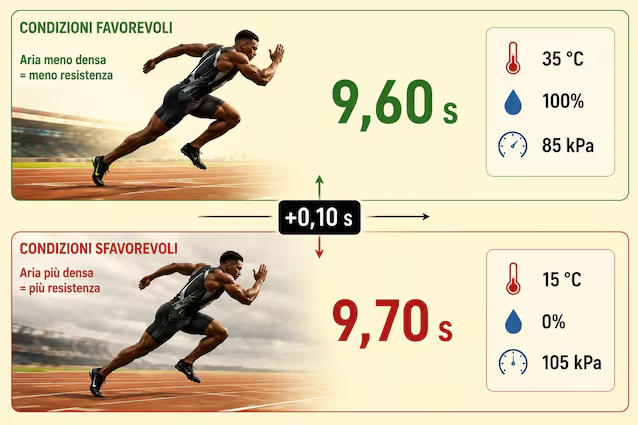
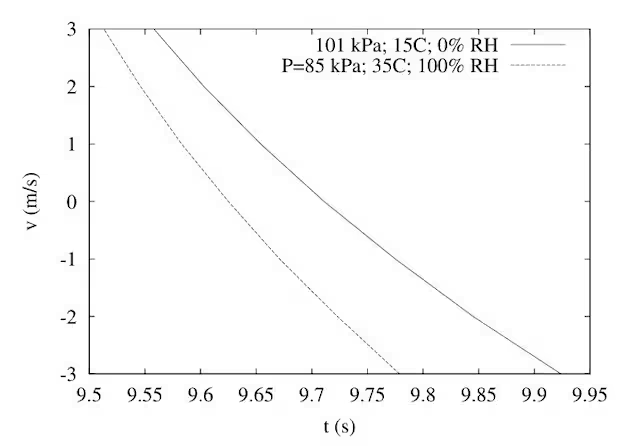
Temperature alone has a limited effect: in the range considered it changes the time by just 0.02 seconds, confirming what has already emerged in previous studies. However, when temperature, pressure and humidity are considered together, the impact becomes much more pronounced. Among the most unfavorable conditions — 105 kPa, 15 °C and 0% humidity, producing the densest air — and the most favorable ones — 85 kPa, 35 °C and 100% humidity, with less dense air — the model predicts a difference greater than a tenth of a secondeven after correcting the times for the effect of the wind. In the 100 metres, where medals and records are often decided by a few hundredths of a second, a margin of this size can make the difference between an excellent performance and a world record.
What it means for the 2026 European Athletics Championships in Birmingham and for records
In August Birminghamhome of the European Athletics Championships 2026historically records maximum temperatures around 22 °C, far from the 35 °C considered in the most favorable scenario simulated by Mureika. This suggests that the effects of thermal conditions alone on performance will likely be limited, although the actual impact will always depend on the combination of temperature, atmospheric pressure and humidity, which together determine the density of the air.
Beyond the specific case of Europeans, Mureika’s work offers a useful tool for compare more correctly performance obtained in different atmospheric conditionsfor example a 100 meters raced in the middle of summer in Rome and one run on a cool evening in Northern Europe. The main lesson is that the traditional correction for altitude and wind, used to “weigh” records and performances, is not enough to make two races truly comparable. It is also necessary to take into account the density of the air that the athlete had to pass through, a factor that timekeepers rarely consider but which physics, as Mureika’s work shows, cannot ignore.
