There extraordinary visibility of the auroral emissions in Italy during the night of 10 and 11 May 2024 was the result of a exceptional solar activity. Pink and red auroras were clearly visible to the naked eye as far away as Sicily.
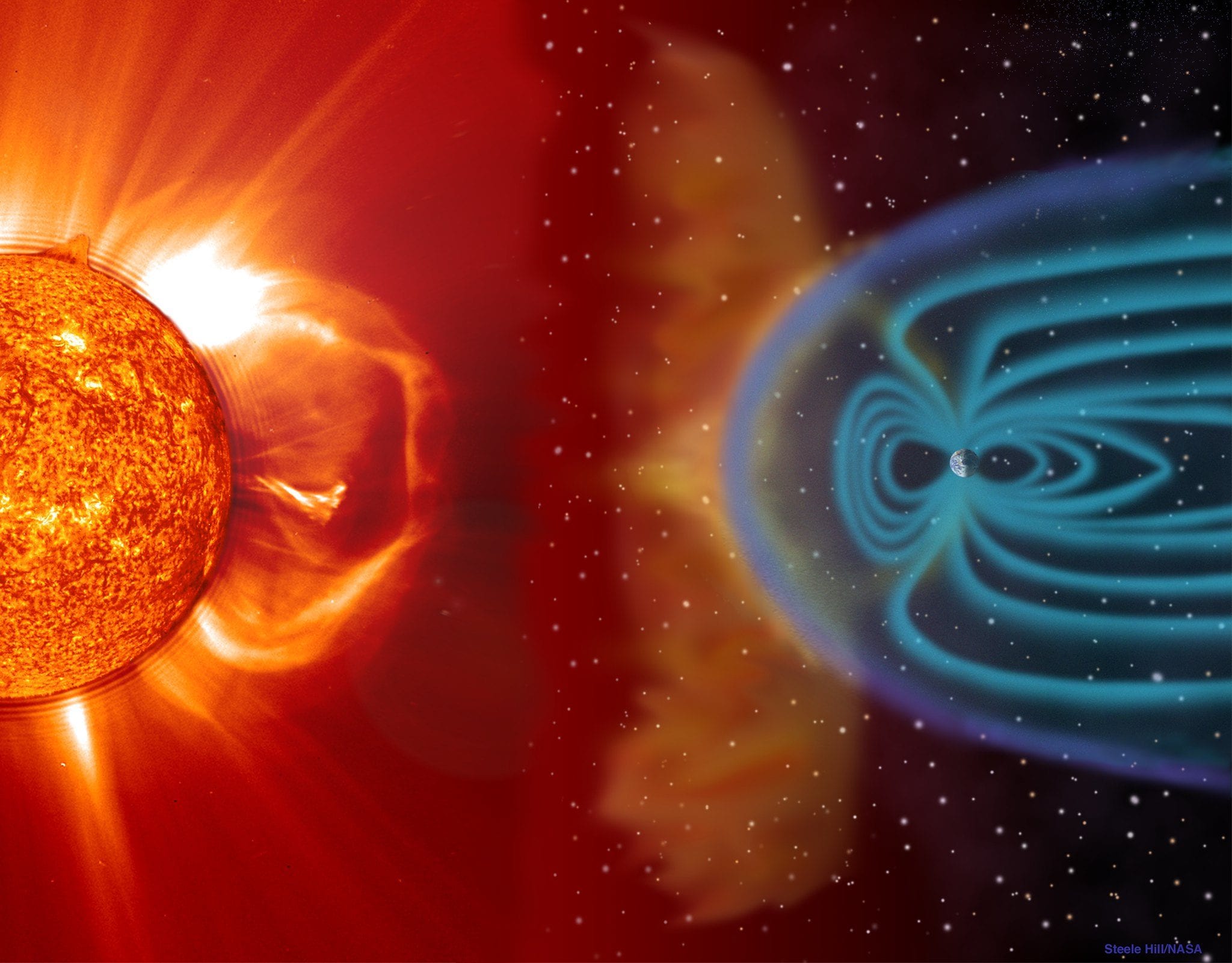
Known as the storm of Mother’s Daythe event was caused by a close sequence of solar flares originating mainly from the active region named AR 13664, a region of sunspots of high magnetic complexity. Coronal mass ejections (known in English as CMEor coronal mass ejection) released from this solar region in rapid succession they interacted with each other during the journey to Earth, producing extreme conditions Of space weather (space weather).
NOAA (National Oceanic and Atmospheric Administration) classified it as a G5 event, the highest level on your scalewith effects from satellites (GPS navigation and communications) to technological infrastructures on the earth’s surface.
A recent study has reconstructed in detail the dynamics of the coronal mass ejections of that event using a new magnetohydrodynamic model (the scientific discipline that studies the dynamics of interaction of plasmas with magnetic fields). The results confirm that the merger of CMEs it dramatically amplified the overall energy of the event. The research team claimed that the new model would allow predict a new similar event to that of May 2024 with an accuracy greater than 70% compared to the results obtained from direct observations in real time.
Events of this magnitude remain difficult to predict well in advance. However, extreme phenomena of this type can occur even when solar activity overall it’s waningas in the historic Halloween storm of 2003. The Sun reached the maximum of the current solar cycle (lasting approximately eleven years) at the end of 2024 (cycle number 25 since the counting of the Sun’s activity began in 1755) and then entered a phase of slow decline during 2025, which is still ongoing.
Ten eruptions in three days in a single geomagnetic storm
At the base of the May 2024 storm is the active solar region AR 13664 consisting of a gigantic group of sunspots which in its moment of maximum development have reached a total width equal to approximately 15 times that of Earth (on average around 200,000 kilometres).
Within this region have developed multiple tangled magnetic fields and with a complex structure that they generated ten coronal mass ejections in rapid sequencelaunching enormous quantities of charged particles into space (CMEs are mainly made up of a very hot and ionized plasma made up of moving charged particles).
The contemporaneity of these eruptions is linked to the extreme magnetic instability of AR 13664 which continued to produce multiple rearrangements of magnetic fields as the Sun approached the maximum of the 11-year cycle. The tangled magnetic lines form arc-shaped structures. These structures they trap solar plasma and they rise above the active areas of the Sun (i.e. those where sunspots are present). When the accumulated voltage is too much, the magnetic field lines break and rejoin in a more stable configuration, freeing the flow of charged particles.
Researchers have built new ones magnetohydrodynamic models (in the study article they are briefly referred to as MHD, from the English acronym magnetohydrodynamic) of solar plasmas and the interaction of particle flows with the Earth’s magnetic field. To reconstruct this evolution the authors used a model called EUHPHORIA (EUropean Heliospheric FORecasting Information Asset, translated into Italian as REuropean information resource for heliospheric forecasting), a three-dimensional magnetohydrodynamic model designed for space weather and the analysis of events of this type.
Simulations with previous models had limited to three interacting CMEs. With the new model the researchers faced for the first time a system of ten eruptions. By simulating their propagation with EUHFORIA they managed to reproduce the arrival time of the storm and the trend of the magnetic field approximately two hours in advance.
Why it was seen all the way to Italy: the 3 reasons
Normally auroras are concentrated at high latitudes because energetic particles come guided towards the atmosphere along magnetic field lines terrestrial. During one great geomagnetic storm the magnetosphere comes instead highly compressed and deformed and the auroral flow can expand towards much lower latitudes than traditional ones.
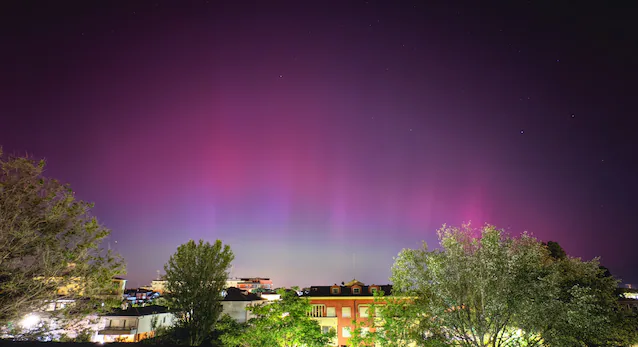
The visibility of the aurora from Italy on the night between 10 and 11 May was the consequence of the combination of three physical phenomena which rarely occur together with this intensity.
The first is precisely the compression of the Earth’s magnetosphere. The almost simultaneous arrival of the molten CMEs hit the planet’s magnetic field with a exceptional dynamic pressure. This pressure compressed the magnetopause and pushed the auroral oval, the band in which the polar lights are normally concentrated, towards much lower latitudes than usual.
The second factor concerns the appearance of SAR arcs (from the English Stable Auroral Red), Often confused with the actual aurora but generated by a different mechanism. While the aurora arises from the direct impact of solar particles with the atmosphere, SAR arcs arise from the heat that the loop current surrounding the Earth transfers to electrons of the ionosphereproducing a diffused and stable red light capable of remaining visible for hours even at latitudes such as the Italian one. Many of the photographs taken that night portray precisely this phenomenon.
The third element is geometric in nature and to the perspective effect linked to altitude of light emissions. The red emissions of atomic oxygen, responsible for most of the colors observed, are generated at altitudes between 200 and 500 kilometresa height sufficient for their light to remain visible even hundreds of kilometers away from the point where it originates.
Space weather and the limits of solar storm forecasts
Extreme geomagnetic storms remain un concrete risk for technological infrastructures. In orbit, the increase in the density of the upper atmosphere due to thermal heating increases the friction on low-altitude satellites, slowing them down and modifying their orbits, almost to the point of cause a possible deorbit and re-entry into the atmosphere.
Radiation, on the other hand, can damage the electronics and disable satellite systems that are not carefully shielded. GPS signals and high-frequency radio communications were also unreliable for several hours in multiple parts of the world.
On the Earth’s surface, the main danger concerns electrical networks. Geomagnetically induced currents can overload the transformersi with the risk in the most serious cases of extended blackouts.
When a CME leaves the Sun, direction, speed and arrival window can be estimated, even with several days’ notice. It is though much more difficult to predict its intensity. A fundamental variable is the orientation of the magnetic field in the active zones of the Sun.
This information cannot be obtained with sufficient precision from observations of probes near the Sun (such as NASA’s Parker Solar Probe) alone. Probes that measure the solar wind become crucial when the CME is close to Earth, reducing the time margin. MHD models like EUHFORIA can then help transform direct observations of the Sun in one physical simulation in real time of the evolution of the storm, significantly expanding the warning window.
