Next, the newsletter of Europa Today which every Monday morning tells you what will happen in the European week
Top of the agenda
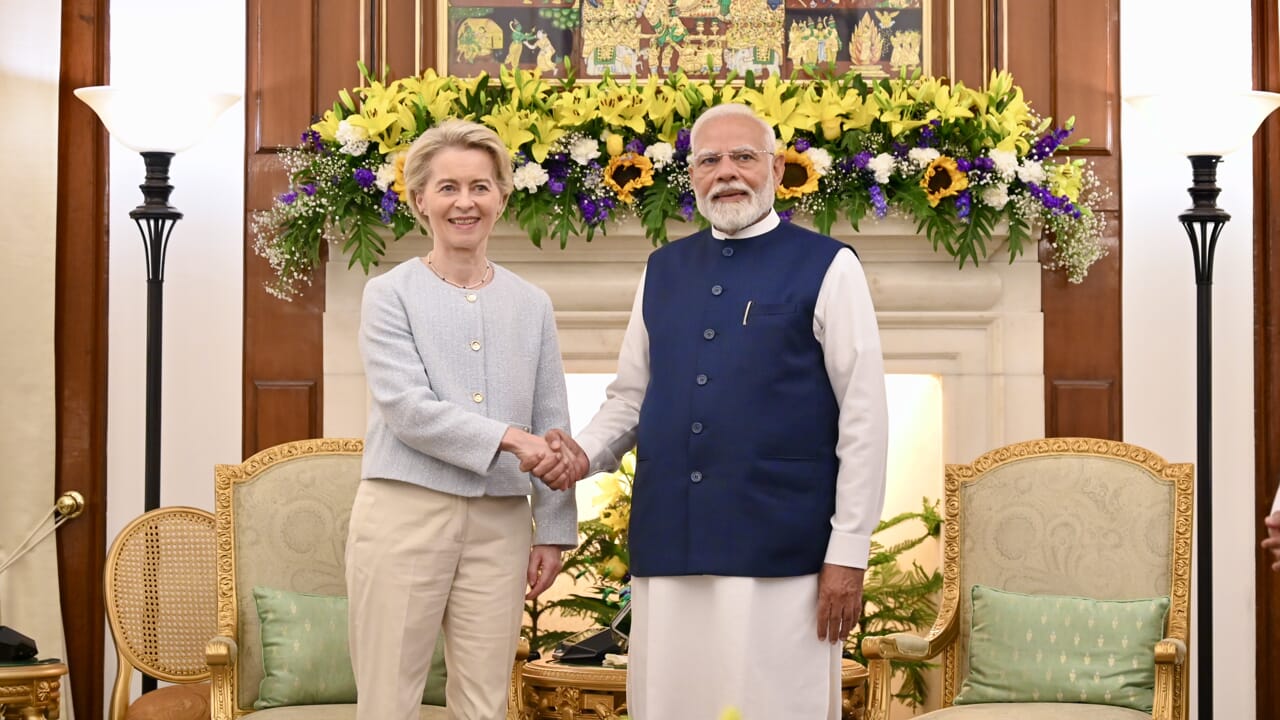
Destination New Delhi – European Commission President Ursula von der Leyen and European Council President António Costa will travel to New Delhi, India, on Tuesday 27 January for the 16th EU-India Summit hosted by Prime Minister Narendra Modi. The summit will serve as a high-level platform to discuss the partnership between the two global players following the approval of the strategic agenda in October last year, to strengthen collaboration in areas such as security, defence, digital and green technologies, connectivity and trade, but above all to try to finalize the free trade agreement negotiations first launched in 2007 and then relaunched in 2022.
After Mercosur, India – The push – particularly from the Commission – in recent months on free trade agreements with the most important trading blocs (other than the United States and China) to diversify partners and supply chains is clear. It only arrived on January 17th the signing of the agreement with Mercosur (the South American common market of 700 million consumers which includes Argentina, Brazil, Paraguay and Uruguay), despite the fact that the European Parliament got in the way by asking for a legal opinion from the Court of Justice of the EU which could hold back the ratification process by several months. A trade agreement with India would open the doors to another market – growing year after year – with 1.4 billion consumers.
Why it matters – Addressing Parliament’s plenary in Strasbourg last week, it was President von der Leyen herself who made it clear that a deal with India would be “revolutionary”, not only to create new opportunities for European businesses and workers, but above all because “the more trading partners we have around the world, the more independent we are, and that’s exactly what we need now”.
Less dependence on Trump – The question of the strategic independence of the European Union is linked to latest tensions with Donald Trump, with the threats of US tariffs against the countries that participated in the military mission in Greenland which forced Prime Minister Costa to convene an extraordinary European Council on January 22nd. Despite Trump’s surprise de-escalation on the eve of the EU leaders’ summit, the discussions still took place to discuss how to manage relations with the new, increasingly aggressive and threatening United States. The relief for the escaped duties has not taken away the bitterness of the attacks from the historic transatlantic partner and ally, with the awareness that it is necessary to recalibrate the relationship in order not to risk a new crisis at the next (really expected at any moment) change of mind of Trump.
The (little) secret ingredient – “We must work more on European independence. The fundamental ingredient for the European Union is economic power.” Thus von der Leyen indicated the way at the end of the extraordinary summit in Brussels, speaking not only of the strengthening of “our Single Market of 450 million consumers”, but above all of the need to “open up to other markets and diversify suppliers and supply chains.” This is why a free trade agreement with India is considered fundamental at this precise moment to put this strategy on the ground relatively quickly. The European Union and India together represent a quarter of the world’s population and GDP.
The gas lord: this is how Trump can blackmail Europe (and raise the cost of bills)
Other hot topics
Eyes on the north – With the tension between Europe and the United States still not completely abated over the Greenland issue, all of Northern Europe is under particular attention. In this context, the North Sea summit scheduled for Monday 26 February in Hamburg, Germany, between leaders, energy ministers and industry representatives from Belgium, Denmark, Germany, France, the United Kingdom, Ireland, Luxembourg, the Netherlands and Norway takes on even more significance. Representatives of Iceland and NATO will also be present for the first time in the discussions to promote the expansion of offshore wind energy and strengthen the region’s energy independence, while Energy Commissioner Dan Jørgensen will participate for the EU.
Migration and visas – The Commission is expected to present the new European visa strategy on Thursday 29 January, which should support efforts to attract students and qualified workers – including researchers, innovators and entrepreneurs – from third countries through legal routes. The five-year strategy on migration and asylum will also be published on the same day, which should include a doubling of returns, stricter border controls and a possible overhaul of the EU asylum agency.
Organic farming – At the Agriculture and Fisheries Council on Monday 26 January, the 27 ministers will discuss the modification of the Regulation on organic farming, in particular as regards the rules on production, labelling, certification and trade. The ministers will also discuss the EU strategy for the bioeconomy on issues relating to agriculture, forestry and fisheries, with the aim of using the contribution for the draft conclusions to be approved by the Environment Council.
Between the United States, Ukraine and the Middle East – The 27 foreign affairs ministers will meet on Thursday 29 January to take stock of the high-tension week with the United States and the results of the leaders’ summit. The Foreign Affairs Council will also discuss the latest developments in the Russian war of aggression against Ukraine, the peace negotiations and the 90 billion euro support for Kiev until 2027. Also on the table is the European position on the situation in the Middle East and the EU’s humanitarian support for the Palestinians, in light of the new Peace Council created by Trump.
Meloni and Merz relaunch the link with the United States: “The EU chooses whether to be the protagonist of its destiny”
From the European Parliament
Recalibrate the relationship with Washington – After Trump’s surprise move to withdraw threats of new targeted tariffs against six EU countries, the European Parliament will have to consider whether to take a step back on postponement of the ratification of the EU-United States trade agreement to a later date decided on January 21st. A first discussion should be held in the Committee on International Trade (Inta) on Monday 26 January, before a discussion between the Committee on Foreign Affairs (Afet) and the US ambassador to the EU, Andrew Puzder.
Steel industry and duties – Speaking of tariffs, the Inta commission will adopt its position on Tuesday 27 January on a draft law to protect the EU steel industry from sustained import pressure in terms of volume and price. The proposal includes limiting customs-free import volumes, doubling import duties from 25 to 50 percent for some steel products and strengthening the traceability of imported steel products.
Between NATO and Greenland – NATO Secretary General Mark Rutte, who has credited himself as the resolver of the crisis between Trump and Europe with an agreement (still unclear in detail) on Greenland, will participate on Monday 26 January in a discussion with members of the Foreign Affairs (Afet) and Security and Defense (Headquarters) committees on the latest developments in transatlantic security and defense commitments.
Priorities of the Cypriot presidency – From Monday 26 to Thursday 29 January, Cypriot ministers will present their priorities during meetings with the relevant parliamentary committees. Cyprus holds the rotating presidency of the Council of the EU until 30 June 2026.
Remembrance Day – The European Parliament will hold a plenary session in Brussels to commemorate International Remembrance Day on Tuesday 27 January. President Roberta Metsola will open the ceremony, with a speech to follow by Italian Holocaust survivor Tatiana Bucci.
Funds frozen for Hungary – On Monday 26 January the Committees for Budgetary Control (Cont) and Budgets (Budg) will discuss the rule of law conditionality mechanism and the funds frozen in Hungary with the Commission’s executive vice-presidents Raffaele Fitto and Roxana Mînzatu and the Budget Commissioner Piotr Serafin.
Against illegal products online – After the refusals to confront the compliance with EU rules on product safety, including the protection of consumers and online platforms.
Towards the new EU budget – The interim report on the proposal relating to the Multiannual Financial Framework (MFF) for the period 2028-2034, the next EU budget, will be presented to the Regional Development Committee (Regi) on Wednesday 28 January. The amendments to the commission’s opinion will be examined in the presence of the co-rapporteurs of the Budget Committee (Budget) Siegfried Mureşan (EPP) and Carla Tavares (S&D), in particular on the issue of new national and regional partnership plans.
In Amazon warehouses – Members of the Committee on Employment and Social Affairs (Empl) will question three Amazon vice-presidents on Wednesday 28 January about working conditions in the US global trade giant’s warehouses. The public hearing will also include testimony from an Amazon warehouse worker in Poland.
Copyright and Ia – Also on Wednesday 28 January, MEPs from the Committee on Legal Affairs (JURI) will present their proposals to ensure greater protection, transparency and fair compensation for the creators of copyrighted materials used to train generative artificial intelligence technologies.
The trip to Rome – President Roberta Metsola will be in Rome on Thursday 29 January, where she will be received in audience by Pope Leo XIV. A series of institutional meetings will then follow, from the Prime Minister Giorgia Meloni to the presidents of the Senate Ignazio La Russa and of the Chamber of Deputies Lorenzo Fontana.
