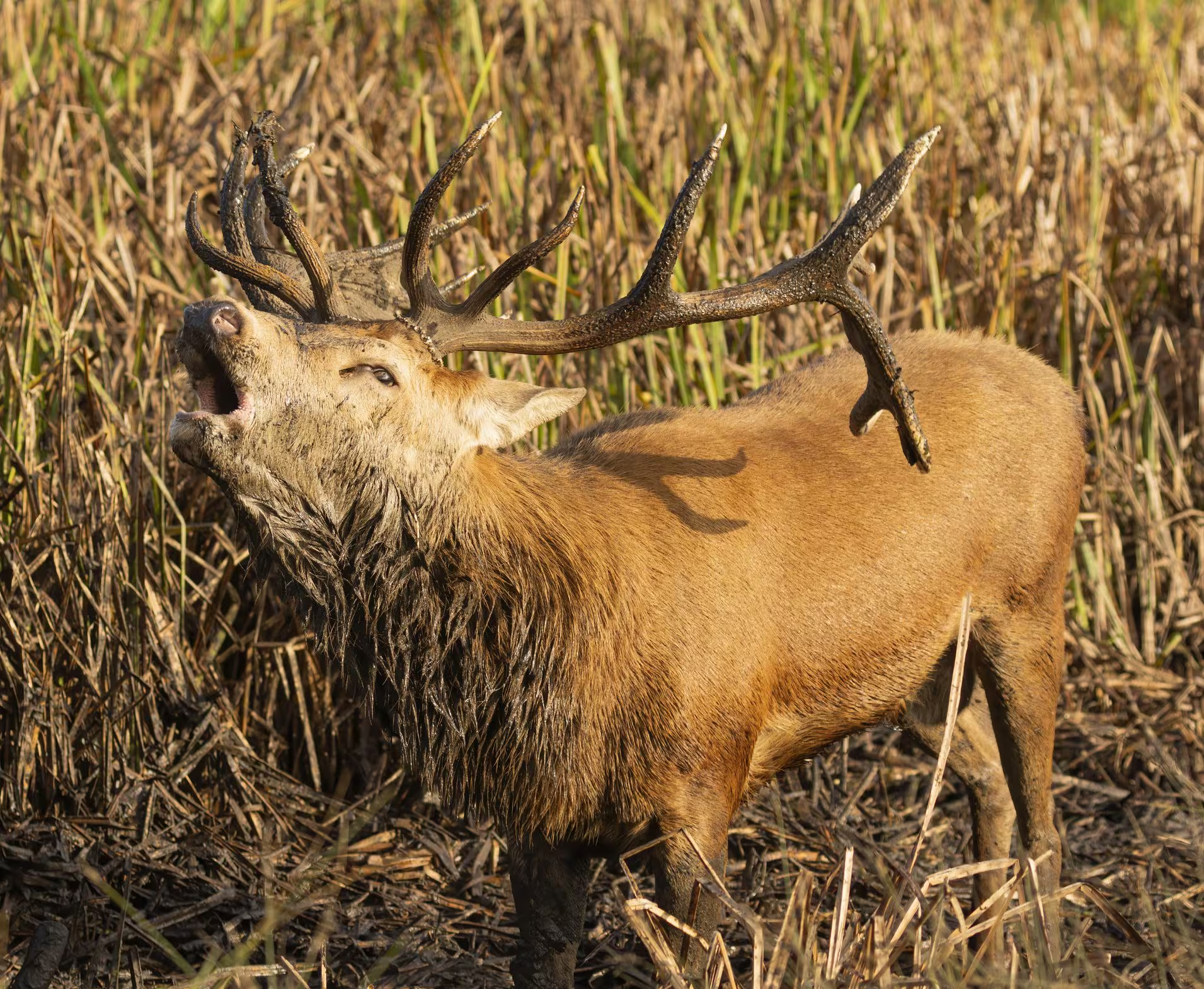
It is among the loudest sounds in European forests, one capable of tearing apart the silence in early autumn: the roar of the male red deer (Cervus elaphus) it is, for those who live near the woods, an unmistakable signal of the arrival of the new season. In addition to developing an increase inaggression and territoriality towards rivals, during the reproductive period male red deer often emit hoarse and deep calls. It is believed, although these are measures that have not been scientifically confirmedwhich are capable of reaching approx 100 decibels and spread for about a kilometre. The male signals not only his presence and willingness to mate, but also his size, since a lower tone corresponds to larger body sizewhich females tend to prefer.
The breeding season in deer
The red deer breeding season runs from September to mid-November, peaking in late October. For male deer it corresponds to a series of hormonal changes which makes them more active, particularly at night, and more aggressive due to the increase in testosterone level in their body (which is why it is preferable to stay away from them even more than usual during our autumn excursions), as noted in studies as early as the 1970s. Males also become a lot protective towards the territorywhich mark by scratching the bark of trees with their horns or by rubbing special scent glands found on the head and legs on the trees. The competition between males is fierce, and this is the period in which it is easiest to observe a duel between contenders intent on locking horns for the favor of a female or to defend their own corner of the forest. The frenetic activity makes them more susceptible to disease and infection, and they arrive exhausted at the end of the season: often they lose their antlers and up to 23 kilos in weight.
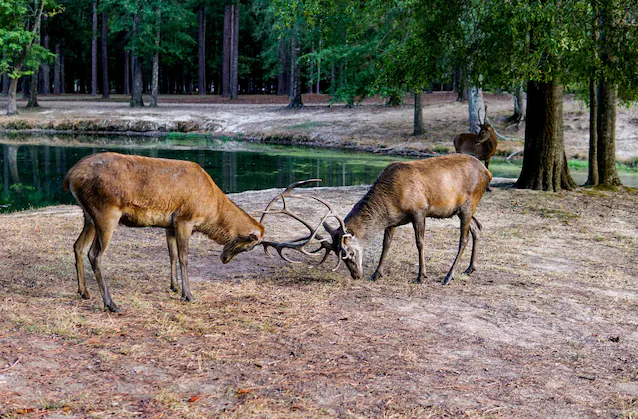
What it is for: the call to attract females
In English, this time of year is called ruth, from Latin rugitus, to indicate the calls that typically accompany the reproductive season of many ungulates such as moose and reindeer. Not all deer emit roars and not all in the same way: the reproductive vocalization of fallow deer (Dama dama), for example, is a series of low, guttural calls at very high frequency, sometimes repeated for hours at a time, as reported by a 2008 study. In the case of the red deer, the roar is reminiscent of a cow’s moo but more vibrant and prolonged. Informal reports from guides and hikers attribute to this sound an intensity of 100-120 decibels and that it can be heard for miles, but in reality there are no studies that precisely attest to this measurement.
Deer tracking studies, which often broadcast recordings of their calls to attract animals, use loudspeakers set to about 105 decibels (the equivalent of an ambulance siren about ten meters away), which would reply according to the researchers a volume comparable to that of the typical cry of a male in heat. Depending on the conditions and how dense the surrounding vegetation is, a sound of this intensity can travel up to one kilometreenough to overcome the typical silence of temperate forests and allow typically shy animals to meet. On the one hand the male seeks the attention of the females, on the other hand he discourages other male deer from getting too close.
Scientific studies on deer calls focus on volume rather than volume hue: females seem to be able to select the favorite male also based on his roar. Research on fallow deer showed that lower frequency vocalizations corresponded to larger body size, and that these were emitted by reproductively dominant fallow deer. A group of researchers from the University of Sussex instead transmitted roars recorded from speakers positioned in the forest, altering the frequency band from time to time and observing the reaction of female red deer. The latter seemed to be prefer calls with a lower frequencyand the same call was less successful if it was altered to become more high-pitched. But this does not seem to be a universal rule: another study on a population of Scottish red deer, for example, did not show a particular preference for the frequency of the call by females.
The evolution of sexual appeals
Attracting a partner with strong moans has a cost in terms of survival: deer signal their presence to the opposite sex, but also to potential predators (and human hunters, who since the dawn of civilization have resorted to calls that imitate animal sounds for this very reason). This behavior may seem like a contradiction in evolutionary terms, but it is actually an example of sexual selectione, which leads to the onset of precise characteristics with the aim of increasing reproductive success – even at the cost of risks.
The best-known example to explain this apparent contradiction is that of the tail of the male peacock. For the animal, such a mass of feathers seems counterproductive at first glance: what’s the point of developing such striking plumage that is expensive in terms of energy and having a tail that could prove a hindrance in the event of escaping from predators? But male peacocks stronger, more agile and in better health (i.e. those who possess a better genetic heritage) are precisely those who can afford the most beautiful plumage. It is therefore the quality of the plumage that signals to the females that he is a good partner, one that will pass strong genes to one’s offspringand this pushes natural selection to favor the most beautiful tails despite the potential drawbacks. The bellowing of the male deer is therefore the equivalent of a peacock’s tail: in terms of costs and benefits, in some circumstances exposing oneself increases the chances of successfully reproducing.
