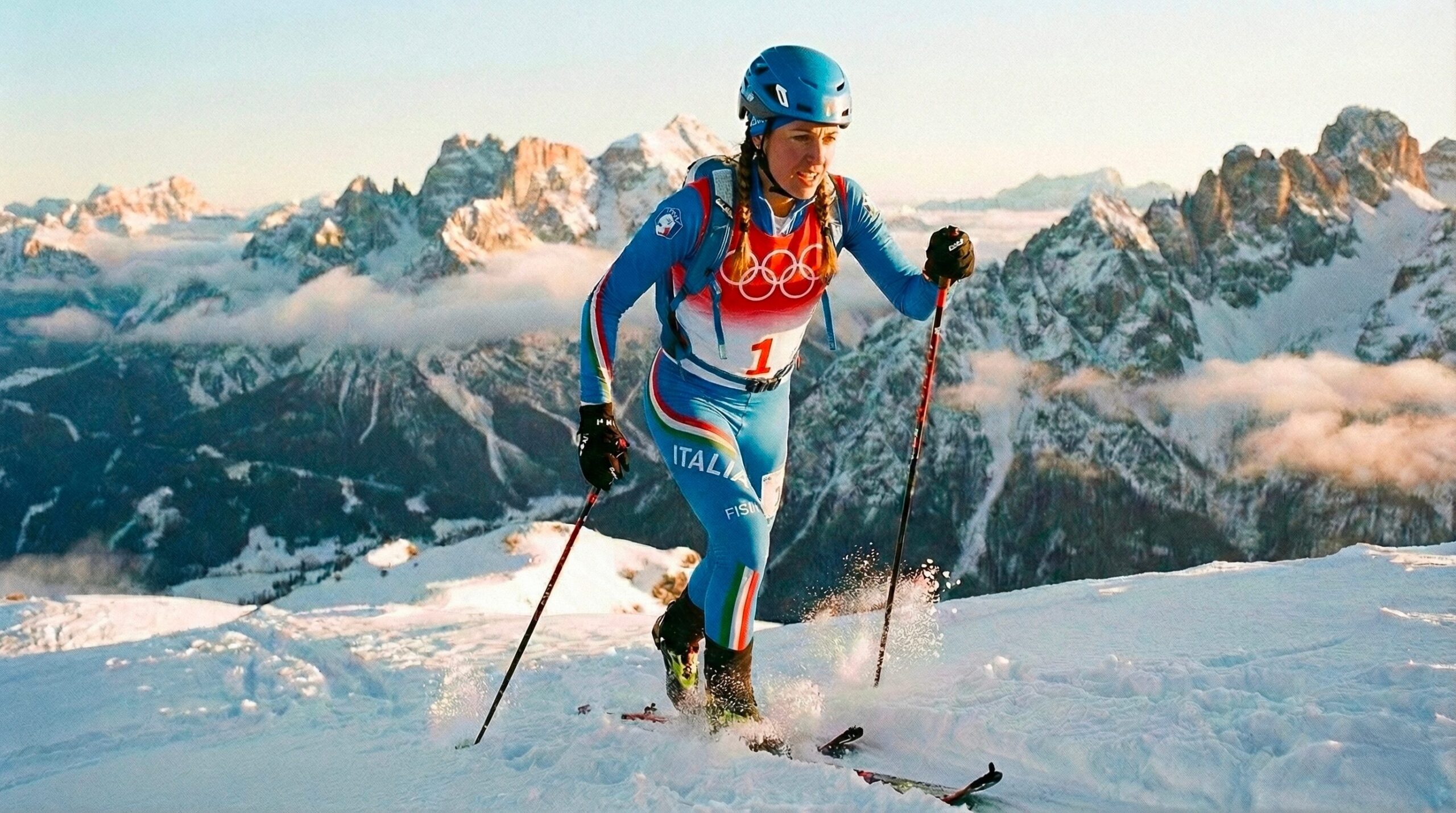
The ski mountaineering will make its debut as an Olympic sport in Milan-Cortina 2026. We had the opportunity, during the event Winter Sports Techto attend a unique demonstration that transformed the Aula Magna of the Polytechnic University of Milan into a research laboratory. The demonstration session was described by Professor Carlo Gorla – professor of the Department of Mechanics – supported by Silvia Bosacciathlete born in 2006 and third in the world ranking and from Ivan Muradaone of the first champions of modern ski mountaineering, today technical coach of the FISI Central Alps Committee: together they combined science and competitive spirit to explain the data monitoring of this sport.
The new Olympic program includes two ski mountaineering specialties. There sprint (men’s and women’s) is a frenetic race (about 3 minutes) structured into elimination heats, semi-finals and finals. The athletes start with their skis on, quickly remove them by placing them on their backpacks to face a section on foot on the steps, put them back on for the last climb and finally take off their skins and head downhill. In the mixed relayInstead, each participant must complete two climbs – managing the relative changes, which also require applying skins, and the sections on foot with the skis on the shoulders – followed by two descents.
The live test: what is monitored in ski mountaineering
She got on the treadmill Silvia Boscacciathlete of the Under 20 national team (third in the world ranking). To analyze her performance, the Polytechnic team “equipped” her like an astronaut. What did they measure?
The engine: Metabolimeter (K5)
Silvia wore a mask connected to a backpack. The metabolimeter is not used to breathe better, but to analyze gases:
- How much oxygen consumes (O2)
- How much carbon dioxide produces (CO2)
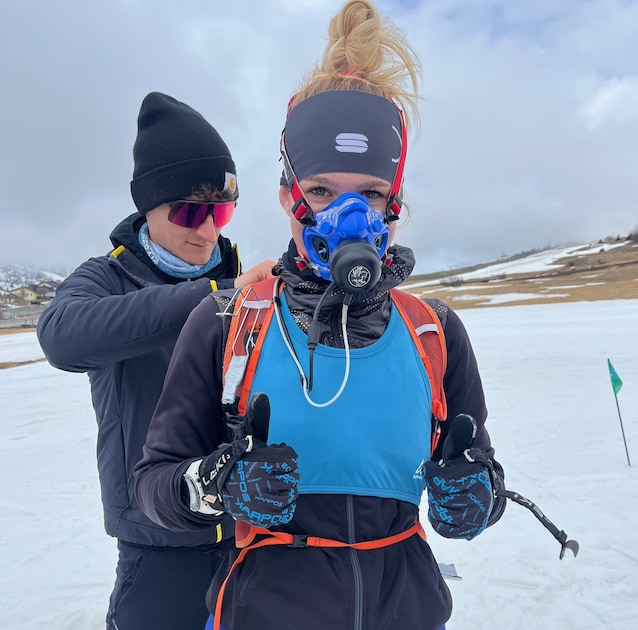
What is it for? From the ratio of these two gases, engineers understand what “fuel” the athlete is burning. If you are in regime aerobic and fats are used, the effort can be maintained for a long time; as performance increases, the aerobic mechanism favors the use of carbohydrates, but the sustainable duration is reduced: a further increase in intensity massively involves the mechanism anaerobicbut performance can be sustained for much shorter times. All this can be kept under control by measuring with surgical precision the ventilatory thresholds useful for calibrating training. The VO is also measured2max (maximum oxygen consumption) which is an indicator of the maximum aerobic performance that the athlete is able to deliver, i.e. the “displacement of his engine”.
Electromyography (EMG)
On the muscles of the legs and arms were applied electrodes. The goal is to understand when and how much a muscle activates. If the athlete change technique (from the traditional alternating step to running, with single or double push), surface electromyography tells us which muscles are predominantly used for each of the progression techniques and this provides useful information to athletic trainers to define a personalized muscle strengthening plan.
Mechanics: kinematics and forces
It’s not enough to see how much the muscles work, but you also need to measure which ones forces useful for advancement are generated and see how the athlete moves. Through inertial sensors, load cells and video analysis, forces are measured thrust angles sticks and indicators useful for describing the movement, such as the position of the center of gravity or the step frequency.
Equipment and features: 500 gram boots
For those who are used to renting equipment for a ski holiday or using skis and boots designed for tourist use, the data on competitive ski mountaineering are incredible:
- “Touring” boot: 1 to 1.5 kg.
- Race boot: approx 500 grams
A racing skiscomplete with attachments, weighs only 750 grams. In ski mountaineering, every extra gram is an enemy that slows down the speed uphill, but you need to lighten up without penalizing your downhill performance too much.
From the laboratory to the Olympic journey
Laboratory testing is essential, but real snow is something else. This is why the team doesn’t stop at the treadmills: the data collected is validated in the field, also carrying out sessions on tracks similar to real race tracks, designed by the technicians who will prepare the tracks.
The answer to questions like “is it better to push with two arms at the same time or alternating them?” it’s no longer “in my opinion”. The answer is obtained from the analysis of graphs of oxygen consumption, muscle activation, speed and forces, which describe the performance and the energy cost to obtain it. This is how gold is improved today: heart, legs and big data.
