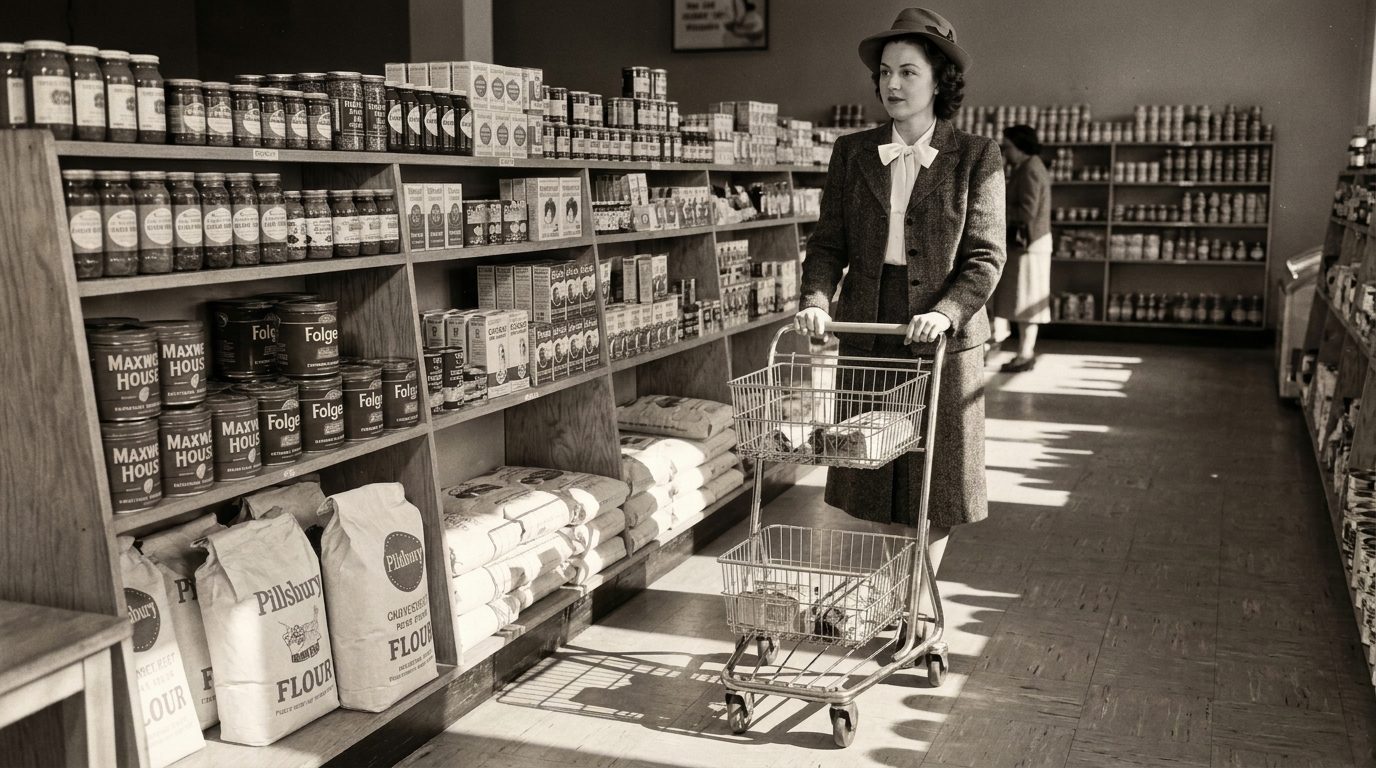
The shopping cart it is one of the most widespread objects in the world, which we now use without even thinking about it. It was invented in 1937 by Sylvan Nathan Goldman for its supermarkets Humpty Dumpty in Oklahoma City and improved by Orla Watsonwhich added the basket and rear opening. The history of this object is also the history of a commercial failure and one marketing gimmickbut today it is used in all supermarkets around the world. In the 1975The New York Times he noted it with a hint of irony: «Everyone knows Henry Ford and the Wright brothers», wrote the American newspaper, «while there are no stamps or monuments dedicated to Sylvan Nathan Goldman».
How people shopped before the shopping cart invented by the Oklahoma businessman
To understand why the trolley was a revolution, you need to understand how people shopped in stores before it was invented. Supermarkets didn’t yet exist: purchases took place in small neighborhood shops, where you asked the clerk directly what you needed. Things began to change in the United States from 1916when the first ones appeared self-service shopsin which the customer wandered around the shelves alone and then went to the checkout to pay.
It was an epochal change, which however faced a practical problem: customers could only take with them what they could hold in their handsin a bag or in a basket. The more the basket filled, the heavier and more difficult it became to transport: when it was too full, essentially, you stopped buying. In any case, domestic refrigerators were not yet widespread and without the possibility of preserving food it made no sense to buy large quantities. In addition to the fact that it would have been difficult to transport home anyway, given that at that time not even cars were yet so widespread.
Sylvan Goldman and the Humpty Dumpty supermarket
Sylvan Nathan Goldman was born in 1898 in Ardmore, Oklahoma, the son of a Latvian immigrant who owned a haberdashery. He spent the years of the First World War in France, taking care of food supplies for the troops at the front. Subsequently, he opened his first store in 1919among the first to experiment with expense “self service”. The business did so well that in 1920 it allowed him to open a “supermarket” in Oklahoma, and within a few years the business grew into a chain of dozens of stores, which Goldman managed to sell before the 1929 crisis and the Great Depression. With the money he saved, in 1934 he bought two new chains, including theHumpty Dumptyin Oklahoma City.
It was on this occasion that Goldman found itself dealing with a very real problem: his customers, especially women with children in tow, stopped buying as soon as the basket became too heavy to hold. Goldman tried a first solution: he invited his store clerks to offer customers a helping hand and a second basket if the first one was full, while carrying the first one to the checkout. It wasn’t enough.
The lighting of the folding chair, the flop and the revenge
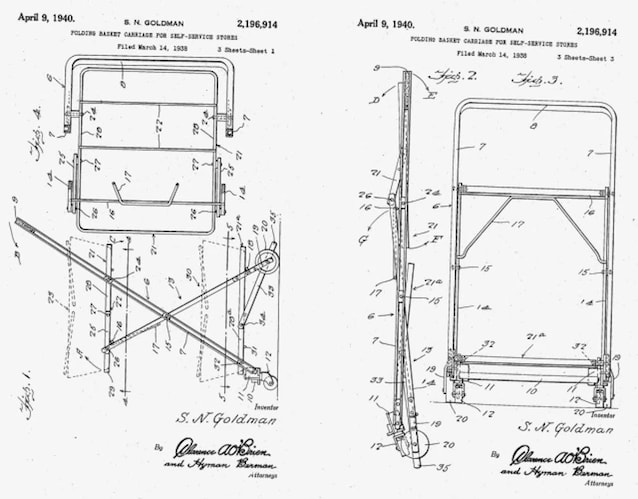
Goldman was enlightened by observing a folding chair: he took two baskets, placed one on the seat and another under the chair. Then, he imagined installing wheels near the legs and a handle on the back. A couple of months to refine the project and the cart was ready! Goldman worked on the project together with his employee Fred Youngand between 1936 and 1937 he designed, built and perfected his first trolley models: it was a metal structure, foldable and which moved thanks to wheels, with space for two overlapping baskets. The June 4, 1937 the first carts were officially introduced in Oklahoma City’s Humpty Dumpty supermarkets.
Goldman was immediately convinced of the potential revolutionary significance of his idea, and time, in fact, proved him right. The trolley’s debut, however, was a disasteralso due to such distinct gender roles in American society. The men were too proud to admit that they needed help carrying a basket, while the women, already accustomed to pushing strollers in their roles as mothers and housewives, did not want to start pushing a trolley as well, associating it with additional responsibilities rather than help.
Nobody wanted to use the cart, but Goldman didn’t give up, in fact, he came up with another idea: he hired attractive people (men and women) to walk around the aisles pretending to shop with the cart in hand. At the entrance, a hostess addressed those who entered without taking it, pointing out that everyone else was using it and inviting them to do the same. THE’herd effect he did the rest. The use of trolleys began to spread and Goldman, after registering the patent, began to mass-produce them and resell them to other shops. By 1940, just three years after their introduction, carts had become so popular that grocery stores began to be designed with more spacious aisles to accommodate movement and counters that could hold larger quantities of food.
The shopping cart we use all over the world today is Orla Watson’s
Sylvan Goldman, thanks to his invention, became one of the richest men in Oklahoma. In 1961 he sold his businesses and devoted himself to other projects until his death as a multimillionaire tycoon in 1984. Shortly before his death, he declared that his cart: “It made all the difference in the world, but if I hadn’t invented it, someone else would have.”
The cart we still use today is not exactly the one Goldman invented. The original model was indeed difficult to manage when not in usebecause it took up a lot of space. The design was improved in 1947 by Orla Watsonwho patented trolleys with a fixed basket and a rear opening, so that they could be inserted one inside the other, as still happens all over the world.
