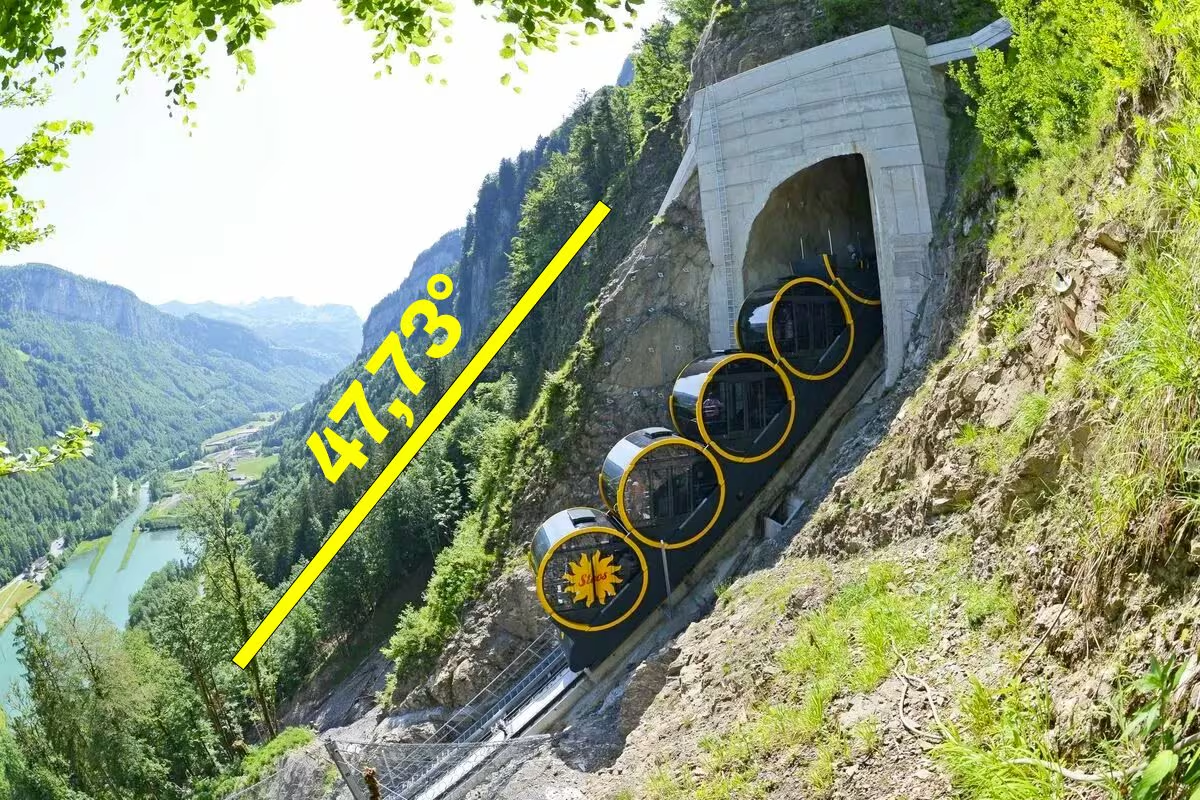
There Stoosbahnin the Canton of Schwyz, Switzerland, is the steepest funicular in the world Still in operation, designed to connect Schwyz to the mountain village of Stoos. The funicular covers a total length of 1,740 meterswith a height difference of 744 metresreaching a maximum slope of 110%.
The infrastructure, which can carry up to 1,500 passengers per hour, includes well three galleries made in the rock and two bridges in steel, combining complex structural solutions and innovative mechatronic kinematics, capable of adapting to the altimetric variations of the route.
The characteristics of the project
There Stoosbahnlocated in Canton of Schwyz in Switzerland, was inaugurated in December 2017 after 14 years of planning and construction: the line connects the station downstream by Hintere Schlattli al village mountain of Stooslocated approximately 1,300 meters above sea level and completely forbidden to traffic automotive.
Analyzing the infrastructural part, the route covers a total length of 1,740 meterssurpassing a height difference of 744 metres, traveled in approx 4/7 minutes: The most impressive engineering parameter is the maximum slope, which reaches the 110% (equal to one inclination angle of 47.73°), surpassing the previous record held by the Gelmerbahn.
The infrastructure required complex geotechnical and structural engineering solutions: includes three galleries dig into rock (for a total of approximately 578 meters) And two steel bridges designed to withstand exceptional loads dynamic e thermal fluctuations severe. The work was carried out with the aim of guaranteeing continuous, safe and efficient transport for both passengers (with a capacity of 1,500 people per hour for direction and about 34 people a cabin) and for the goods necessary for the maintenance of the plateau.
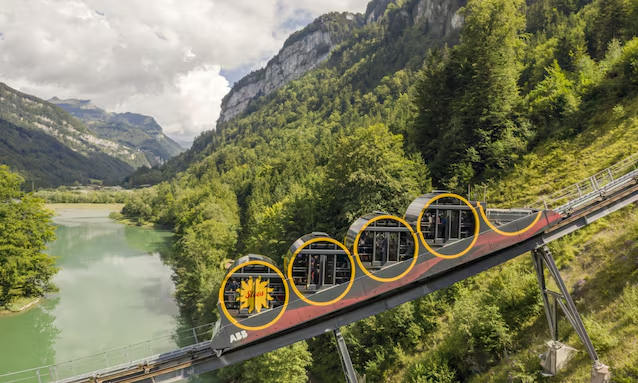
The system of cabins that rotate to adapt to the inclination
The most innovative and interesting element of the Stoosbahn lies in the creation of transport carriers. Solve the problem of passenger comfort and safety on a route that radically varies its inclination, passing from almost flat sections to the extreme slope of the 110%, required development ad hoc by the manufacturer Garaventa/Doppelmayr.
Each of the convoys is in fact composed of four rotating cylindrical cabins, technically defined as “drum-shaped cabins”. Through a mechatronic system based on active hydraulic leveling, each cabin rotates along its horizontal axis, coordinated with the inclination of the track, as visible in the video below. This ensures that the floor inside the passenger compartment remains perfectly horizontal throughout the journey, eliminating any sensation of unbalance.
The funicular also works thanks to the classic come-and-go principle with a single high-resistance hauling cable. The main traction system, located in the mountain station, is equipped with high-efficiency electric motors driven by inverter with low harmonic distortion, which contain the disturbances introduced into the network. In descent phases the group works in regenerative braking, giving back to the network energy potential of the convoy rather than dissipating it.
Due to the slope of 47.73°, in case of hypothetical breakage of the hauling cable or serious mechanical failure, classic pulley brakes would not be sufficient. The train is equipped with emergency brakes with direct action on the rails (rail brake), intrinsically safe (fail-safe): yes insert automatically in case of rope breakage, overspeed or failure, stopping the vehicle even at the point of maximum slope.
The investment of 52 million Swiss Francs
The total investment for the construction of the new Stoosbahn was approximately 52 million Swiss francs (CHF). Although the figure represents a significant financial effort for the region, the long-term cost-benefit analysis has demonstrated a highly positive socio-economic impact.
Before the construction of the new funicular, the connection to Stoos depended on a old system reached the end of its useful life and with limited capacity. The new infrastructure today represents the main transport artery both for the resident population and for the supply of goods to hotels, restaurants and local commercial activities.
The work has taken on global media and engineering resonance, transforming the journey itself from a mere means of transport to tourist attraction. This has led to a significant increase in tourist flows in both the summer and winter seasons, increasing the hotel occupancy rate and the revenue of the entire area.
