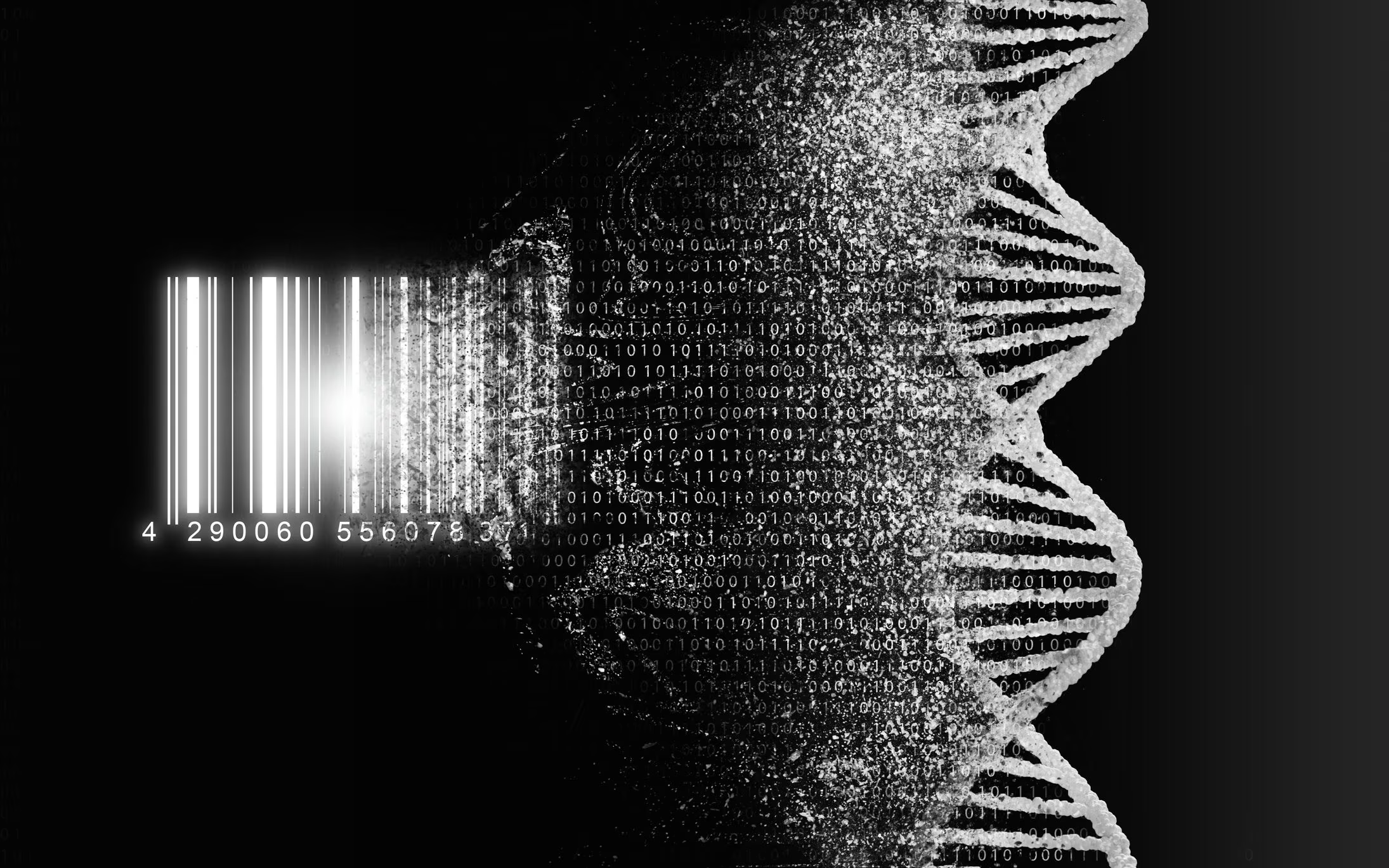
The DNA barcoding it is a genetic technique that allows you to identify living species by analyzing a short standardized sequence of theirs DNAused exactly as if it were a barcode. It works on the same principle as supermarket checkouts: a scan on the classic black and white lines is enough to instantly reveal the identity and origin of a package of pasta, whereas without that code you would have to guess by just looking at the packaging.
Scientists do the same thing with Earth’s biodiversity. It is estimated that on our planet they live approximately 9 million species of plants and animals, but today we know less about them 15%. Recognizing them using classic techniques, such as observing the external appearance (morphology), requires time, dedicated experts and, above all, often risks misleading. Indeed, they exist “cryptic” speciesthat is, organisms that appear identical on the outside but belong to different species, not to mention specimens that are impossible to identify with the naked eye, such as eggs, larvae or fragments of processed food. In all these cases, reading the genetic “barcode” allows us to give an exact name and surname to the organism without any margin of error.
DNA barcoding identifies living species: the different recognition genes
To identify a book you don’t need to reread it from the first to the last page, but just look at the ISBN code on the cover. Similarly, to recognize a species it is not necessary to analyze its entire genome (a complex and expensive operation), but just read a small specific piece of DNAa few hundred genetic “letters” long (A, T, C, G). The technique is based on a fundamental rule, the so-called barcoding gapthat is: the “barcode” must be very similar between individuals of the same species, but clearly different between different species. This genetic detachment allows biologists to say with certainty to which species the analyzed sample belongs.
Since living things have evolved in different ways, there is no single recognizable gene that is valid for everyone. For this reason, scientists chose an official marker for each group:
- For the animals a fragment of the is used COI gene, that is, the gene coding for subunit 1 of cytochrome c oxidase, present in the mitochondria.
- For them plantsince the COI gene mutates too slowly, two genes present in called chloroplasts were chosen rbcL And matK.
- For i mushrooms specific regions of nuclear DNA called ITS.
- For i bacteria, instead, the standard marker is the 16S gene of rRNA.
When carrying out a barcoding study, after reading the sample sequence, it comes compared (through computational analyses) with other sequences present in international databaseslike BOLD (Barcode of Life Data System) or GenBank, to find a match and identify the species.
How an analysis is carried out and how it works
The conduct of a DNA barcoding analysis can be summarized in 5 steps:
- Sampling: as you can imagine, the tissue to be analyzed is taken.
- DNA extraction: DNA is isolated from the sample.
- Amplification: with a method called Polymerase Chain Reaction (PCR) the piece of DNA we are interested in is amplified, i.e. we create more copies of it.
- Sequencing: using this technology we are able to go and read, letter by letterthe DNA sequence.
- Database search: the sequence obtained is compared with the databases to find a match and identify the species.
What is this “barcode” for?
DNA barcoding has concrete applications, not only in research, but also at the level of biosafety and can be applied in various fields, from the table to the environment. One of the classic examples of application of this technique is that of food scams. When we buy a fillet of fish, filleted or frozen, or when we order at a restaurant, it is almost impossible to understand which species what we have on our plate belongs to. In recent years the food sector has been at the center of several scandals: checks revealed that low-value species were being passed off as valuable fish. In these cases, analyzing the COI gene from a stick or a meatball, DNA barcoding allows you to immediately discover the true identity of the fish.
Another fundamental area is that of healthcare. If a person accidentally ingests a poisonous plant or toxic mushroom and arrives at the hospital in serious condition, doctors must immediately understand what he has ingested. Since the material in the stomach is now digested and unrecognizable to the naked eye, extracting and barcoding DNA from the residues allows the plant to be identified and the correct antidote administered in record time.
Finally, DNA barcoding is a valuable tool for environmental protection and defense against alien species, i.e. those organisms introduced by man (voluntarily or by mistake) outside their natural environment. Freight ships often carry invisible eggs or larvae of organisms from other continents. If these species spread, they can devastate local ecosystems. DNA barcoding identifies them immediately, allowing action to be taken before they spread.
The new frontiers: DNA in water and air
Today biology has gone further with the metabarcoding and the Environmental DNA (eDNA). You don’t even need to collect the animal or plant anymore: just take a glass of sea water or a handful of earth to read all barcodes present. We can thus know which fish swim in a bay simply by analyzing the traces of DNA they have left in the water.
DNA barcoding acts a bit like a molecular magnifying glass, becoming a fundamental tool for protecting biodiversity, ensuring the transparency of what we eat and protecting our health.
Sources
Antil S, Abraham JS, Sripoorna S, Maurya S, Dagar J, Makhija S, Bhagat P, Gupta R, Sood U, Lal R, Toteja R. DNA barcoding, an effective tool for species identification: a review. Mol Biol Rep. 2023 Jan;50(1):761-775. doi: 10.1007/s11033-022-08015-7. Epub 2022 Oct 29. PMID: 36308581.
