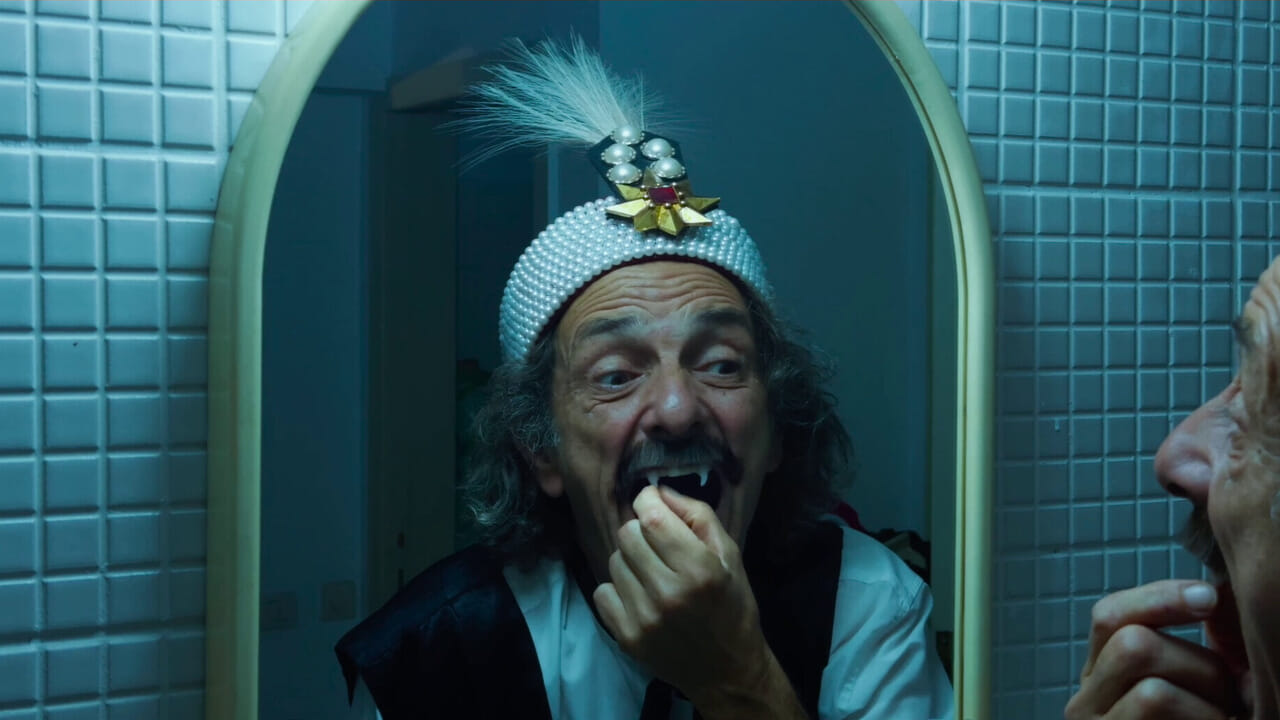
This “Dracula” is not the Dracula you think he is
Let’s go back to the title right away: there is a “Dracula” who is not quite the Dracula you would expect. It is in theaters from May 7th with Cat People and EXA and was written and directed by the Romanian director Radu Jude, one of the most irreverent and biting film authors in Europe.
It is wedged into a trend that rethinks Bram Stoker’s novel which has been particularly rich in recent years. Between the arthouse re-edition but with money (read: “elevated”) of Robert Eggers’ Nosferatu, the caciarone and kitsch chaos of Luc Besson and a chatty, but still on the high seas, reinterpretation by Chloé Zhao. And here in the middle he makes his film explode, a satirical comedy not for all tastes.
What is Dracula about?
Jadu is a pampered and rewarded director on the festival circuits – his stronghold is Berlin, where he won the Golden Bear in 2021 for Bad Luck Banging or Looney Porn, then the silver one for director for Aferim! (2015) and another on the screenplay for Kontinental ’25 (2025). Because he takes what he sees in the world around him and throws it onto the screen, which becomes the surface on which he investigates the foolish drifts of a present with fewer and fewer certain coordinates.
For those who don’t know him, it needs to be clarified immediately: Jude’s cinema is not easily digestible. One could almost say that it is not digestible at all, and therein lies the point. It sits on top of you like a boulder and causes an intestinal blockage. If this present is indigestible, in some way the work that comments on it must also be.
The plot is a plot just by name. There’s a sort of vertical story. A director (Adonis Tanța) thinks – or writes? – the screenplay of a film about two actors (Gabriel Spahiu, Oana Maria Zaharia) who play Dracula and Vampira in a theatre-tavern-brothel. And then it follows them as they try to escape when they get trapped in a show that turns against them.
Then there are several horizontal stories that this director outsources to a phantom artificial intelligence, which generates various reinterpretations of the Dracula myth with which Jude mixes and distorts the linear progression of the story. Which are often petty, vulgar, sappy, apparently nonsense, compacted together in a vain and sometimes vile mixture, full of a broken and torn sexuality – a field of existence understood on the one hand as a liberating haven to be re-inhabited, on the other always at risk of commercial nullification.
The age of rot
Here’s the question. We live in times that are sinking, where reality is brutalized and unrecognizable and where culture manifests itself only as a parodic fallout, a harlequin precipitate in a constant background noise.
Faced with the pulverization of contemporary logic, the Romanian filmmaker does not try to bring order to the fragments of reality that surrounds us, an effort in vain for him. For Jude it is much more honest to throw these pieces into his films, leaving them lying and sharp while the invitation to the spectator (if we can speak of an invitation in the case of his works) is to venture into the midst barefoot.
If for many among the problems of today’s cinema there is the excessive literality of the message, intended as a guideline of the subtext of the films, works like Dracula correspond to an inverted antidote. The message rises to the surface and expands in structure, form and aesthetics. It is not enough to state the dispersion of meaning, it is necessary to disperse it at every stage of the film.
All Dracula’s cartoons start from the rejection not only of the commercial, but even before that of spectatorial taste. Or at least of the regulated and normative spectatorial taste, which Jude undresses by contrasting it with the other side of the coin and the only truly valid discursive process in recent years, that is, the pantomime of scrolling, of brain rot, of ‘brainrot’.
And Jude goes to get the vampire not only because he is the myth par excellence of Romanian culture (in his works there is always a retrospective on the society of his country), but also and above all precisely because he is a cannibalistic character and a response to the extreme reshuffle undergone again and again by his myth. He ridicules the standardization of the message (Egger’s Nosferatu) and the pulp tendencies (Besson’s Dracula) – we’ll see if and what Zhao will be; let’s hope he doesn’t follow Hamnet’s sorrowful violin, brrr….
There is a limit to Jude’s operation, however. The film lasts a very long time, probably too long even considering its nature: two hours and fifty minutes. Although it hits the ground running with swashbuckling humor placed at the service of unbridled satire, not all variations of this episodic tale are able to maintain the ferocious and incorrect irony promised at the beginning. Some frameworks work much better than others. It may not be his most successful work, but the director’s undoubted lucidity and critical ruthlessness remain.
Rating: 6.5
undefined
