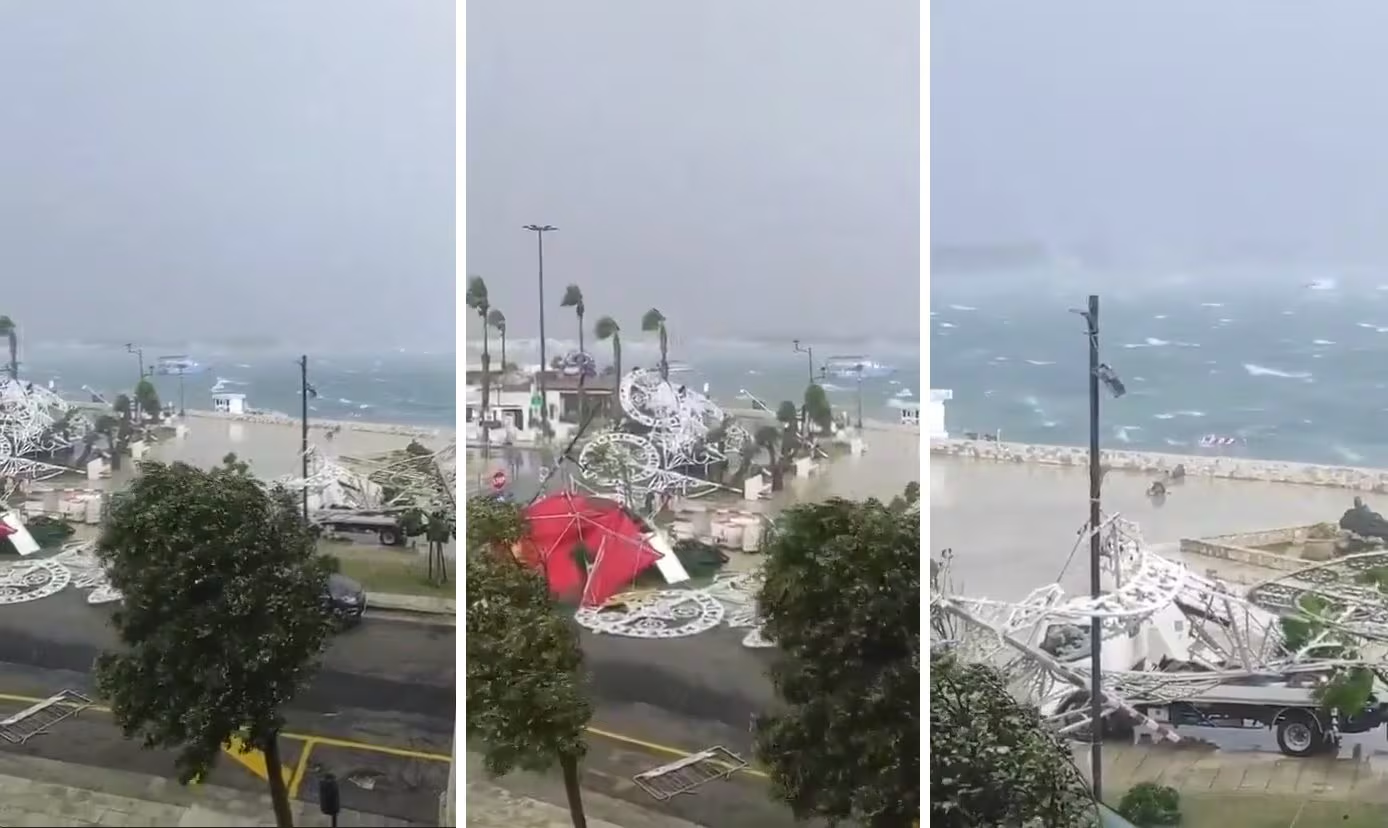
A violent one storm it hit yesterday Porto Cesareoin Puglia, causing flooding, the sudden collapse of the lights set up for the patronal festival, extensive damage to bathing establishments and numerous trees uprooted. The episode of Tuesday 18 August generated moments of great fear among residents and tourists along the coast, which was suddenly hit by extreme wind gusts and heavy rainfall. However, what triggered this devastation was not a rotating structure, or a whirlwind, as many media have declared, but rather a downbursta meteorological phenomenon typical of the most energetic summer storms.
The dynamics of the event and the damage: what happened in Porto Cesario in Salento
When a storm cell develops into a environment saturated with heat and humidityaccumulates within it a large quantity of cold and dense air at higher altitudes. If this mass of air suddenly falls downwards together with precipitation, it generates what in meteorology is called a descending current, or downdraft.
When this column of air impacts the ground it expands horizontally at great speed in all directions with a horizontal and rectilinear movement, giving rise to the downburst. This is exactly what happened in Porto Cesareo blast of cold airwhich hit the coast generating linear wind gusts at very high speed, even exceeding 100 km/hcapable of overwhelming the structures, uprooting the vegetation and causing the party arrangements to collapse before dispersing. This caused a lot of damage: the wind knocked down the lights and hit the beach, while the rain caused flooding.
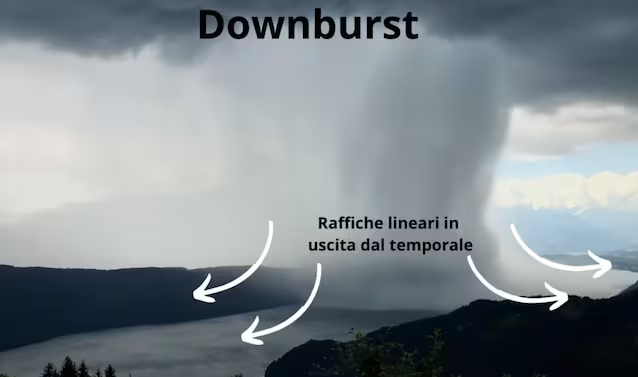
How to recognize the downburst phenomenon from the traces on the ground
The analysis of the damage left in the area allows us to precisely reconstruct the nature of the phenomenon. In the case of downburstthe impact of the air against the ground creates a uniform thrust outwards, creating strong downward wind currents with horizontal motion. For this reason, affected trees, poles and structures are cut down all in the same directionpushed by the shock wave of the air coming out of the storm, which can reach high speeds, close to or even exceeding 100 km/h.
On the contrary, in the presence of a real one whirlwind (or tornado)the air rotates in a vortex around a central pivot; as a result, debris and vegetation are uprooted and projected in chaotic or converging directions along a narrow and well-defined path.
The inaccuracy of the media and the mistake about the “tornado”
In the aftermath of the event, several newspapers made headlines talking about yet another “tornado” that would have overwhelmed the Salento town. This is an inaccuracy which is repeated almost systematically every time a storm produces destructive winds.
Using the term “tornado” as a generic synonym for strong wind is a conceptual error. Although the ground effects in terms of damage may be visually similar and equally dangerous, the tornado involves a vertically rotating column of air connected to the cloud, while the downburst it is a falling jet of air that spreads out in a straight line. Calling things by their name helps to better understand how the dynamics of the atmosphere work and to correctly interpret the severity of weather phenomena.
