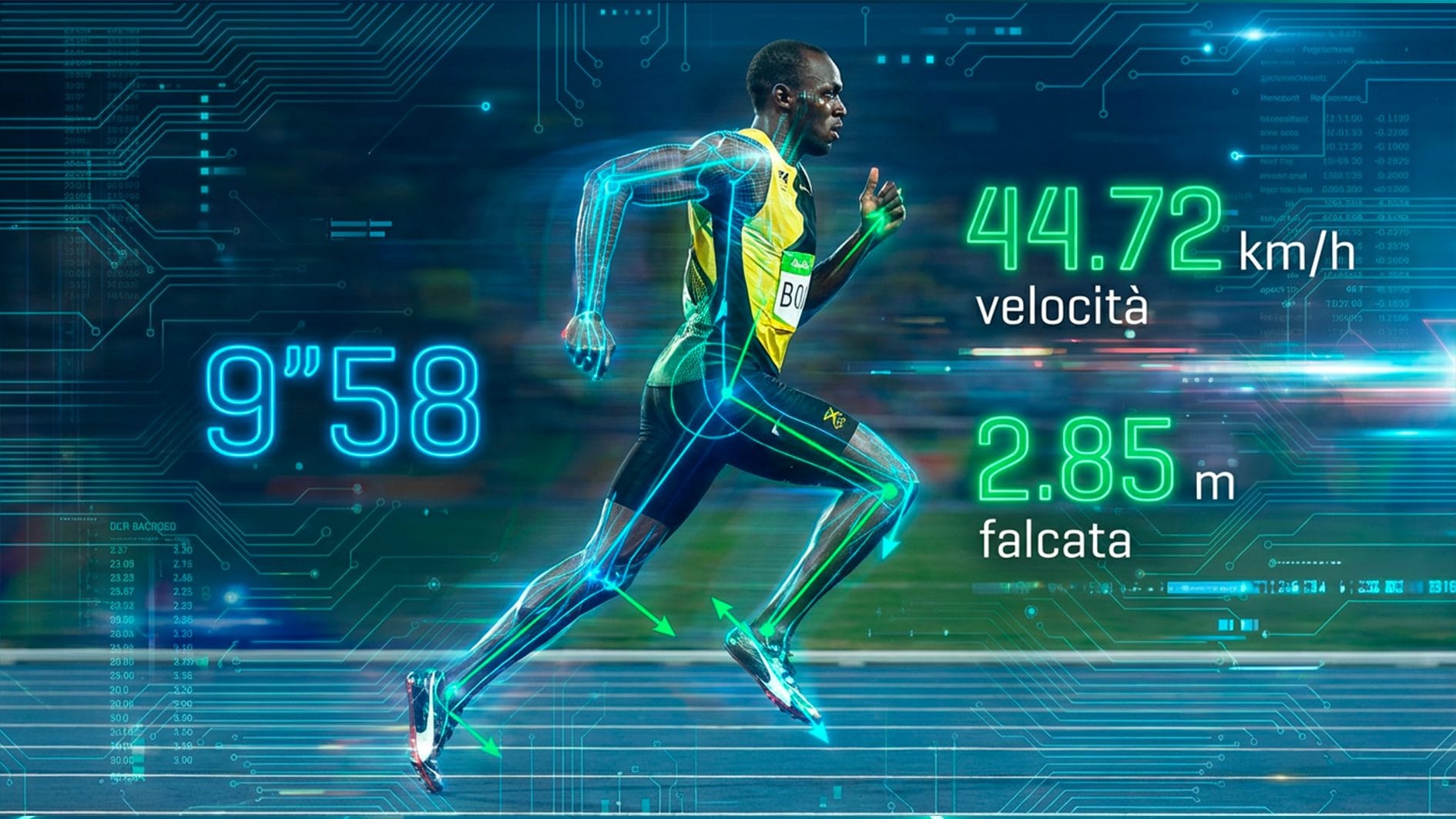
Usain Bolt he redefined the limits of athletics and biomechanics by running i 100 meters in 9″58 at the 2009 world championships at the Olympiastadion in Berlin. August 16 of that year is a date that marked the history of sportand in which science had to stop to study and observe. In that race, Bolt touched one maximum speed of 44.72 km/h with just under 41 steps thanks to his off-scale stride. The former Jamaican sprinter, winner of 8 Olympic gold medals and 11 world championships he is a living legend of athletics, still the world record holder 100 meters flat and gods 200 meters flat.
Usian Bolt, the former sprinter with an imperfect but effective body
Usain Bolt, with his 195 centimeters tall, has been judged several times “too high” to be able to achieve good results in sprinting, and in fact he is about 10-15 cm taller than the average top-level sprinter of the last 20 years (Marcell Jacobs is 186 cm tall, Noah Lyles 178 cm, Tyson Gay 181 cm).
And even his running didn’t seem optimal, in fact, it was completely asymmetrical. His right leg is slightly shorter than his left, yet it is the one with which he pushes the most: about 13% more force with each support, according to studies. An asymmetry that would cause in normal athletes inefficiency in running, but which Bolt instead managed to make efficient thanks to very long strides and an extremely low contact time of the feet on the ground.
One of its secrets lies in the perfect ratio between braking and pushing during its running movements: 37.3% versus 62.7%. It means that, in each step, the “useful” part of the movement is almost double compared to the “dissipative” one. A biomechanical balance very rare so much so that it is considered almost unrepeatable.
The record of 9”58 time in the 100 meters: a stride off the charts
In the 100 meters in Berlin, Bolt covered the distance in short order less than 41 steps: other sprinters use them on average between 45 and 48 in a competition like this. The 2nd and 3rd place in that race, the American Tyson Gay and Jamaican Asafa Powellthey place one foot on the ground 44 and 46 times. Marcell Jacobs took 45 and a half steps when he won the gold medal at the Tokyo Olympics.
Fewer steps thanks to a very long stride: 2.52 meters on average, which gets longer up to 2.85 meters in the last 20 meters of the race.
Taking fewer steps means arriving less tired in the last 30 metres, when the maximum speed has just been reached and tends to drop, and closing the race still pushing when opponents are struggling. It is precisely in that phase, in the last 20-30 meters, that Bolt shook off any opponent and became unattainable for anyone.
Furthermore, every time Bolt’s foot touches the ground, he generates a vertical reaction force equal to over 4 times his body weight, for a very small fraction of time: 0.086 seconds on average. In practice, Bolt applies the same force to the ground as a racing bike accelerates when stopped. This balance between width and speed, also made possible by his 195 cm height, allows him to advance further than anyone else with every single support.
Furthermore, the biomechanics of his running “save” energy wherever possible to release it to the ground. His center of gravity, for example, fluctuates by less than 5cm, compared to the 6-12cm of his opponents. This means that if we look at a head-on shot of Bolt’s run, we would see him always stableunlike its lane neighbors who we could see move slightly up and down with each step. It means that almost all of its energy goes in a horizontal direction, not upwards, minimizing unnecessary movements.
Athlete-specific genetics and training
But the secret of his running is not just biomechanics, there is also the genetics.
Bolt has a high percentage of type II muscle fibers, the fast-twitch ones, powered by the ACTN3 genea very frequent gene in Caribbean populations and one of the main creators of the great abilities of Jamaicans in short distance running. Its muscle fibers contract very quickly and generate a lot of force, but they don’t last as long. Perfect to run 100 or 200 metersless suitable when distances become longer.
Clearly his DNA is an ideal basis, but not sufficient: it made the difference the trainingbuilt over years of study on movement. Plyometrics to train the muscle lengthening-shortening cycle, stabilization and strengthening of the core to improve the transfer of energy between trunk and limbs, coordination exercises to synchronize legs and arms. It is not enough to be strong and powerful, it is essential to be efficient to reduce energy dispersion and defeat air resistance, which a almost 45 km/h becomes the most difficult enemy to overcome, especially when you are almost two meters tall.
A record impossible to approach?
That 9”58 in 2009 seems, to this day, to be a complete time out of reach for the speed performers who in recent years have worn the most important international medals around their necks.
Let’s look at the best times ever recorded in the 100 meters: for over 10 years no one goes below 9″75. The fastest in history after Usain Bolt are Tyson Gay and Yohan Blake, both with 9″69, athletes who ran in the same years as Bolt. In the summer of 2025 the Jamaicans Kishane Thompson And Oblique Seville they ran in 9″75 and 9″77 respectively (the latter time which earned Seville the world gold), two times which place them among the 10 best athletes in the history of the 100 meter dash, but no one today would bet on their performance being close to 9″60. A record which today seems unapproachable because no athlete has yet managed to embody the biomechanical perfection that characterized Usain Bolt’s running, made up of an atypical but efficient anatomy, great muscular power, and an ability to reduce energy waste that made him the greatest sprinter in the history of athletics.
