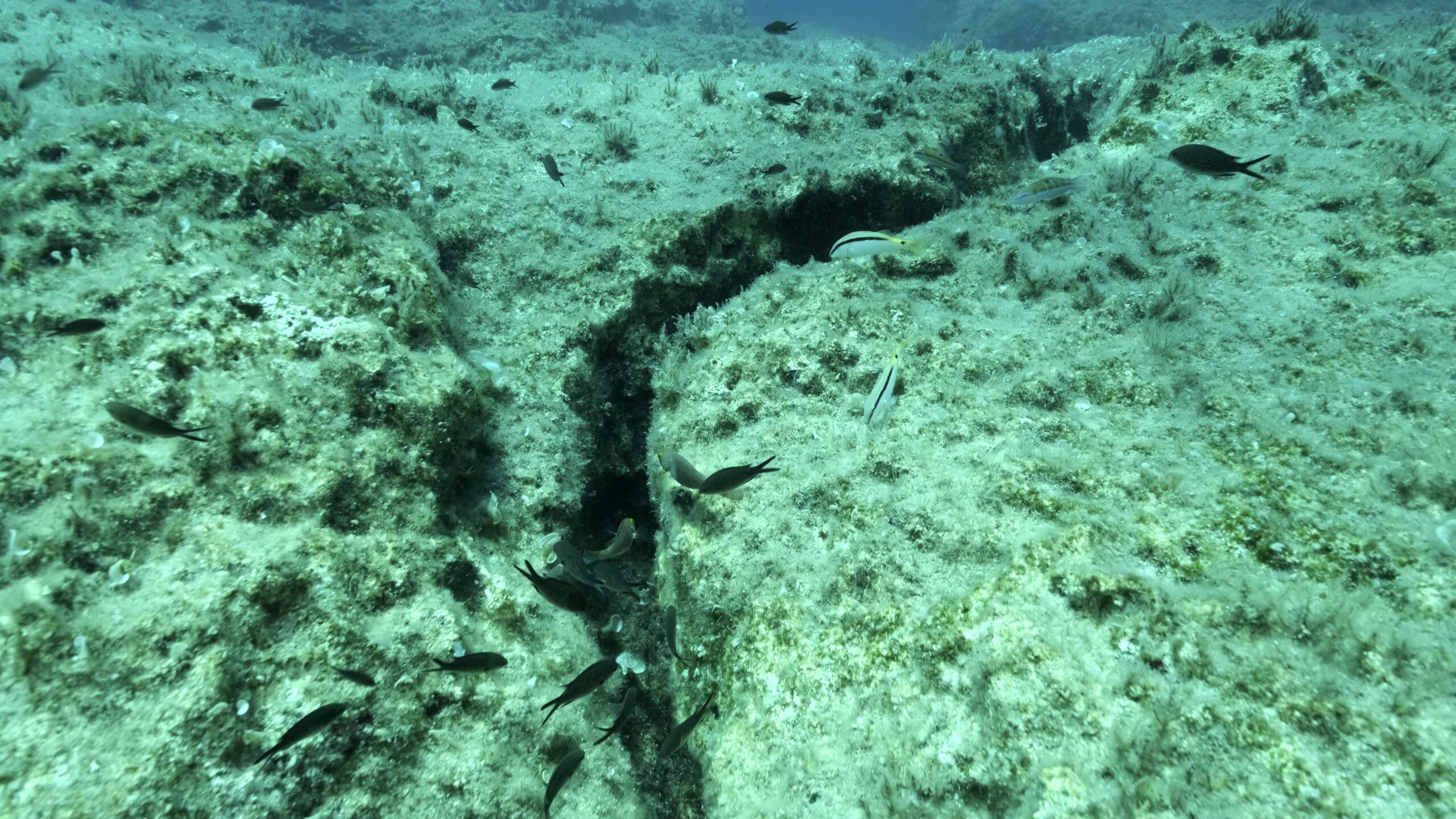
Oceanic faults alternate rigid zones, where the most violent earthquakes are generated, with structurally weaker and more complex segments, which hinder the propagation of ruptures and limit magnitudes.
Whenever a violent earthquakethe focus is on his origin. Yet, for seismologists there are still many crucial aspects without a clear scientific answer. For example, what determines when a fault stops rupturing? Understanding the genesis of stop mechanism is one of the most important goals of seismological research, also because it would allow us to better estimate the maximum expected magnitudes and, consequently, to improve seismic prevention. A new study published in the journal Nature Communications sheds light on this process, analyzing the data collected, thanks to the instrumentation, in one of the most inaccessible places on the planet: the ocean floors.
The results of scientific research on the fault Gofar
The researchers obtained new information by continuously and high-resolution monitoring the Gofar transform faultlocated along the Eastern Pacific Ridge. In this region of the ocean floor, some portions of the fault periodically produce high-magnitude earthquakes, while the adjacent segments slide slowly and almost aseismically. The latter act as shields or barriers to disruptionstemming the spread of the most violent tremors.
The scientists analyzed an entire year of recordings from sixteen underwater seismometers. The processing of the acquired data, through artificial intelligence algorithms, has also made it possible to identify micro-earthquakes – i.e. earthquakes with low intensity, practically imperceptible on the surface – as well as to map 2,323 focal mechanisms. This is a particularly large data set for a single oceanic fault, which has allowed us to precisely reconstruct how the mechanical behavior varies along the different segments of the Gofar: from the exact rupture points to the typology and directions of the movements of each individual event. The main result of the study emerges from the recordings: although one is expected in a transform fault horizontal scrolling of the plaques, only the 31% of the seismic events analyzed follows a purely passing and linear movement. With the exception of some purely compressive or extensional events, the remaining 60% consists mostly of earthquakes characterized by oblique and mechanically complex movementswhich therefore do not follow a precise pattern, a repetitive or predictable pattern.
The complex mechanics of the seabed
From the investigations conducted it therefore emerged that the Gofar fault does not constitute a homogeneous system by mode and type of seismic events. On the contrary, it appears fragmented into compartmentseach characterized by a specific mechanical identity:
- The areas where the main ruptures are triggered, i.e. those associated with earthquakes of magnitude greater than 6, are dominated by classical horizontal scrolling (that 31% we were talking about before). In these places, the rock that makes up the substratum of the earth’s crust is mechanically rigid and resistant and can therefore accumulate large quantities of elastic energy.
- The barrier zoneswhich instead contribute to stopping the propagation of large tremors, are characterized by fractures with heterogeneous three-dimensional kinematics. This indicates that the substrate rock is structurally weaker, therefore less rigid and resistant. Precisely because of its lower resistance, it tends to break after having accumulated smaller quantities of elastic energy: consequently, its release does not give rise to earthquakes of high magnitude.
The results suggest that a possible explanation for the different mechanical behavior observed may lie in the porosity fluid characteristics. In particular, water at high pore pressures, trapped in the pores of rocks at depth, absorbs contact pressures and, consequently, reduces the mechanical resistance to sliding. A principle consistent with the theories of soil mechanics, still today the basis of the study and design of the foundation structures of buildings. In these conditions, the fault, which we could define in a certain sense as “lubricated”, it cannot accumulate enough energy to fuel a major rupture and ends up behaving like a sort of natural buffer, as essentially also happens in newly developed seismic isolation devices.
The response of the fault after a high magnitude shock
The added value of the study also lies in having observed the fault in the midst of a “crisis”, since the monitoring period randomly included recordings relating to a violent earthquake of magnitude 6which occurred in 2008. Measurements show that, following the main shock, a large variety of failure mechanisms in the different segments. In essence, the release of energy has upset the balance of forces throughout the region, modifying its geophysical structure and reactivating also a complex network of secondary faults, until then inactive.
