
On average, in the world, a person spends approx 90 thousand hours of their life working (equivalent to approximately 45 years of full-time work). We can say that work constitutes a very significant part of the lives of billions of people (around 3.5 billion global workers).
In recent years the younger generations they have reevaluated their expectations and demands regarding the world of work, no longer considered central in the definition of themselves and their lives, but one of its many parts. This has led younger people to reject, more and more often, all those models that do not guarantee economic security, real well-being And consistency with one’s values. In fact, when one of these three dimensions is missing, rates of stress, disaffection and turnover increase, i.e. the turnover of personnel in a company.
According to research by General States of Welfarethe classic permanent job is no longer enough for young people between 18 and 34: the majority of them (72%) aspires to a job that allows you to express yourself, generate an impact, but, above all, have time to cultivate your life outside of work.
Similarities and differences between Gen Z and Millennials: balance between money and free time
According to data from Deloitte Global 2025 Gen Z and Millennial Surveyfor Millennials (people born between 1981 and 1996) but especially for Gen Z (people born between 1997 and 2012), job satisfaction and happiness depend on the balance between 3 fundamental factors: first of all, financial securitya very delicate piece, given that 48% of Gen Z and 46% of Millennials (a sharp increase compared to 2024 data) do not feel financially secure. The cost of living is the main problem for these groups for the fourth consecutive year: over 50% of those interviewed live from paycheck to paycheck and around 1 in 3 struggles to cover their monthly expenses.
For 89% of Gen Z and 92% of Millennials it is important that their work has a meaning: nevertheless, it emerges from the data that for approximately 1 in 4 workers their work is not aligned with theirs values. This led 44% of Gen Z and 45% of Millennials to leave a job they felt was meaningless. However, the data also shows that many are willing to move the meaning outside of work, if in exchange they obtain: a better work/life balance – third fundamental factor –, time and energy to engage in personal causes and higher pay. Only 52% of Gen Z and 58% of Millennials rate their mental well-being as good or very good: 40% of Gen Z and 34% of Millennials feel stressed or anxious “often or always”, and identify the financial future and daily finances as sources of stress, consistently with economic difficulties, followed by health and family and, for about a third of respondents, work itself.
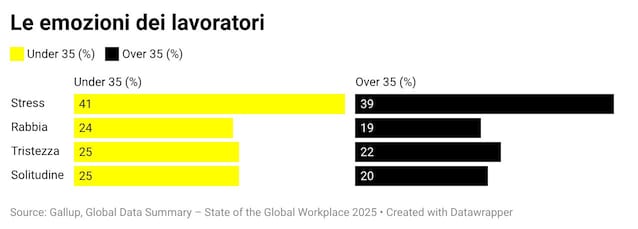
According to Gallup report Global Data Summary – State of the Global Workplace 2025younger workers (under 35) tend to experiment more frequently stress, anger, sadness And loneliness compared to those over 35. More precisely, stress for 41% against 39%; anger for 24% against 19% of over 35s, sadness for 25% against 22% and loneliness for 25% against 20% of over 35s. For this reason, in a world where half of workers of any age say they are actively looking or looking for a new job, the percentage of active searches rises among younger people.
According to the Randstad Workmonitor 2025, which carried out almost 27 thousand interviews in 35 countries, if in 2024 27% of workers were willing to change jobs in case of hardship, in 2025 the percentage rose to 57%.
Flexibility, remote working and business ethics: where young people do not compromise
In general, what younger workers, particularly Gen Z, ask of their employers comes first and foremost flexibility. According to research by Ali Lavoro (an Italian HR consultancy and services company), at least 35% of Gen Z wish that flexibility does not remain an exception but becomes something normal in the workplace: the possibility of independently choose the start and end times of your working dayto meet your extra-work commitments and needs.
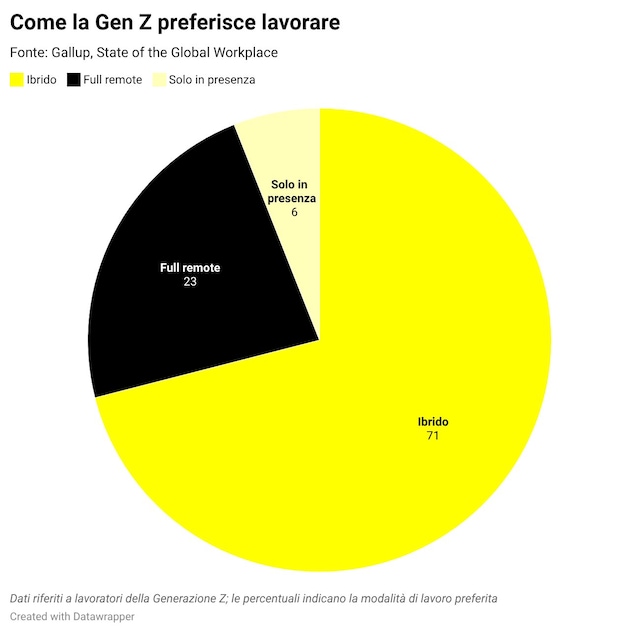
And again in terms of flexibility, according to Gallup data, only 6% of Gen Z workers would like to always work in the office, without remote working. Full remote, on the contrary, is preferred by 23% of interviewees (against 35% expressed by Millennials, Gen the preferred formula is the hybrid onewith 71% of the votes. Full remote is less preferred by a generation that entered the world of work in years in which Covid has redefined interactions, and which reports the highest levels of loneliness among workers of all ages. Young people thus tend to want to build personal relationships with colleagues and teamssomething that is harder to achieve while working fully remotely, as well as mentoring and professional development opportunities.
Furthermore, among the requests is that it be recognized by employers as the commute from home to work can affect employee stress: travel can greatly increase the number of hours dedicated for workers, especially for those who live very far away, and also the expenses. According to Deloitte research, remote working promotes a better work-life balance and a cut in expenses related to travel and consumption. The lack of hourly flexibility – and in some cases the lack of smart working – leads many workers, particularly women, to consider new jobs, or to work less than they would like to be able to dedicate more time to their family. Here in Italy 71% of Millennials and 63% of Gen Z believe in the almost impossibility of starting a family.
Healthy leadership, emotional intelligence and ability to motivate
Rigid and authoritarian hierarchies and the “culture of terror” not only no longer work, but are considered repellent: Gen Z expects the employer to be collaborative and able to create a healthy environment around them, in which they can feel free to express themselves, while at the same time feeling listened to and taken into consideration. According to research Gen Z: Redefining the Future of Work by the Top Employers Institutewhich collected opinions and preferences on the world of work in eight countries (Germany, Spain, United Kingdom, United States, South Africa, Mexico, China and India), the thing most appreciated by Gen Z in the field of leadership isemotional intelligence. For over half of those interviewed (55%) a good leader must be able to motivate and inspirewhile 53% see it as fundamental empathy and attention to people.
Speaking of motivation: according to the report State of the Global Workplace 2025 by Gallup, on a global average of employee engagement of 21% – however down two points from last year, with a loss of productivity costing the global economy 438 billion dollars -, the value drops to 13% for the European average (with 73% of unmotivated workers) and collapses to 10% in Italy. This means that in Italy only one worker in 10 declares himself fully motivated and involved. Manager engagement fell from 30% to 27% in 2024 – with a greater decline among female and younger managers – and this decline is necessarily also reflected in teams: 70% of a team’s level of engagement depends, in fact, on the manager.
According to the last one report on the labor market released by LinkedIn, globally almost one worker in two (52%) plans to change jobs in 2026; in Italy at least 2 people out of 5 will do so (44%). The conditions, however, make this change difficult: high competition would be a problem for 44% of those interviewed, together with more rigid selection processes (according to 36%) and very slow response processes (24%).
What should companies do for happier employees and keep them?
As mentioned, in Italy the cost of living is a real emergency for young people: almost half of Millennials and 38% of Gen Z are directly affected. This is why, if we take into consideration the last ten years, the emigration rate of new graduates has more than doubled. Many choose to expatriate reluctantly also because it will be easier to find companies able to offer, for example, continuous training – on average, around 16% of young people between 25 and 34 take part in training courses in Europe, with peaks exceeding 30% in Northern European countries, while in Italy we are only at 13% – and support and flexibility in reconciling private life and work. According to the LinkedIn report, among Gen Z, over 8 out of 10 people (81%) are considering moving abroad, followed by 2 out of 3 Millennials (67%).
According to a study carried out by McKinsey Health Institutewith the World Economic Forum, conducted on over 30 thousand workers in 30 countries, around a fifth of employees showed symptoms of burnout. In the same report, data shows that companies that choose to invest in mental health and quality of work experience growth in productivity per hour worked and a decline in employee turnover. The study estimates that invest in employee health and well-being can generate up to 11.7 trillion dollars globally (+4-12% of global GDP), thanks to higher productivity, less absenteeism on the one hand and presenteeism (in which people do not work to their full potential) on the other, a better ability to attract and above all retain talent, and lower healthcare and turnover costs. Investing in mental health and the quality of work is therefore not only an ethical issue, but would also be shown to be capable of producing measurable economic benefits.
According to an article in Sole24Oretoday many Italian companies are increasingly offering more in order to attract the best talent benefits: corporate welfare, smart working and flexible hours. All these benefits can certainly make a difference in the initial period, but what emerges is that after six months the resource begins to see them as normal and the level of discontent grows again. This happens, according to the Sunbecause companies offer benefits through isolated activities with poorly structured projects, without taking one into account broader vision on work-life balance and the workerbut only a small portion of the problem. Who knows, maybe the habits and requests of the younger generations can really contribute to changing the world of work for the better.
