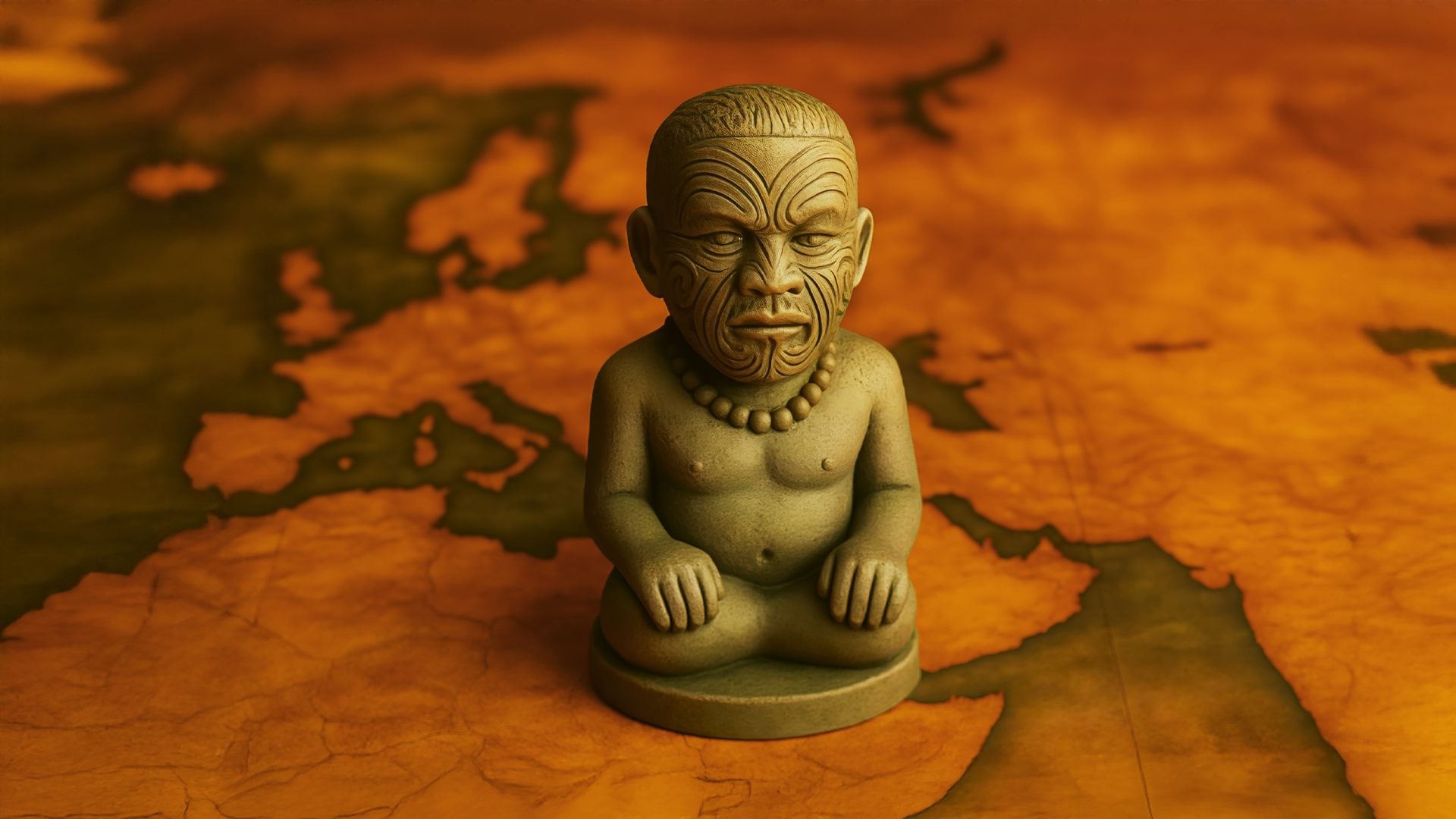
The people Maori has become internationally famous both thanks to haka – the ritual dance performed by the All Blacks before each rugby match – and thanks to the animated blockbuster Oceania. But their story, in reality, is much more detailed and complex than that and has its roots in Oceania.
How did the Maori people arise?
We don’t know for sure how the Maori population arose but in all likelihood it was some Polynesian community who sailed around the South Pacific Ocean until he discovered around 1300 that island which, today, we call New Zealand but which at the time was baptized as Aotearoawhich can be translated as “big white cloud”.
These ancestors of the Maori once they arrived on this beautiful Pacific island had a high priority, i.e eat, and therefore first of all they devoted themselves to fishing and hunting, in particular to seal and moa hunting. These are – or rather, were – the largest birds in the world. They were similar to ostriches so to speak… at least until the Maori hunted so many of them that they became extinct.
Obviously, as time passed, the Maori understood that they could not go forward just by hunting, and therefore slowly from the coasts they began to advance towards the hinterland, hunting other animals, collecting berries and cultivating sweet potatoes. These first Polynesian explorers therefore gave life to small communities, forming many fortified villages scattered throughout the island, the so-called pa.
How Maori villages were made
Everything is fine pa was made in strategic positions, often atop small hills and surrounded by multiple sets of palisades And trenchesso as to defend themselves from possible enemy attacks. If these defense systems were not sufficient to stop the enemies, weapons, such as the merea sort of stone truncheon, or the taiahaa long wooden stick. In general we can say that the Maori were enough bellicose And hostile towards each other, therefore they often formed alliances and counter-alliances to resolve disputes of various types.
An interesting thing is that they, often, before going into battle, did a particular dance where they shouted, stamped their feet and made faces, that is, the haka. Yes, the same haka that they also do All Blacks New Zealanders before starting their matches. This dance had the objective of both charging the warriors and scaring the enemy. And unlike what we might think, there was not just one haka, but several. So much so that, for example, even today the Black Ferns, that is, the New Zealand women’s rugby team, they do a different haka to that of the All Blacks.
In short, we understood that battle was an important part of their culture, so much so that even in their beliefs war was a recurring theme.
The Maori religion
One of the main deities Tūmatauengawhich was both the god of humanity than that of War. Although among all the multitude of deities they believed in, the one that is still most famous today is undoubtedly that of Mauithe demigod who became famous thanks to Oceaniathe Pixar cartoon. Maui is so important because according to tradition he is the one who gave fire to men and caused the island of New Zealand to emerge from the seabed – although in reality the characteristics of each deity could vary slightly from island to island.
But religion was also part of the very appearance of the Maori, given that the famous tattoos they got were considered sacred.
The meaning of Maori tattoos
These tattoos, called tāmokoand reserved in particular for members of the aristocratic social classes, were done above all on the facesince this was considered the most sacred part of the body. In the case of men, they often had their entire face tattooed, while for women it was usually only the chin and possibly also the lips that were tattooed.
To make tattoos the Maori used gods chisels which cut into the skin and created grooved scars, while as ink they used a mix of dried caterpillars or clay, with water, fish oil and resins. Each tāmoko was unique and created specifically to tell the story and successes of its owner. For example the koruwhich is a fern that grows there, was used to symbolize new life and growth and often represented a family member or loved one.
Well. We then gave an overview of the Maori, their culture and their religion. But these villages, apparently so isolated, in reality soon came into contact with other civilizations: those of the Europeans.
The arrival of the Europeans
One of the very first contacts with Europeans dates back to 1642, when he arrived on the island Abel Tasman (from which the island of Tasmania takes its name), although the decisive meeting was the one with the British captain James Cook in 1769, which reached the New Zealand from Thaiti. After his journey the island began to become an economically interesting destination and, in fact, around 1800 numerous English settlers began to arrive in New Zealand, followed by a multitude of Christian missionaries. The objective was twofold: convert the people And establish commercial links, so as to make assimilation and colonization easier.
At first everything seemed to be going well, for the Europeans I mean, since they managed to convert many of them, teach them to read and write in English and raise pigs. All this allowed him to impose a British government In the 1840… but this was obviously not accepted by the population. The Maoris in fact went in war against the English, but in the end they won and the Maori came deprived of almost all their assetswhich came under the direct control of the English crown.
So much so that the New Zealand flag has been in use since 1869 and you can clearly see that inside it is the flag of the United Kingdom.
The Maori today
During the first half of the twentieth century, however Maori spirit returned to the surface and after the Second World War new protests began by Maori groups who, especially in the cities, demonstrated to regain the rights to their lands, and to promote their language and culture. Since then, small steps forward have been made, even if today there are still millions of Maori who live in the less wealthy areas of the country and who do lower-paid jobs. In short, I am one minority and unfortunately they have all the disadvantages that this entails, even if the increasingly high presence of Maori in parliament could in the future lead to a change in their conditions and to a fair recognition.
