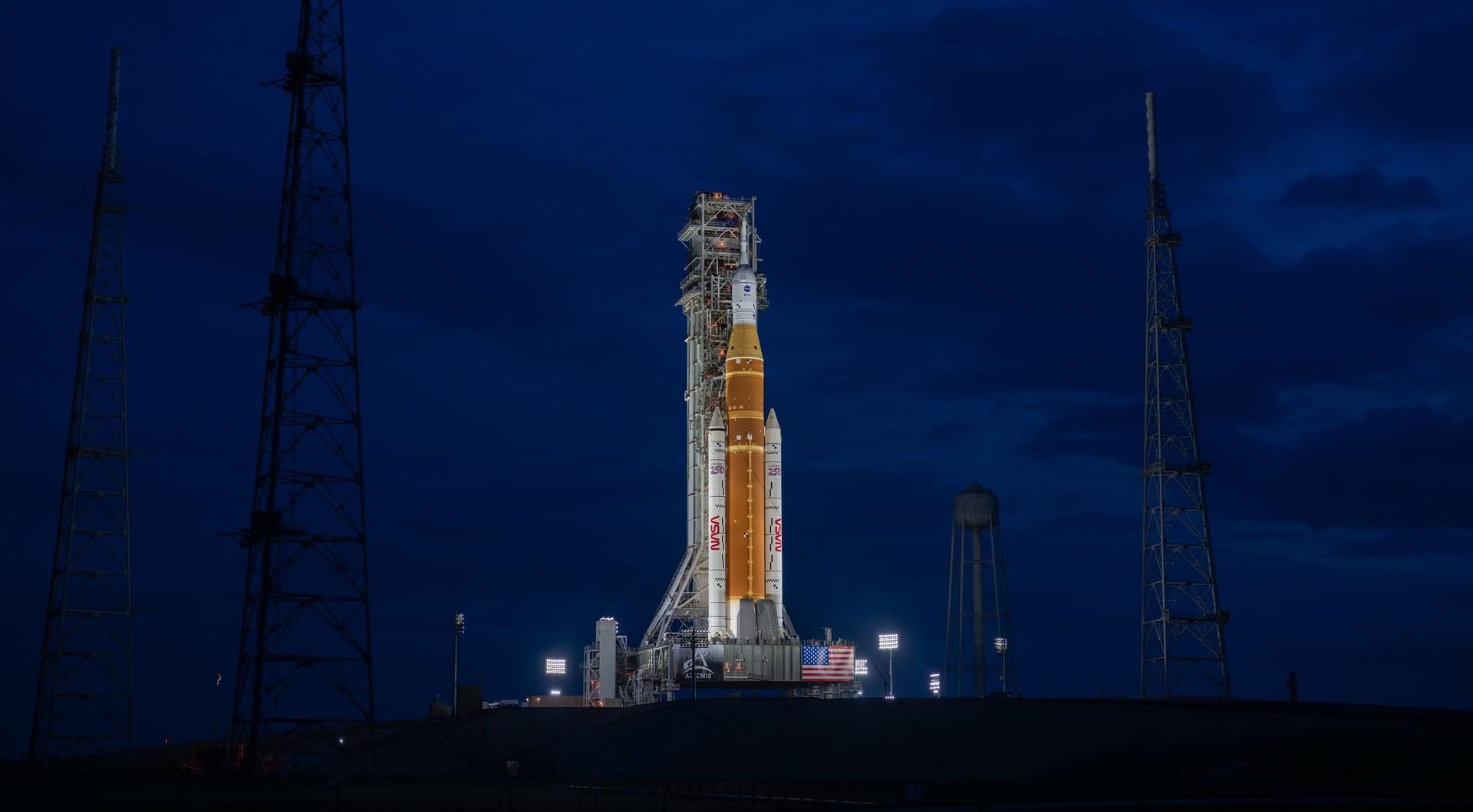
NASA released new and more detailed information on the decision to postpone the launch of Artemis IIduring a press conference held at 6:00 pm (Italian time) on February 3. Following the anomalies that occurred during the phase wet dress rehearsalor the simulation of all pre-launch operations – including loading propellant onto the rocket – NASA decided permanently close the February launch windowwhose first useful date should have been the 9th at 05:20 Italian time, in favor of that of Marchwhich extends from 6th to 11th, with March 10th excluded.
But how do they come? choices these launch windows? The decision is made so that the combination of Earth-Moon geometry, lighting and security for the crew allow the Orion spacecraft to be inserted on the planned lunar trajectory while respecting all mission constraints.
What are launch windows and how to choose them
The launch windows in aerospace they are specific periods of time during which a launch must occur in order for a desired orbit or specific destination to be reached. The dates they are not randombut the result of careful planning. In the case of Artemis II, these windows are determined by the relative positions of the Earth and of the target of the Orion spacecraft, that is Moon. It must take into account the rotation of the Earth on its axis and of orbital position of the Moon around the Earth during its lunar cycle. This involves calculations of orbital mechanics to find the most advantageous configurations in terms of minimization of travel time towards the Moon. At the time oftranslunar injectionin fact, the Orion capsule must be correctly aligned with the Earth and the Moon so as to draw a trajectory that puts it both in route for the flyby of our satellite than on one free return pathin which the spacecraft uses the Moon’s gravity to return to Earth without further propulsion maneuvers. This “aligned” geometry doesn’t happen every day: for Artemis II you get it groups of opportunities concentrated approximately one week in fourwith 4-5 possible launches for each group.
Minimizing flight time, however, is not the only parameter used to choose a launch window. The launch day and time must allow the Space Launch System to bring Orion into high Earth orbitwhere the crew and ground teams will evaluate the spacecraft’s life support systems before the crew ventures to the Moon. The launch configuration must always ensure that, even with limit corrections, reentry to Earth satisfies the entry conditions (speed, trajectory angle, dispersions) necessary for thermal safety and loads on the crew.
Furthermore, the launch window must ensure that Orion does not stay in the dark for more than 90 minutes at a timeso that the solar panel wings can receive and convert sunlight into electricity, and the spacecraft can maintain an optimal temperature range. The launch windows also have a limited duration ranging from a few minutes (in which the launch must take place with surgical precision) to several hours. In the case of Artemis II, all launch windowsexcept that of March 11, last two hourswith the start generally attempted at the beginning of the allocated time.
What are the launch windows for Artemis II
There first opportunity launch date of Artemis II should have been February 9th at 5.20am Italian time. The date had already been moved by a few days compared to the opening of the February launch window (6-11) due to bad weather which delayed operations wet dress rehearsal. Due to the anomalies found in this last procedure, NASA decided to permanently close the February windowfreeing the astronauts from the pre-departure quarantine to which they were subjected.
The next date for the launch of Artemis II is therefore postponed to March. In this month, the useful dates for the launch will be fiveall lasting 120 minutes and all a few hours after sunset in the United States which results in night launches from Italy:
- The first date will be March 6 at 8:29pm ET (ET for Eastern Time) which is the1:29 am on March 7th from Italy. The launch window will open for 120 minutes approximately two hours after the Sun sets.
- The next one will take place on March 7 at 8:57 pm ET, which is the1.57am on March 8th in Italy. Here too the window will be 120 minutes, but two and a half hours after sunset.
- The third date is scheduled for 10:56 pm ET on March 8, corresponding to 2.56am on March 9th in Italy. Still 120 minute launch window, but three and a half hours after sunset.
- The fourth date is March 9 at 11:52 pm ET, that is 3.52am on March 10th in Italy. Again 120 minute launch window, but further and further away from sunset, four and a half hours this time.
- The latest available date for March is for Day 11 at 12:48 AM ET which is 4:48, also on the 11thin Italy. This time the launch window is shortened to 115 minutes, with a distance to sunset of just over five hours.
If by bad luck the launch does not take place in March, Artemis II could launch in April with well six dates available which include the1, from 3 to 6 and 30 April. All dates will have a 120 minute window. These will also be evening launches that will take place after sunset in the United States, when it will therefore be night in Italy.
The results of the wet dress rehearsal
NASA held a press conference at 6:00 pm Italian time on February 3rd to illustrate the results of the wet dress rehearsal. This test, which would literally translate as “wet dress rehearsal”, alludes to the fact that they come simulate all pre-launch phasesincluding the load of liquid propellant (hence wet), up to a few seconds from T-0, but without ignition of the engines.
The press conference was attended by Amit Kshatriya, NASA Associate Administrator, Lori Glaze, Associate Administrator of the Moon-Mars Program, Charlie Blackwell-Thompson, Artemis Launch Director, and John Honeycutt, Chair of the Artemis II Mission Management Team. After the NASA Associate Administrator’s ritual thanks to all the staff for the incredible effort put into the wet dress rehearsal, Lori Glaze went on to illustrate some details of the results of this critical test:
- The launch is now scheduled no earlier than March. Because of this, the astronauts have been released from pre-departure quarantine and will return two weeks before the next launch window.
- The experience gained from the Artemis I mission proved crucial in refining the pre-departure procedures for Artemis II. An example is the load of liquid hydrogen propellant which caused several problems for Artemis I. With the data collected this time it was possible to complete the propellant load on the first attempt. Despite this, there was a leak of liquid hydrogen during refueling. Attempts to fix the problem involved stopping the flow of liquid hydrogen into the core stage, allowing the interface to heat up to allow the seals to be repositioned and regulate the propellant flow.
- TO T-8 minutes The access arm used by astronauts to enter the Orion capsule from the launch tower successfully retracted.
- TO T-6 minutes the phase has begun pressurization of the main stage which was followed by a peak in liquid hydrogen loss rate (above 16%) which it did stop the procedure Of wet dress rehearsal at T-5 minutes from launch.
- All the tanks they were emptied successfully during the night.
- In addition to the loss of liquid hydrogen, a valve associated with pressurization of the recently replaced Orion crew module hatch required a new tightening and the closing operations took longer than expected.
- Before the next launch, a new one will be made wet dress rehearsal to ensure the complete safety of the crew, NASA’s number one priority.
