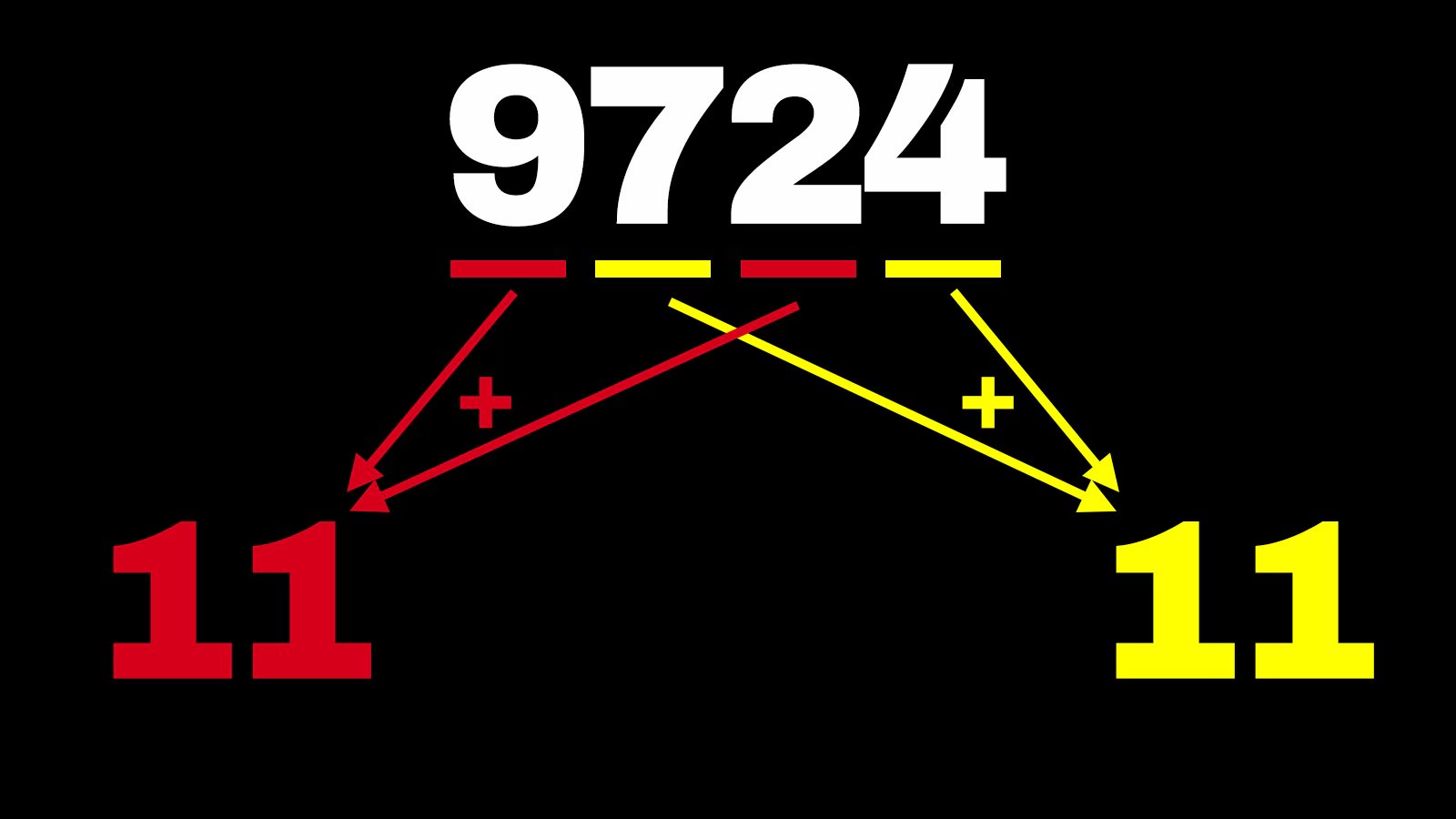
There is a rule to understand at a glance whether a number is divisible by 11. Simply add and subtract the digits of the number alternately and check if the result is a multiple of 11. But why does this trick work?
The numbers divisible by 11 they are very easy to identify. In fact, there is a very simple divisibility criterion, a trick mathematical!
We all know that multiples of 11 are initially very simple, because they are composed of two repeating digits: 11, 22, 33, 44, 55, 66, 77, 88, 99. But things get complicated with numbers larger than 100 and becomes complex identify new multiples. Just consider that the number 111 is not a multiple of 11 even though its digits are all the same.
In short, when the numbers involved become more than 2, it can become quite difficult to immediately understand whether they are multiples of 11… unless you know the secret of the number 11: a divisibility criterion as easy as adding and subtracting single-digit numbers.
The number 111, we were saying, is not a multiple of 11 and we can understand this from the fact that 11 × 10 = 110 and to find the next multiple of 11 we have to arrive at 110 + 11 which equals 121. In other cases it is more complicated to immediately understand if we are dealing with multiples of 11, for example only one between 539 and 544 is divisible by 11 but it is not easy to understand I fly which of the two. In this regard, the divisibility criterion by 11 helps us:
A number is divisible by 11 if and only if there alternating sum (i.e. I alternate addition and subtraction) of the digits of the number, from first to last (or from last to first), is equal to 0 or is multiple of 11 (positive or negative).
So, to understand if 539 is a multiple of 11 we calculate 5 – 3 + 9 = 11 which is the first number of the 11 times table, consequently 539 we can say that it is a multiple of 11 and can be divided by 11 without remainder, in fact, 539 = 49 × 11 and 539 ÷ 11 = 49 with remainder 0.
However, as regards the number 544, the alternating sum of the digits is 5 – 4 + 4 = 5 which is not in the 11 times table, so we can be sure that 544 is not divisible by 11: the division 539 ÷ 11, in fact, does not give a remainder of 0 but gives a remainder of 5 so 544 is not a multiple of 11.
Sometimes the result of the alternating sum of the digits comes negativebut it’s not a problem, just remove the minus sign and check if what remains is a multiple of 11, for example for the number 2759 the alternating sum is 2 – 7 + 5 – 9 = – 9 and 9 (without minus sign) is not a multiple of 11 so 2759 isn’t either.
In some cases, if the number is very large, the alternating sum may give a large result not immediately recognizable as a multiple or less than 11, and we can get away with iterating the procedure.
For example, in the case of the number 9190909090909090909191919191919191, with 34 digits, the alternating sum is 9 – 1 + 9 – 0 + 9 – 0 + 9 – 0 + 9 – 0 + 9 – 0 + 9 – 0 + 9 – 0 + 9 – 0 + 9 – 1 + 9 – 1 + 9 – 1 + 9 – 1 + 9 – 1 + 9 – 1 + 9 – 1 + 9 – 1 = 144 but 144 is not immediately recognizable as a multiple or less than 11: no problem, just move forward also calculating its alternating sum 1 – 4 + 4 = 1 from which we conclude that 144 is not divisible by 11 because 1 is not a multiple of 11.
But why does the policy work? We can see this with an example by transforming the number a bit 539 which is a multiple of 11:
- 539 is the sum of 500 + 30 + 9 which is equal to 5 × 100 + 3 × 10 + 9
- we note, however, that 100 = 99 + 1 And 10 = 11 – 1so we can say that 539 = 5 × (99 + 1) + 3 × (11 – 1) + 9
- at this point the calculation rules allow you to multiply the number outside the brackets with the numbers inside the brackets (distributive property), so we get 539 = 5 × 99 + 5 ×1 + 3 × 11 – 3 × 1 + 9
- In the end let’s change the order of the addends to get to 539 = 5 × 99 + 3 × 11 + 5 – 3 + 9
The number 539therefore, is given by the sum of 5×99 And 3×11which are multiples of 11 and of, and of 5 – 3 + 9 which is nothing other than the alternating sum of the digits of the number itself and which in this case equals 11. In essence 539 is given by the sum of 3 numbers that are multiples of 11 and is therefore divisible by 11. On the contrary in the case of the number 544, doing the same type of calculation, we find 544 = 5 × 99 + 4 × 11 + 5 but 5 is not a multiple of 11 and so the result we get by adding it to 5 × 99 and 4 × 11, which are multiples of 11, cannot be either.
