
The plague doctor’s dress was composed of a long tunic and from one Mask with glasses and a long curved beak. It was used to prevent the contact of the doctors with the “infected air”, since, until the nineteenth century, it was believed that epidemics and pestilences were caused by mysmslike bad smells widespread in the air. The history of the dress is not known with certainty: the first news regarding the use of masks by the doctors who visited the patients of plague date back to the fourteenth century But, in its complete form, the dress is certified only from the 17th century Staying in use until the following century, when the plague disappeared from Europe, to then become an element of folklore, so much so that today the curved beak has become a Venetian mask.
What was the role of the mask with the bird’s beak
The dress of the plague doctor was the guise used over the centuries of the late Middle Ages and the modern age by Doctors who visited the sick during epidemics. The dress was made up of a long black tunic and a mask with curved glasses and beak, which constituted the most characteristic element. The beak served a filter the air: According to the scientific beliefs of the time, infectious diseases were caused by mysms, harmful substances present, in certain circumstances, in the air. Miasma theory remained popular until the nineteenth century, when, thanks to scientists such as Louis Pasteur, Robert Koch and others, it has been scientifically shown that infectious diseases are caused by bacteria and viruses.
At the time of mysatic theory, it was believed that to avoid contagion it was necessary not to breathe the “infected” air. For this reason, the doctors inserted In the beak of the mask herbs and dry flowerslike roses and carnations, which should have kept bad smells away. The clothes of the plague doctor therefore drew his origins from theories that we know today. However, “protecting” breathing, it is likely that guaranteed some form of protection to those who wore it.

History of the plague doctor’s dress
The first news about the use of masks to protect themselves from contagion date back to 1373when the Second pandemics of plague which had started with the “black death” of 1347-48 to last until the eighteenth century. We do not know with precision what shapes had the first masks, but it is likely that from the origins they had the long curved beak. More precise documents date back to the 17th century: in 1619 the court doctor of Louis XIII, Charles de Lorma, He developed a complete dress model to protect himself from miasms, drawing inspiration from the reinforcement of the soldiers. In Italy, in the same century a poem that described it was composed. We also know that the dress, in its complete shape, was used by doctors during the Greater plague epidemics of the 17th century: the one that affected central-northern Italy in 1630-31 (the plague called “Manzoniana”, because it was described in the Promessi Sposi), the one developed in the Dutch city of Nimega in 1637, the one that hit Naples and Rome in 1656
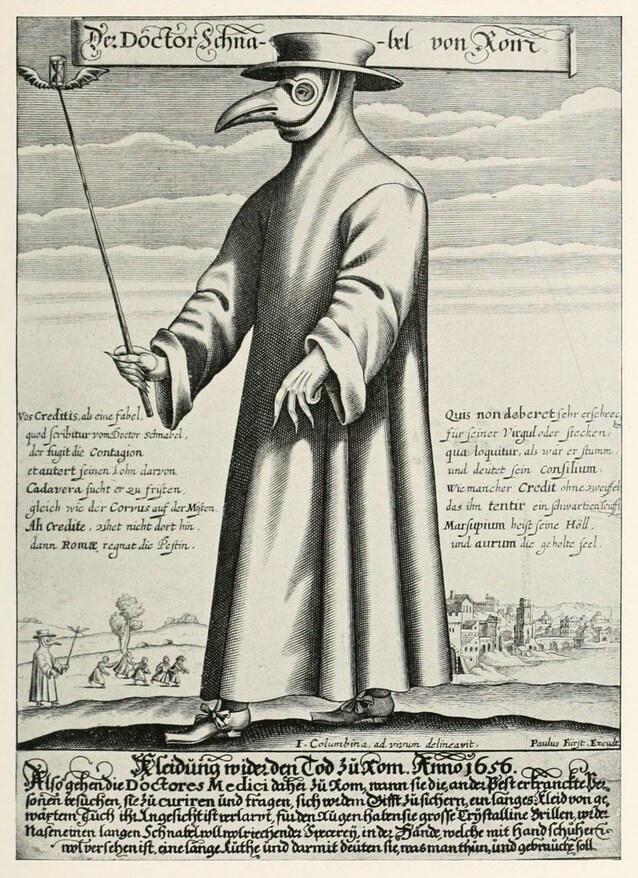
The use of the dress falls in disuse in the eighteenth century, in conjunction with the disappearance of the plague from Europe (The last great epidemic hit the city of Marseille in 1720). Since then, the mask with the curved beak has become an element of folklore and is used on the occasion of Venice Carnival. Furthermore, the popularity of the dress has increased in 2020, due to the Covid-19 pandemic, which has made the interest in the epidemics of the past grow all over the world.
