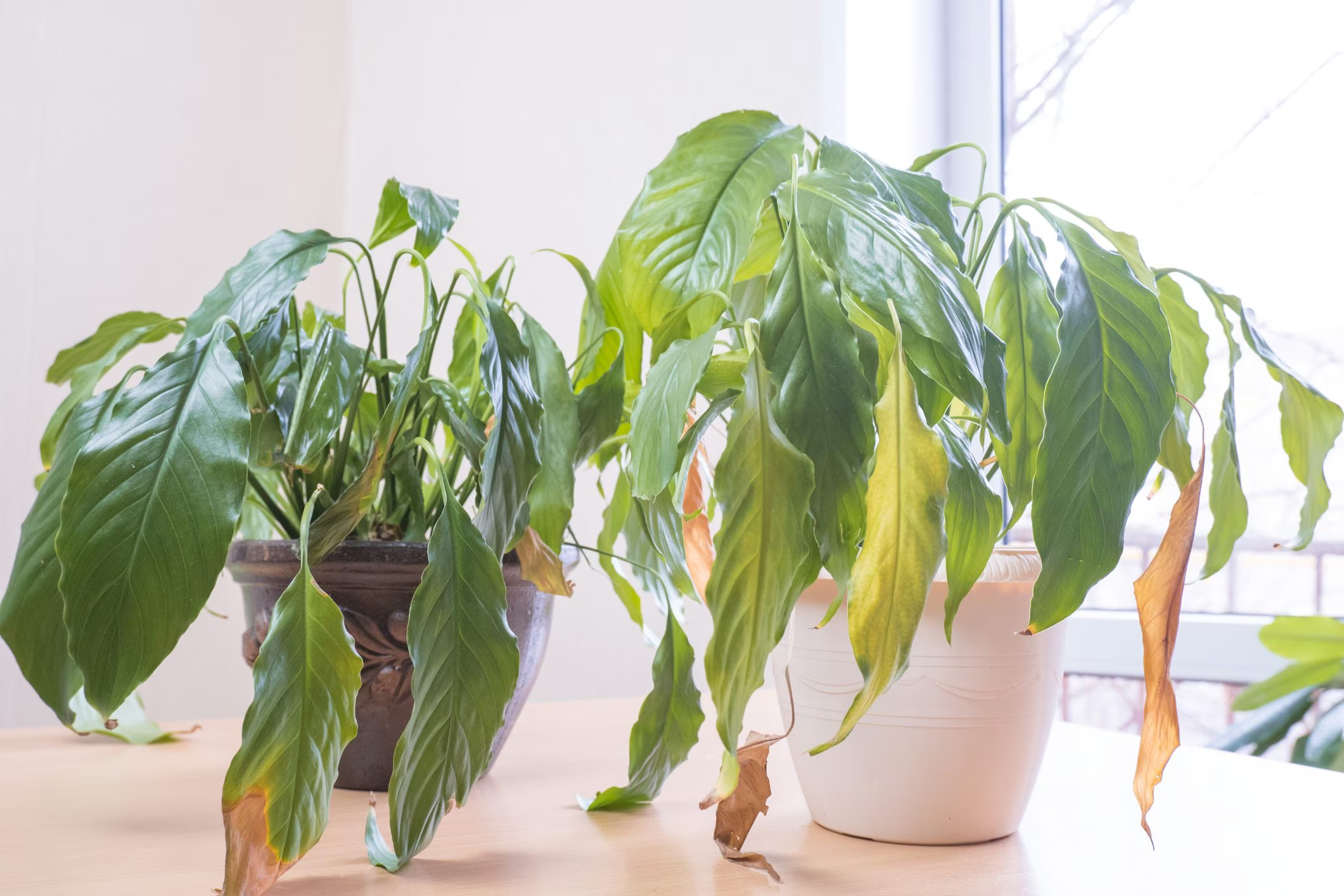
You come home from vacation and the plants are all limp and sad. First reaction: take the watering can. WRONG! The reason why plants wilt is related to a lack of water, but not always as you think. THE’withering it depends on a delicate balance between the water that the plant absorbs from the roots and that which is lost: when more water is lost than is absorbed, the plant withers. But the cause of this imbalance can range from actually little water in the soil to the opposite scenario: too much water it can cause the roots to rot. Light (both too much and too little), sudden changes in temperature, any plant diseases and the level of nutrients, particularly potassium, in the soil also come into play. The solution is not uniquedepends on the plant and is often the result of a mix of various attempts such as moving the plant to places with more or less light and trying to vary the fertilizer. I mean, put down that watering can.
Fun fact grammatical: you can choose the form you prefer between watering/watering and watering can/watering can. According to the Accademia della Crusca, they are both correct.
When the soil is dry, it is better to give water
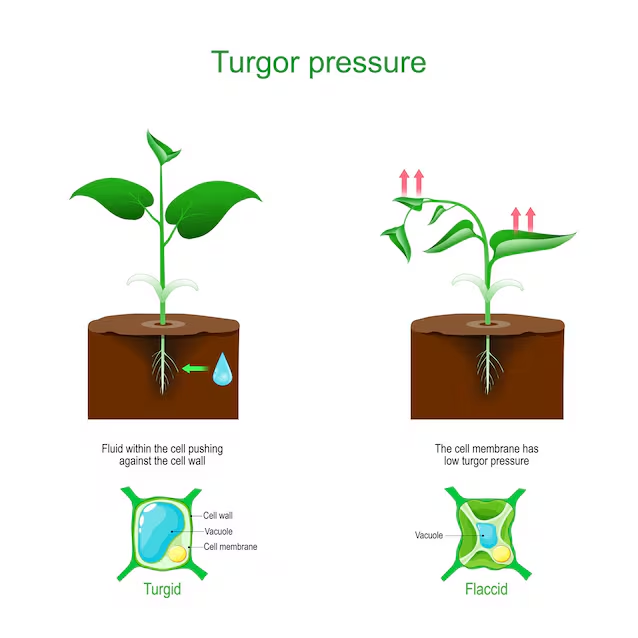
Plant tissues, such as leaves or stems, stand up thanks to the turgidity, the pressure of the water that presses against the rigid walls of the plant cells and makes them stand upright. This pressure depends on a continuous balance: the roots absorb water from the soil, while the leaves constantly lose it through small openings called stomatain a process called perspiration. When this pressure disappears, the cells “deflate” like a balloon and consequently the entire plant collapses.
The most typical case is forgetting to water our plant, who knows why it is often a basil plant, and therefore finding ourselves with soil that is actually dry from which the roots cannot absorb water. Here: in this case, run and give your plant a drink. How to notice it? Enough stick a finger into the ground more or less up to the second knuckle and if it is completely dry, you have to water.
If the soil is moist, wilting can be a defense
The rate of transpiration is highly dependent on environmental conditions: excessive heat, wind, low humidity cause the plant to lose more water, even if the soil is well hydrated. This happens simply because transpiration is faster than absorption by the roots, but the good news is that it is a temporary phenomenon! With the cool of the evening, the balance is restored and the plant recovers.
A curiosity, also shared by the Encyclopedia Britannica, is that withering can also be a defensive strategy. During hot summer days, folded and withered leaves expose less surface area to the air, reducing water lossand then “cheer up” when temperatures drop during the evening hours.
In both cases, if we stuck our finger into the soil, we would find a moist soil: there is nothing to worry about. In case the withering should persist even in the eveningthen it could be a real water shortage.
Too much water and withered plants: the paradox
In too wet soil, the water saturates the pores of the roots so they can no longer absorb oxygen. Without oxygen, the roots stop functioning and the entire flow of water to the plant stops. It’s a paradox: the soil drips with water, but it doesn’t reach the leaves.
In this situation, continuing to water the plant leads to water stagnation which can favor the development of pathogenic fungi of the roots, such as those caused by root rot, which aggravate the damage even after the soil has become dry again. In these cases, in addition to remove stagnant watersome nurseries recommend repot the plant, cutting those parts of the roots that show rot. Maybe better if helped by a gardener, if you are not particularly expert.
A short circuit in water transport
The water absorbed by the roots travels to the leaves through the xylema network of interconnected hollow cells, let’s say the plant version of our blood vessels.
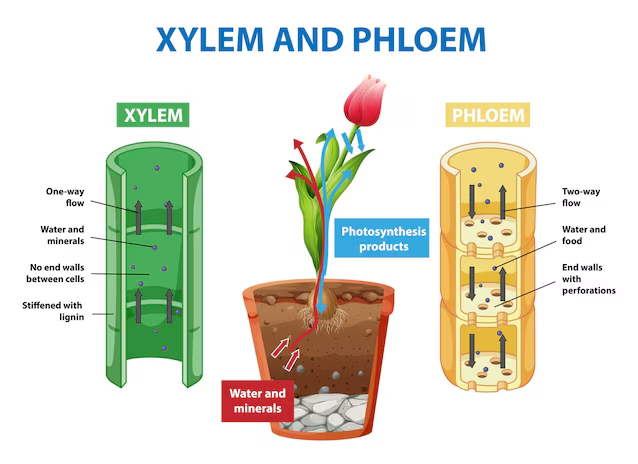
If something there obstructsthe plant withers even with water available in the soil: this is the case of vascular wilting diseasessuch as fusarium, verticilliosis, oak “wilt”, elm graphosis, often caused by fungi, which colonize these ducts and physically clog them. To make the situation worse, the plant itself often takes care of it: to isolate the infection, it produces gummy substances and cellular growths (tills) which further close the vessels (tillosis), blocking the flow in an attempt to limit the damage. A phenomenon that is well known and also treated in international references such as the Encyclopedia of Forest Sciences edited by Burley, Evans and Youngquist. For these diseases there are no specific treatments, the only strategy is prevention and early recognition of bacteria and fungi present in the soil. For verticillosis, for example, techniques such as PCR have been developed which allow the bacterium to be identified even before the symptoms appear, but these are solutions that are still little used.
Also causing agents physical damage to the roots or stem, such as xylophagous insects, larvae that gnaw at the roots, rodents that damage the bark, can interrupt the flow of water.
Too much or too little light
Direct and intense light increases the demand for water in the same way as the heat: more energy to dispose of, more transpiration, and if the roots don’t keep up the plant withers anyway. Excessive exposure can even reach burn the leaves: Heat degrades chlorophyll and leaves light or brown spots on leaves. If your plant is on a terrace bathed in sun from dawn to dusk, and shows signs of wilting, it could be useful move it to a less sunny place.
On the contrary, too little light It weakens the plant’s tissues because with low light energy, photosynthesis slows down and the plant produces less sugar to grow. The result is often etiolation: the plant turns yellow, grows abnormally and the stems and petioles remain thinwith weak walls, sagging more easily for minimal stress. To complicate matters, in the shade the soil dries more slowly, and by continuing to water with the same frequency, without checking the soil, you risk watering too much, creating water stagnation with all the resulting problems. Likewise, if you see your favorite plant wilting in the dark hallway, try move it somewhere else illuminated. Be careful though because not all plants love direct light: some prefer softer lighting.
Nutrient imbalances
If all this doesn’t seem enough, think that the minerals present in the soil also play a role in this delicate water balance. In particular, the potassiumwhich regulates the opening and closing of the stomata: if it is missing, the plant loses control of water lost through perspiration and appears flaccid even with moist soil. In this case, as described by Penn State University, the plant that lacks potassium tends to wilt on sunny, dry days, with a flaccid appearance and the leaves can turn dark green tending to bluish, almost metallic.
In houseplants, wilting from excess fertilizer is more often observed. Too many mineral salts increase the salinity of the soil: the soil becomes too “salty” and it is more difficult for the roots to absorb water to osmosis. In practice, excess salt “holds” water out of the roots instead of letting it in, causing wilting from excess fertilizer.
According to the University of Maryland, the symptoms are similar to other types of wilt: flaccid plant, with reduced growth and yellowing leaves. A particular characteristic to distinguish from other causes is the formation of a white film on the soil, a sign of fertilizer accumulation. The advice, in this case, is obviously to act preventively, using specific fertilizers for our plant in the appropriate quantities and methods of administration. If you are too late, it is possible to “wash” the soil with water alone (in technical jargon, leaching), letting the water drain from the holes in the vase and repeating the operation over and over again using “a volume of water at least equal to the capacity of the vase itself”, again according to the University of Maryland.
Sources:
Petruzzello, M., Why Do Plants Wilt?, Encyclopedia Britannica Wilt, Encyclopedia Britannica Spangenberg, B., Reasons Why Plants Wilt, Wisconsin Horticulture, UW–Madison Division of Extension Wilting Burley, Evans and Youngquist, Encyclopedia of Forest Sciences (2004) Burley, Evans and Youngquist, Vascular wilt diseases, Encyclopedia of Forest Sciences (2004) Garg, A., Bordoloi, S., Ganesan, S.P. et al. A relook into plant wilting: observational evidence based on unsaturated soil–plant-photosynthesis interaction. Sci Rep (2020). Czyż, Ewa & Dexter, Anthony. (2012). Plant wilting can be caused either by the plant or by the soil. SoilResearch. Troubleshooting Common Problems: Houseplant How-To, South Dakota State University Extension Diagnosing Houseplant Problems from Improper Environmental Conditions, Iowa State University Extension, Yard and Garden Leigh, RA and Wyn Jones, RG (1984), A hypothesis relating critical potassium concentrations for growth to the distribution and functions of this ion in the plant cell. New Phytologist Hydroponic Growth Systems and Plant Nutrient Deficiency, Western Michigan University Attia H, Rebah F, Ouhibi C, et al. Effect of Potassium Deficiency on Physiological Responses and Anatomical Structure of Basil, Ocimum basilicum L. Biology (Basel). 2022;11(11):1557. Published 2022 Duressa D, Rauscher G, Koike ST, et al. A real-time PCR assay for detection and quantification of Verticillium dahliae in spinach seed. Phytopathology. 2012 Penn State University University of Maryland
