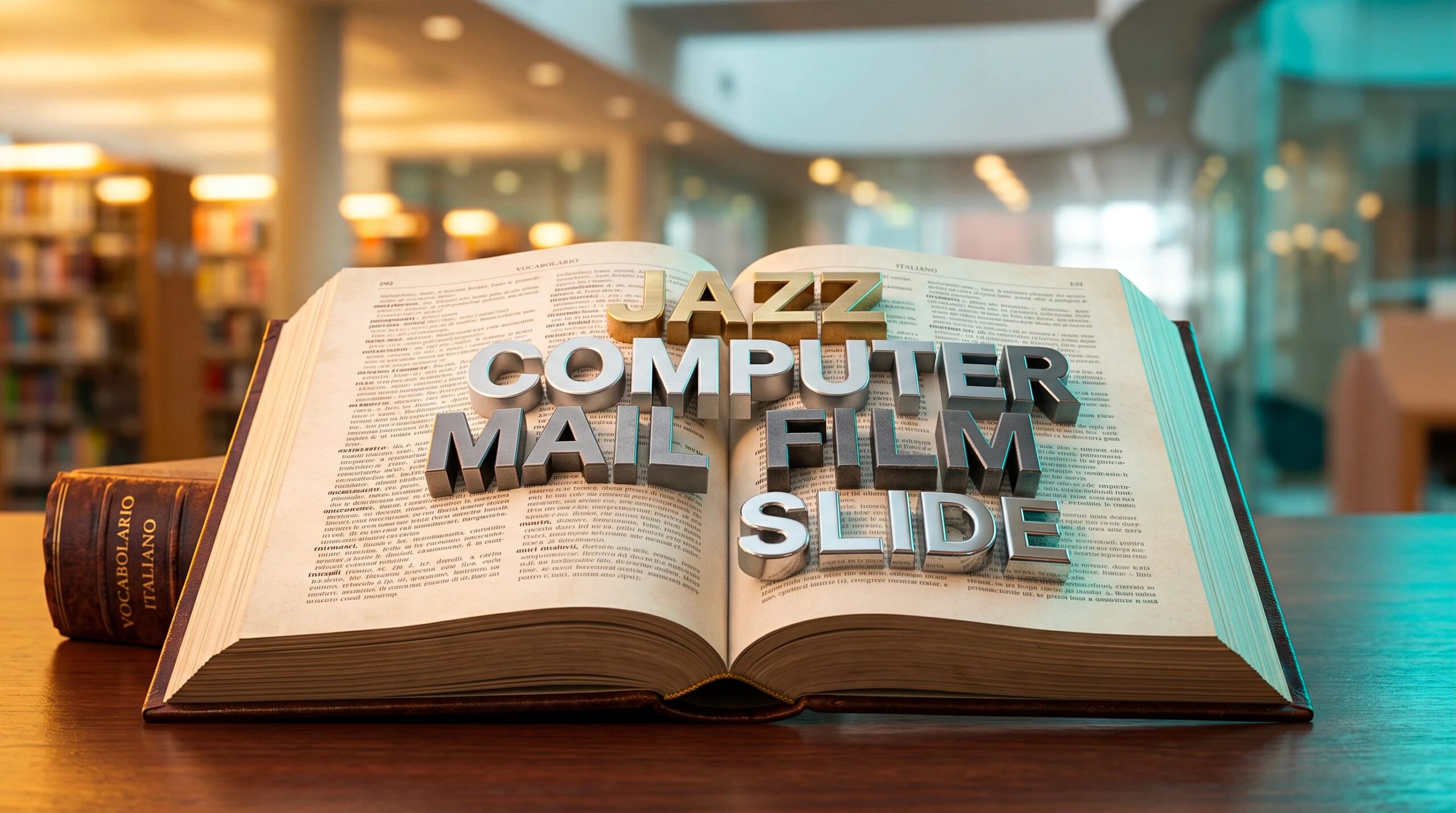
Every time we adopt a word from a foreign language, it must surpass a linguistic frontier before it can be admitted into our linguistic system. To become part of the Italian vocabulary, it needs to respect certain grammatical rulesamong which one of the most rigid stands out: the one according to which every name must belong to the masculine or feminine grammatical gender category.
The dilemma about where to place them arises above all from nouns taken from Englishthe language from which we take most of ours foreignismsamong other things, and which this article will cover in greater detail. English, in fact, does not indicate the grammatical gender of nouns, especially when it comes to inanimate objects, except for some exceptions (such as ship“ship”, which for the English is feminine). How, then, does our brain decide whether a new word will be “the” or “the”?
While there are no absolute universal rules for this interesting phenomenon, linguists have identified a few extraordinarily precise mechanisms with which our mind solves this enigma. Let’s find out how.
The rules of assignment to male or female: email, computer and others
The basic rule in Italian is that the male is considered the “unmarked” genderthat is, the basic genre to which our brain automatically assigns the new term if there is no other more specific rule that can be applied. Furthermore, there is one phonetic rule for which we tend to assign this genus to words that end in a consonant. That’s why it’s called the movieThe barThe computerThe jazz or it sport; although this is the basic phonological rule, it is very often replaced for deeper logics related to the meaning and other suffixes of the word.
When the minds of Italian speakers approach a foreign word, they immediately try to anchor it to concepts they already know and do so following two main paths. The first is theassociation to the translator (the Italian term “relative”), while the second is that of thehyperonym (the broader class to which the new term belongs).
According to the first rule of association, our brain searches for the closest Italian translation and simply no follows the genre. This is why we say the band (because you think of “the gang”) or the cover musical (very close to “the song”). A clear example is the slideswhich is feminine by direct association with the Italian word “diapositiva” and which is sometimes preferred to our Italian counterpart.
The other way of gender assignment of loans is that of the hyperonym as mentioned above. In linguistics, the hypernym is a word with a broader meaning which contains others; e.g. “animal” is the hyperonym of “dog”, while “tree” is the hyperonym of “cherry tree”, and so on, applicable to many groups of words; it is essentially a larger container into which the logically closest terms are inserted. When we import a word from another language, we often assign it its gender conceptual container basic.
A widespread example is that of carswhere in Italian “machine” and “car” exist as feminine gender terms. As a result, almost all types of cars imported from English automatically become feminine; we will say, like this, the spiderthe city carthe station wagonthe convertibleetc. To point out the precision of these semantic associations, just think of the opposite gender with the term SUVs. In Italian the SUV is masculine, and not the SUV, since it is the acronym of “Sports Utility Vehicle“, which our brain immediately connects to the Italian term “vehicle”, also masculine.
Cognitive linguists point out that this gender borrowing occurs in the so-called basic levelwhich is nothing but one psychological ploy by which our mind labels and recognizes objects around us in the real world, used for save precious mental energy. Our brain does not carry out an abstract logical analysis and does not get lost in the details but simply takes the gender of the most common and middle-of-the-road Italian word (such as machine) that describes that object, not the too generic one (such as vehicle) unless it is strictly necessary.
The dress makes the monk: the appearance of a word categorizes the gender
The appearance of a word certainly helps categorize the gender of a loanword. If a foreign word has an ending that reminds us of a familiar sound or shape, we assign it the appropriate gender accordingly. There are a set of rules that help you associate these terms more easily at a basic level.
- Shared suffixes: many English words ending in –ity–reeds or –tion they automatically remind us of our suffixes -ità, -anza and -zione, which are strictly feminine and the English had in turn acquired them directly from Latin or French centuries ago. This is why we have no doubts in using the feminine for words like la locationthe escalationthe fiction or the performance. Similarly, suffixes indicating abstract qualities how –ship (e.g. the leadershipthe partnerships) become feminine, while words that end in –ment (e.g. the management, the understatement or the establishment) or –eng (e.g. the marketingThe meetingThe feelingThe fixings or the dribbling) are perceived as similar to the masculine.
- False friends: many foreign words that by chance end in -a are often treated as feminine in Italian because of this vowel, even if they were masculine in the original language. Examples are Spanish or Portuguese loans such as samba or the tequila.
- Compound words: in compound words made up of multiple elements, the gender is decided there head of the compound. In English words, the key element is usually at the end, so we say the slot machines because the head is machine (machine), or the panic room or the Situation Room because the word room recalls the feminine “the room”.
Ambigender terms
At this point it is also necessary to clarify the existence of “ambigenere” loans, that is to say that they do not primarily fall into one or the other grammatical category but both are accepted; they are not to be confused with native Italian terms (often ending in -And) that identify an individual, e.g.: granddaughter, journalist, kind, bold, etc.
An emblematic example is the term fonta dilemma born of old typography and modern computing. Most of us would say “the font” in the masculine because our brain often applies the translating rule by looking for the Italian word with the closest meaning, and in the IT field we tend to mentally translate “font” with “typeface”, thus transferring this gender to the loan English word. If instead we were to enter a classic typography, the professionals in the sector would use the feminine, saying “the font” due to a phenomenon linked to phonetic assonance and etymology. In fact, the English word sounds similar to the French term (there) sourcewhich historically indicated the “casting” of lead alloy characters, and therefore an Italian typographer would associate the noun with the French feminine.
Another case is “e-mail“. Initially it was called the mail, because it was mentally associated with the translation “message” but over time, however, the association with “mail (electronic)” took over, pushing the word towards the feminine, the mail, which today is the most widespread form. The same happens today also for formwhich fluctuates because some think of the masculine “module”, while others think of the feminine “card”; or even Internet which technically should be masculine due to the default rule mentioned at the beginning of the article, but is very often used in the feminine because our mind perceives the word net and think about “the network”.
Some examples of common loans
Many loanwords are now integrated so well into ours daily vocabulary that they are used so frequently that we are no longer able to see them as words of foreign origin and it is almost strange to think of them as “foreign” terms. And it’s not just English that constantly enriches our language, despite it being the most productive and widespread!
Some masculine borrowings include, for example, computer, movie, bar, sport, jazz, weekend (or weekend), chewing gum, kebab, blog, forum, posts, network, sponsor And monitors, wok, gingeng, karate, sushi, karaoke, tsar, favela, hammam, falafel. Many ending in a consonant enter the category of masculine due to the basic phonological rule.
Among the female ones we find the aforementioned car brands such as Spiders, Citycar, Station wagon. But also email / e-mail, chat, band, cover, slides, samba, tequila, paella, community, social, web, star, hits, fiction, manicure, brochures, star... Terms of this type are among the most productive and widespread that enter the feminine gender category.
Finally, some terms do not clearly belong to one category or the other. Among these in addition to those already mentioned font, Internet And form (often perceived as “form” or “card”) also exist Graphic Novel (“graphic novel” versus “novel” or “comic story”), showroom (in the masculine because it is associated with “salon”, but the word “room” pushes many to think of “room”), emoji (the basic masculine applies, but the feminine is very strong because of “smiley” or “emoticons“, also feminine) or finally flute (the sparkling wine glass which in the language of origin is a feminine noun). And these are just a few examples.
In this sense, the case of is interesting cameraman And barman to underline how much the language evolves with the society in which it lives. In English the suffix –man clearly indicates man, so historically the name of these professions originated as masculine terms because they were born in an era in which the activity was carried out mainly by men. Today, however, in a different society, many women carry out this job, creating quite a few misunderstandings. This generates a curious oscillation among the writers, where the editors sometimes keep the generic masculine, but other times, to identify a female figure, indicate the grammar creating hybrid phrases like “the cameraman” or “the barman”.
To conclude, assigning gender to loanwords is not a random mess, but a very fascinating logical operation by which our brain acts like a simultaneous translator, thinking about morphology (form), phonetics, meaning and even culture to find the most suitable Italian adaptation for each new word that is accepted.
