The ability to speak seems one of the most natural and obvious characteristics ofhuman beingwhich develops from childhood, when we learn to combine sounds into words, until we build complex sentences and thoughts, thanks to a unique combination of vocal anatomy and brain architecture, combined with the need to cooperate and communicate. The origin of human language, according to scientific studies, lies in the network of complex structures present in our brain (such as Broca’s and Wernicke’s areas), which interacts with systems linked to the ability to process and associate symbols, allowing us to create complex linguistic structures. If you look at the origins of language and the rest of the animal worldone quickly realizes that only humans have developed a linguistic communication system with a level of productivity and complexity equal to what we know like the one we know, due to the history of our evolution, but animals are also capable of communicating, from the dance of bees to the alarms of birds up to the complex communications between cetaceans. Let’s see how.
Communication in animals and humans
Some animals communicate uniquely to their species (i.e. in a species-specific manner), such as dogs, whales, bees, and monkeys, while many other species emit sounds and signals or carry out behaviors that transmit information so complex that it seems like science fiction to us. None of these forms, however, however extraordinary, reaches the complexity and flexibility of human language. The question then is: why are we the only ones “talking”?
First of all we need to clarify what we mean by “speakIn scientific and cognitive language, speaking does not simply mean emitting sounds or signals, but use a symbolic system articulated, arbitrary and combinatorial to transmit potentially infinite messages starting from a finite number of elements.
This system includes three fundamental components:
- The phonemes they are the basic sounds we emit, to simplify vowels and consonants;
- The semantics it is the field of meaning, what we mean by words and sentences;
- The syntax includes the rules for combining minimal elements (sounds into words, words into sentences and sentences into sentences).
Mastering these structures allows human beings – starting from a very limited number of basic elements – to generate new sentences and express abstract concepts, talk about the past or imagine the future. No other known animal species has such a layered communication system with all these characteristics.
The origin of human language and evolutionary causes
Human language was probably born between 160,000 and 200,000 years ago, coinciding with the appearance of theHomo sapiens. The reason humans developed the ability to “speak” has to do with a complex interaction of biological, anatomical and social evolution. From an anatomical point of view, ours vocal apparatus it is profoundly specialized: the shape of the larynx, the oral cavity, the tongue and the facial muscles allow a decidedly wider range of sounds than that of any other primate. Ours too brain it is unique in this sense, as Dr. Friederici explains in a very recent review published on Physiological Reviews, with a network of specialized and interconnected regions, such asBroca’s area and theWernicke areainvolved in the processing, production and understanding of language. Compared to other primates, this network presents peculiar characteristics for organization and connectivity with other brain areas. The aforementioned areas, in fact, are part of one brain network widerwhich interacts with systems related to memory, planning and the ability to process and combine symbolic information, allowing us to build complex linguistic structures.
Another key element is related to social cognition. We know that humans are extremely social animals, because we depend on each other to survive and to transmit cultural knowledge. Communication has been selected evolutionarily because it favors cooperation, teaching and collective planningessential skills for survival in a brutal world. A community in which individuals can share plans, recount experiences, or coordinate actions has an enormous adaptive advantage over one in which each individual invents solutions alone. Human language is not just momentary vocalization but is a real instrument of cultural transmission which developed collectively.
Communicative differences between humans and other species
If we take into consideration other animal species, we discover that many of them possess sophisticated forms of communication but limited and linked to specific situations.
The beesfor example, perform the famous dance to indicate the location of food, but this form of communication does not have an open repertoire of symbolic combinations.
The whales hey dolphins they emit complex sequences of sounds, but it is not clear whether these constitute a language with syntax and semantics comparable to human ones.
The chimpanzee and other primates can learn arbitrary symbols and even a rudimentary form of artificial grammar, but the complexity and productivity of human language far exceeds those forms of communication.
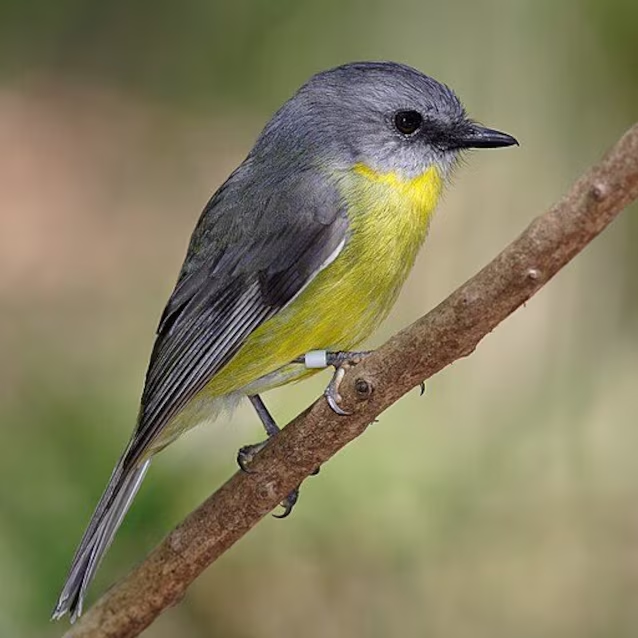
Finally, in recent years it has been discovered that some species of birdslike the Japanese tit (Parus minor), during vocalizations, they use sound combination rules with characteristics similar to our grammar and syntax to convey specific meanings, combining and rearranging different sounds based on what they want to convey.
The differences between humans and other species
Another interesting element concerns the plasticity of human language. Each individual acquires their native language simply through exposure to the language and social interaction during childhood, without the need for explicit teaching, as confirmed by a 2020 review published in Science of Learning, a portfolio magazine Nature. This ability to learn complex systems of symbols and rules from social context is rare in the animal world and reflects a cognitive architecture unique to the human brain, which led to communicative arbitrariness and the creation of different languages throughout the evolution of our species. Furthermore, languages can differ greatly in the way they categorize and describe certain aspects of reality: it should therefore come as no surprise that there are huge differences between more than 7,000 languages (according to UNESCO data) are spoken around the world today.
The answer to why only we “speak” is not, therefore, linked to a single aspect or a single genetic mutation, but a series of gradual changes which have affected the vocal anatomy, brain structure and social dynamics of human populations over tens of thousands of years. Language is not just a biological masterpiece, but a cultural product, built, consolidated and transmitted from generation to generation. We speak not only because we communicate, but because this complex symbolic system allows us to represent the world, share ideas And collaborate For change reality in which we live.
