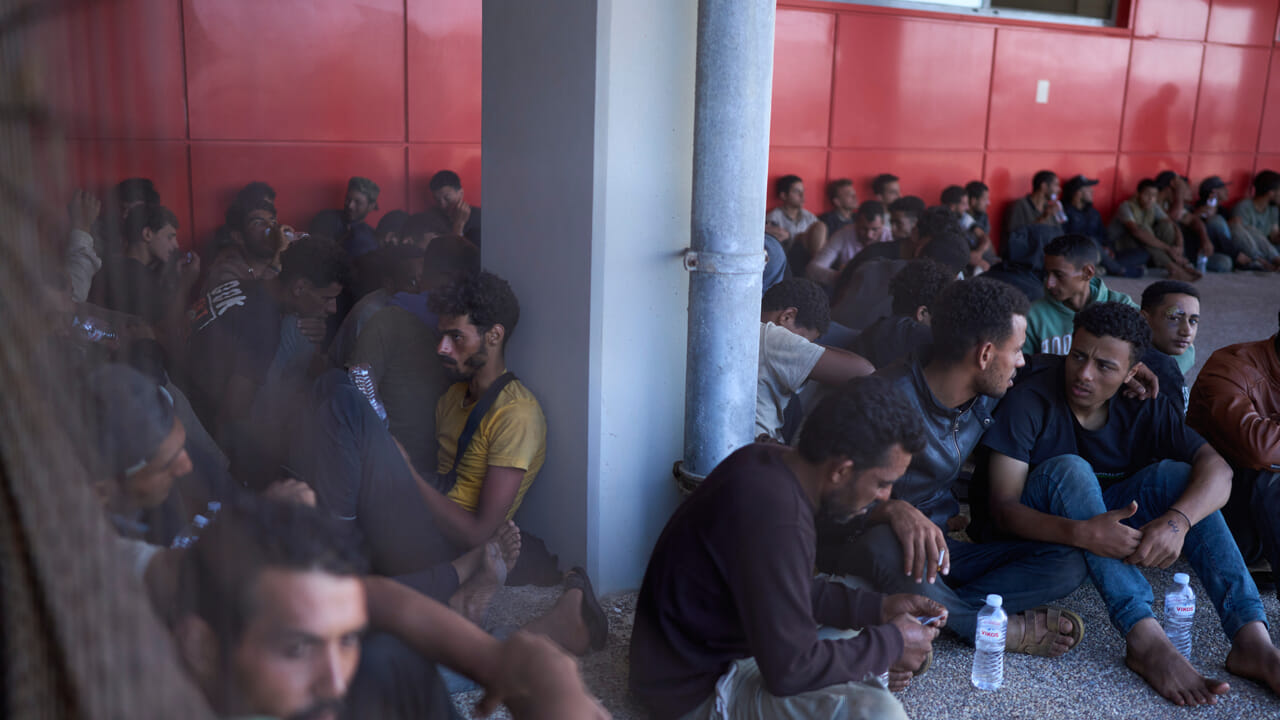
The European Parliament has approved new rules on the right to asylum which will allow member states to expel migrants more easily, also sending them to third countries, even if they do not have a direct link with those nations. This will pave the way for EU governments to establish so-called repatriation centres, following the model put in place by Prime Minister Giorgia Meloni with the pact with Albania.
And it is no coincidence that the new rules on safe countries of origin and safe third countries were approved by the European Parliament in Strasbourg thanks to the “Venezuela majority”, or “Giorgia majority”, which unites the People’s Party, the Conservatives of the Brothers of Italy, the Patriots for Europe of Matteo Salvini’s League and also the Europe of the sovereign nations of the German AfD. The new rules on safe countries of origin were approved with 408 votes in favour, 184 against and 60 abstentions, while the more controversial ones on safe third countries were approved with 396 votes in favour, 226 against and 30 abstentions.
The turning point
It is “a political turning point in the management of migration”, claimed one of the speakers of the text, the Italian Alessandro Ciriani of Fratelli d’Italia, according to whom “the agreement reached puts an end to a period of ambiguity and outlines a clear course: common rules, quicker and more effective procedures, protection of the right to asylum for those who are entitled to it and a firm approach against abuse”.
“With today’s agreement on the concept of safe third countries, we provide another key element for a functioning and credible asylum system. By allowing manifestly unfounded asylum applications to be rejected more quickly and efficiently in the future, we speed up asylum procedures, ease the pressure on Member States’ systems and help people avoid being trapped in legal limbo for years”, claimed the rapporteur for the rules on safe third countries, the German MEP Lena Düpont.
The Pact on Migration and Asylum
The vote on the EU list of safe countries of origin arises from the path of the European Pact on migration and asylum, agreed by Parliament and the Council in December 2023 and translated into five regulations in 2024. Among these, the one on asylum procedures already introduced the concepts of safe country, but without a common European list, leaving member states with different and less than uniform approaches.
With two parallel political agreements, the European Parliament and the EU Council have updated the rules to speed up the examination of asylum applications considered to be at low risk of acceptance and to broaden the cases in which a request can be declared inadmissible because the applicant could have obtained protection in a non-EU country considered safe, or because he comes from a safe country.
Safe countries of origin
For the first time the European Union will have a common list of countries of origin considered safe. This means that asylum applications submitted by citizens from Bangladesh, Colombia, Egypt, India, Kosovo, Morocco and Tunisia (the first on this list) will be processed with accelerated procedures.
The underlying principle is that these countries generally offer sufficient protection against persecution and serious violations of fundamental rights. Consequently, it will be up to the applicant to demonstrate that this presumption does not apply in his specific case. Member States will also be able to carry out the examination at the border or in transit zones, reducing the overall time of the procedure.
The list is not immutable and may be expanded in the future through the normal European legislative procedure.
The EU candidate countries and the safeguard clauses
In addition to the initial list, the candidate countries for membership of the Union will also in principle be considered safe. We are therefore talking about Albania, Bosnia-Herzegovina, Georgia, Moldova, Montenegro, North Macedonia, Serbia and Turkey, but also Ukraine, whose citizens however benefit from temporary protection status due to the Russian invasion. This presumption of security may fall in the presence of specific situations, such as internal or international armed conflicts, European sanctions linked to violations of fundamental rights or an asylum recognition rate above 20 percent at EU level.
The European Commission will constantly monitor developments in the countries included and may suspend, even temporarily, their safety qualification. In the event of problems limited to certain areas or categories of people, the suspension may only concern a part of the territory or clearly identifiable groups. Member States will also maintain the possibility of having national lists of safe countries, as long as they do not include those suspended at European level.
The concept of a safe third country
At the same time, Parliament and the Council have updated the rules on the so-called “safe third country”, i.e. a non-EU state in which an asylum seeker could have requested and obtained protection before arriving in Europe, and to which he can therefore be sent back.
With the new rules, a Member State will be able to declare an application inadmissible when at least one of three situations occurs: there is a link between the applicant and the third country, such as the presence of family members, previous stays or linguistic and cultural affinities; the migrant passed through that country before entering the EU and could have asked for protection there; or there is an agreement or understanding, bilateral, multilateral or at EU level, which provides for the examination of asylum applications in that State.
The main innovation is that, compared to the past, the requirement of personal connection will no longer always be indispensable, effectively expanding the cases in which the concept can be applied. In theory, therefore, migrants could be sent to Albania or Tunisia even if they have never transited there, if a bilateral agreement allows it.
Protections for minors
A central element of the new rules is the possibility for EU states to conclude agreements with safe third countries for the transfer of asylum seekers and the examination of their applications outside the Union. These agreements will have to be notified to the Commission and other Member States before they enter into force and the European Parliament will have to be informed when dealing with agreements at EU level. Unaccompanied minors are excluded from the application of the safe third country concept.
More difficult appeals
Another relevant change concerns appeals against inadmissibility decisions based on the safe third country. In future, simply lodging an appeal will not automatically guarantee the right to remain on the territory of the Member State while the appeal is being examined. However, there will remain the possibility of asking a judge to suspend repatriation on a case-by-case basis. The same acceleration logic also inspires the use of rapid procedures for applicants from countries with asylum recognition rates lower than 20 percent.
What does “safe third country” mean?
When we talk about a safe third country, the starting point is the principle according to which no one can be sent back to a country where they risk persecution, torture or inhuman treatment, not even indirectly through chains of repatriations. For this reason, it is not enough for a State to be “generally safe”: it must be so in each specific case.
According to the European regulation on asylum procedures, a country can only be considered safe if it guarantees protection against persecution and serious violations of fundamental rights, offers a real possibility of requesting asylum and obtaining it if the requirements are met and allows the transferred people to remain legally in the territory.
It must also ensure minimum living conditions, such as access to food, shelter, healthcare, education and work, as well as stable protection until a lasting solution is reached. An important innovation is that it is not necessary for the country to have formally ratified the Geneva Convention on refugees: what matters is that, in fact, it offers equivalent protection and a functioning asylum system, at least according to the assessment of the EU or the State that stipulates the agreement.
Who determines whether a state is safe
The European Union can create a common list of safe third countries to make decisions more uniform and avoid secondary movements of asylum seekers. At the same time, each state retains the right to have its own national list or to apply the concept on a case-by-case basis. The limit is triggered if the EU suspends or removes a country from the common list: in that case the states cannot continue to consider it safe at a national level. If, however, the suspension occurs through an ordinary European law, states can reinstate it only if the Commission does not object.
How Member States are behaving today
In practice, the use of the safe third country concept remains fragmented. Only some states have true national lists. In the Italian one, for example, 19 countries appear: Albania, Algeria, Bangladesh, Bosnia-Herzegovina, Cape Verde, Ivory Coast, Egypt, Gambia, Georgia, Ghana, Kosovo, North Macedonia, Morocco, Montenegro, Peru, Senegal, Serbia, Sri Lanka and Tunisia.
Many states considered potentially safe, however, do not have solid asylum systems, do not always respect human rights and do not easily accept the return of migrants from the EU. The case of Türkiye remains emblematic, with European sentences that have documented pushbacks towards Syria and serious violations of fundamental rights.
