
It may not be an existential question about the origin of life and the universe, but we have all asked it at least once in our lives: why does poop smell? The answer lies in volatile molecules (VOC) which form when bacteria break down carbohydrates, proteins and fats in the colon. One out of many, yes box itdespite being present in small concentrations, is responsible for that typical smell of feces and which, strange to say, in low concentrations is even used as ingredient for perfumes (in fact it is present in jasmine essential oil). In reality, however, the stench of feces is the result of a delicate agreement between an orchestra of molecules, rather than the performance of a single musician: Short Chain Fatty Acids (SCFA), and sulfur compoundsthe main culprits of the smell of feces, together with scatòl, according to a 1987 study by Moore. In addition to being a curiosity, knowing what is in our feces is proving to be very useful on a diagnostic level, especially for gastrointestinal pathologies.
The causes of smelly stools: scientific studies
Human feces are nothing more than the final product of a huge chemical laboratory: the intestinal microbiota. Most of the volatile compounds that we perceive as “stink” originate, in fact, from bacterial fermentation of carbohydrates, proteins and amino acids that we have not digested in the main sections of the intestine and which are definitively “destroyed” in the colon.
The reference work in this field is that of Garner and colleagues, published in The FASEB Journal in 2007. The researchers analyzed the feces of 30 healthy donors using head space(specifically solid phase microextraction, SPME), which allow you to “capture” the volatile compounds present in the air just above the sample, without the need to touch it directly. Thanks to gas chromatographyan instrument that separates the different molecules of a sample one by one (a sort of chemical sieve) have identified well 297 different volatile compoundsbelonging to three main families:
- short chain fatty acids (SCFA): in particular acetic, butanoic and pentanoic acid. They are the most abundant compounds in feces and arise from bacterial fermentation of undigested carbohydrates (particularly dietary fiber) by bacteria such as Bacteroides.
- sulfur compounds: methanethiol, dimethyldisulfide, dimethyltrisulfide and hydrogen sulfide, which derive mainly from the metabolism of methionine by clostridia such as Clostridium sporogenes. Hydrogen sulfide also has a similar origin, generated by sulfate-reducing bacteria from sulfur compounds in the diet. So be careful if you eat eggs, garlic, onion and other foods that contain sulfur: your poop will be very rich in these sulfur compounds and will have a smell particularly similar to that of rotten eggs.
- nitrogen compounds: especially indole and skatòl (3-methylindole), are the products of bacterial fermentation of tryptophanan amino acid that our intestine is unable to absorb completely and which when it reaches the colon is “broken down” into these two smelly compounds. Fun Fact: They are also present in some flowers, such as jasmine.
However, the head space techniques used leave out some important odorous poop molecules: putrescine And cadaverineproduced by bacteria such as Escherichia coli, are not well suited to this technique. Subsequent studies, including one published in the journal Nutrientshowever, they allowed us to measure them and include them in the orchestra of stinky compounds in feces.
A question of olfactory threshold, not quantity
The first study to focus on the typical smell of poop and the compounds that determine it was that of Moore, Jessop and Osborne in 1987 published in Gastroenterology. The researchers specifically isolated odorous molecules from feces and concluded that the real protagonists of fecal odor are gods methyl sulfides (methanethiol, dimethyldisulfide and dimethyltrisulfide) respectively described by the same authors as having a “rotten cabbage”, “pungent-sulphurous” and “repugnant and nauseating” smell.
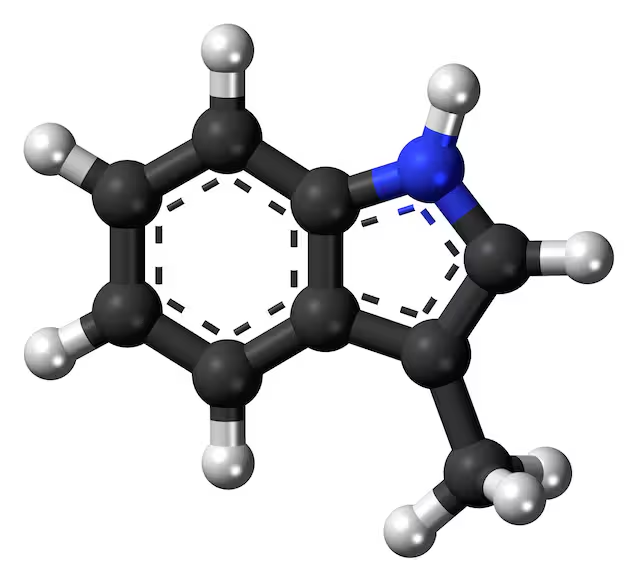
But then why do we read everywhere that the cat is responsible for the smell of feces? The same study by Moore demonstrated that skatol and indole, in their pure state, actually produce an odor that is more reminiscent of naphthalene some mothballs that poop. The point is that concentration and odor perception are two different things. It is true that skatol is present in lower concentrations, both compared to SCFAs and sulfur compounds, but it has a olfactory threshold (the minimum concentration necessary for the human nose to be able to perceive it) much lower: in a 2023 study its olfactory threshold in air emissions is reported to be equal at 0.00309 mg/m³.
In addition to skatolo, there are also sulfur compounds perceivable already in infinitesimal traceswhile short-chain fatty acids have relatively high olfactory thresholds and therefore contribute less to the malodorous symphony of feces.
Tell me how your poop smells and I’ll tell you how you are: VOCs
All this is not just a curiosity to rattle off to friends (possibly not at dinner), but can prove very useful for diagnosing various pathological states. Garner and colleagues also compared the VOC profile of healthy donors with that of patients suffering from ulcerative colitisinfection by Campylobacter jejuni and from Clostridium difficilefinding patterns of molecules that are clearly different from one group to another, to the point of being able to differentiate the three pathologies with a predictive accuracy of 94.9%. Still on the gastrointestinal health front, another study, published on Frontiers in Medicineinstead tested the use of a rapid and economical technique (ion mobility spectrometry) to distinguish patients with irritable bowel syndrome from healthy subjects, obtaining a good ability to distinguish between the two cases and even managing to differentiate the subtypes of the syndrome.
More recent studies have extended this approach well beyond gastrointestinal diseases, suggesting that some compounds may be taken as biomarkers (in simple terms, as indicators) for the onset and progression of Alzheimer’s. A work published on International Journal of Molecular Sciences analyzed fecal VOCs from patients with Alzheimer’s disease at different cognitive stages, finding that patients presented quantities higher than acids and esterswhile healthy subjects showed more terpenes, sulfur compounds and aldehydes. In particular, it seems that SCFAs increase in the early stages of the disease, in parallel with specific bacterial genera such as Faecalibacterium And Lachnoclostridium. In short, our feces could be both a photograph of our intestinal health, but even a real crystal ball to investigate our state of health at 360°.
Sources:
Garner, C. E., Smith, S., de Lacy Costello, B., White, P., Spencer, R., Probert, C. S. J., & Ratcliffe, N. M. (2007). Volatile organic compounds from feces and their potential for diagnosis of gastrointestinal disease. The FASEB Journal, Moore JG, Jessop LD, Osborne DN. Gas-chromatographic and mass-spectrometric analysis of the odor of human feces. Gastroenterology. 1987 Barreiro-Alonso, E., Castro-Estrada, P., Sánchez, M., Peña-Iglesias, P., Suárez, L., & Cantabrana, B. (2024). Association of polyamine intake, other dietary components, and fecal content of N-acetyl putrescine and cadaverine with patients’ colorectal lesions. Nutrients Ye, J., Fu, Q. Screening of skatole-degrading bacteria and control of human fecal odor by compound bacteria. Ann Microbiol De Schepper, H.U., Van Malderen, K., Hanning, N., Lambrechts, H., Haverhals, T., Van Marcke, S., Ceuleers, H., De Man, J.G., & De Winter, BY (2022). Volatile organic compound profiling as a potential biomarker in irritable bowel syndrome: A feasibility study. Frontiers in Medicine Ubeda, C., Vázquez-Carretero, M.D., Luque-Tirado, A., Ríos-Reina, R., Rubio-Sánchez, R., Franco-Macías, E., García-Miranda, P., Calonge, M.L., & Peral, M.J. (2023). Fecal volatile organic compounds and microbiota associated with the progression of cognitive impairment in Alzheimer’s disease. International Journal of Molecular Sciences
