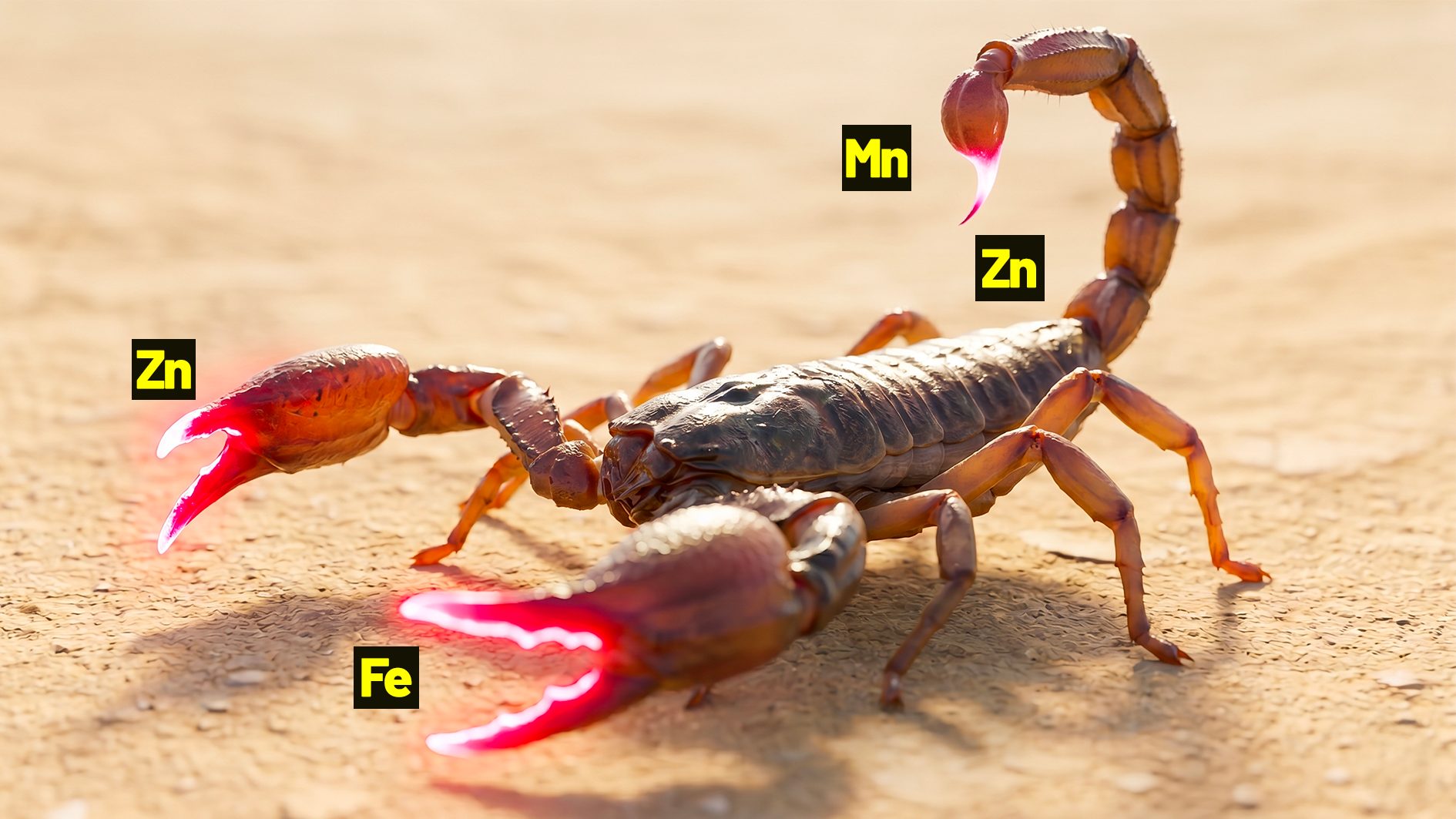
A Scorpio has two weapons: the sting on the “tail” (metasome), with which it injects the poison, and the frontal clawswith which it grabs and crushes prey. Both contain heavy metals such as zinc, manganese And iron incorporated directly into the exoskeleton. This is not an environmental contamination but an evolutionary choice refined over 450 million years. And a study just published on Journal of the Royal Society Interfaceconducted by researchers at the Smithsonian Institution’s National Museum of Natural History and Museum Conservation Institute, led by Sam Campbell of the University of Queensland, has that these metals are not distributed randomly, but follow precise and different patterns for each weapon. Iron is found only in the claws, manganese almost only in the sting, and zinc appears in both but in an inverse proportion. Where there is more in one weapon, there is less in the other. As if every scorpion had a budget of resources to spend, and invested it in the weapon he uses the most.
Why does a scorpion need metals in weapons
THE’exoskeleton of arthropods (insects, spiders, scorpions) is mainly composed of chitina structural sugar. It is a resistant material, but alone it is not enough to withstand the forces involved during scorpion predation. The evolutionary solution was to incorporate metal ions directly into the structure. The result is a harder, more wear-resistant material.
To understand how these metals are distributed, the team analyzed 18 species of scorpions from different families, using high resolution electron microscopy And X-ray fluorescence (µXRF). The results show very precise patterns.
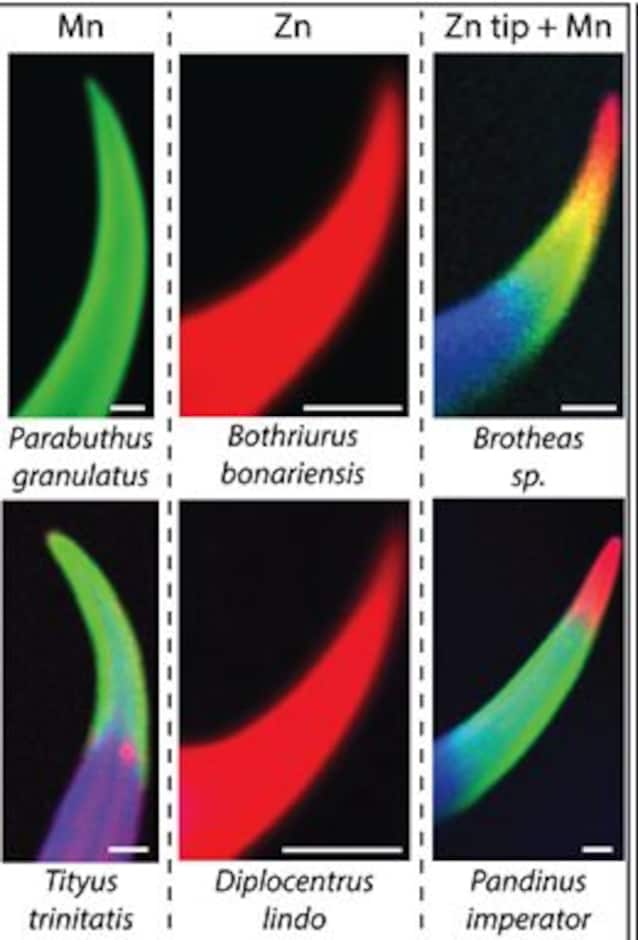
In the sting (telson), lo zinc it is concentrated at the end of the needle structure. Just below this point, the manganese becomes the dominant metal, creating a clear boundary between the two layers. Beyond that transition zone, the metals disappear: the bulb containing the poison is free of it. As study co-author Edward Vicenzi of the Museum Conservation Institute described it, “it looks just like a layered popsicle.”
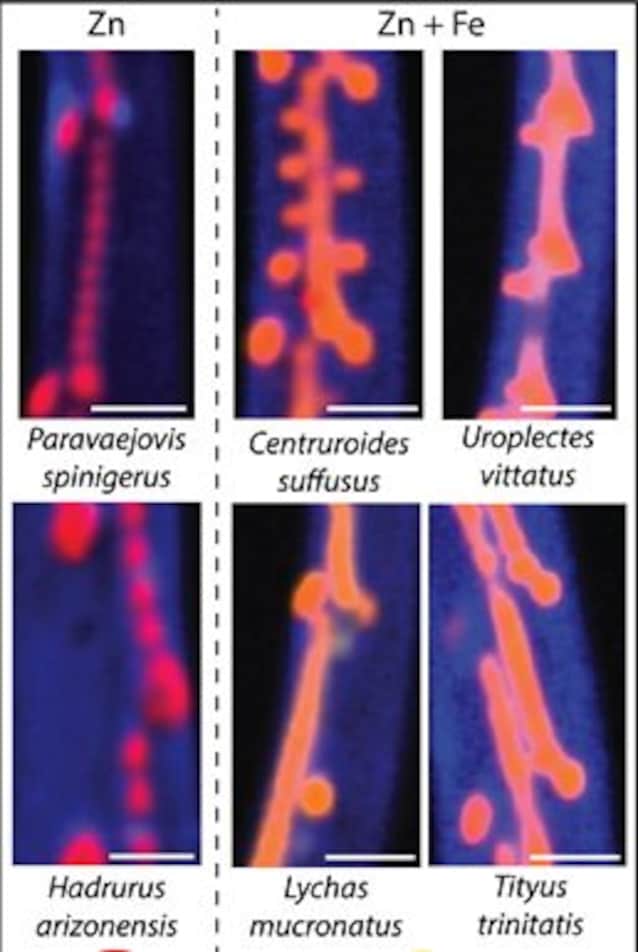
In clawsthe pattern is different: metals appear only along the cutting edge of the pincer, reinforcing the parts that bear the most stress. Here it is zinc it is present in almost all species, often accompanied by the iron in species of the Buthidae family.
The evolutionary meaning
Scorpions that “run over” lots of zinc in the stinger tend to have lower levels of zinc in the clawsand vice versa. Vicenzi explicitly speaks of an “evolutionary compromise” in which one of the two weapons is preferentially reinforced.
Scientific literature has long indicated that scorpions with strong claws they use the stinger less frequently, preferably crush the preywhile those with thin claws they rely almost exclusively on poison. The distribution of metals seems to reflect exactly this hunting strategy.
To make the data more robust, the team mapped the evolutionary relationships between the species analyzed, choosing scorpions from different families (the collection of the National Museum of Natural History includes between 3,000 and 4,000 specimens). The risk was that if multiple species show the same distribution of metals but are all closely related, the result says nothing new. “That was a really innovative aspect of this study,” says co-author Hannah Wood, curator of arachnids at the National Museum of Natural History.
Scorpions are not the only arthropods with “metal weapons” either ants, wasps And centipede have body parts enriched with metals. The methods developed in this study could offer a model for studying them all. Knowing what lies behind their arsenal might make these animals seem more fascinating than scary.
