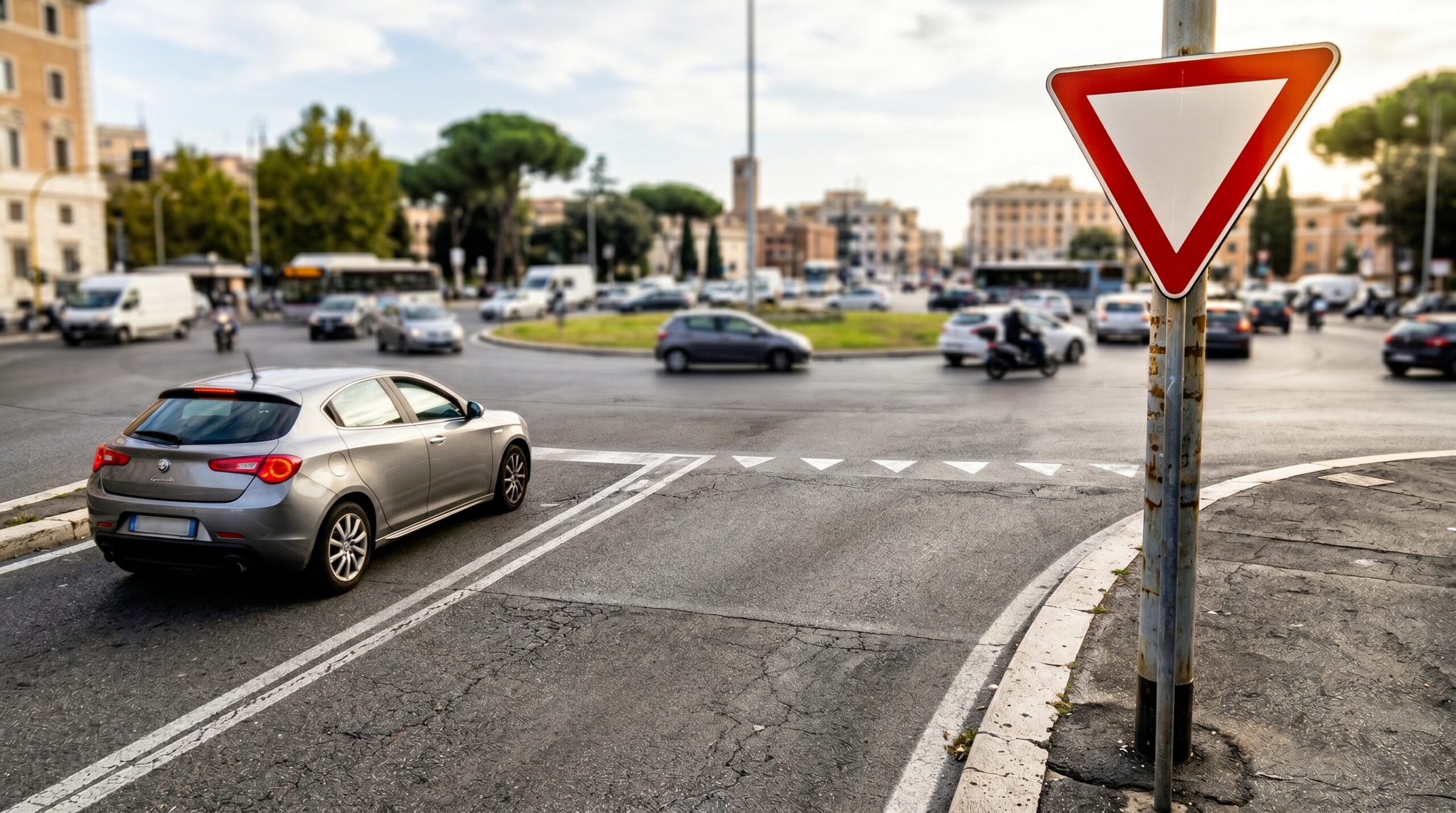
Anyone who drives in Italy knows: roundabouts are one of the more chaotic points of road traffic. There are those who enter without looking, those who don’t know which lane to use and those who systematically forget to use the arrows. But why does this happen? The problem is not (only) linked to the way we drive: the truth is that in the Highway Code There is actually a lack of clear regulation and unique on roundabouts.
Also for this reason, he had to intervene directly in 2017 the Ministry of Transportwhich he provided with Circular no. 6935 more precise indications on how to navigate roundabouts, specifying the behavior to be adopted depending on whether they are roundabouts with one or more lanes and based on the exit location that we intend to take.
The situation, however, is still complex if we consider that they exist in Italy two types of roundaboutsthe “French” ones and the “Italian” ones, for which precedence works in exactly the opposite way.
The regulatory void in the Highway Code on roundabouts
The main cause why many motorists have difficulty navigating roundabouts correctly is to be found first and foremost in the Traffic Laws Italian, which it does not contain a specific discipline on roundabouts. The rules of behavior, therefore, yes they derive indirectly from the general rules relating to intersections.
In particular, we take into consideration thearticle 143 of the Highway Code, which regulates the position of vehicles on the right side of the road, thearticle 144, which concerns circulation in parallel rows, e Article 145which instead imposes the obligation to give the precedence to who it comes from right, unless otherwise indicated.
Precisely this regulatory void is the reason why, for decades, drivers have found themselves navigating roundabouts without having a clear reference on how to behave, which lane to occupy, when and how to activate the arrows (direction indicators) and who to give precedence to.
How to navigate roundabouts according to the 2017 Ministerial Circular
To resolve the problem, the Ministry of Transport had to intervene directly, which in 2017 published Ministerial Circular 6935 “Administrative procedures for obtaining a category B driving licence”, in which for the first time are provided detailed instructions on the behavior to be followed at roundabouts. This document represents fact the most complete official source to refer to to understand how roundabouts are used.
The document starts from a fundamental assumption: the roundabout is still an intersection and exits from the roundabout can therefore be considered as turns. Consequently, when approaching a roundabout, the motorist must moderate his speed and monitor the behavior of other drivers, preparing to give way if necessary.
The circular then distinguishes the behavior to be followed based on the type of roundabout and to maneuver that drivers must do.
Single lane roundabout
In the case of a one-to-one roundabout single lane in each direction, the distance is rather simple:
- The driver must enter the roundabout staying close to the right edge.
- When entering the roundabout, it is not necessary to operate the left turn signal, as it goes immediately activate the right arrow if you intend to take the first release.
- However, if you continue beyond the first exit, you will reach the roundabout without arrow and only the direction indicator is activated right in advance of the chosen exit: in practice, the right arrow must be inserted immediately after passing the last exit before ours.
Roundabout with two or more lanes
With the roundabout with two or more lanes, the travel methods become more complicated. It all depends on where the exit we need to take is located:
- If the exit is on the right sidethe driver is traveling in the right lane. If its output is exactly there before the roundaboutthen you must activate the right arrow before entering the roundabout. If, however, his exit is still on the right side but is not the first, then he inserts the right arrow after entering the roundabout, and in any case before taking the chosen exit arm.
- If the driver must instead continue straighttwo cases open:
- In the absence of traffic, the driver remains in the right lane, activating the right indicator only when approaching his exit.
- In case of heavy trafficHowever, the Ministry establishes that the driver can choose one any free lane to merge intoalways maintaining the same lane while walking around the roundabout. At this point, before exiting, you must move into the right lane in advance, activating the right indicator and making sure not to cut off other vehicles.
- If finally the exit And on the left sidethe driver enters the left lane. On active entry the left direction indicatorcirculate in the left lane of the ring keeping the left arrow active, and before taking the exit activate the right indicator moving to the right lane, always in advance.
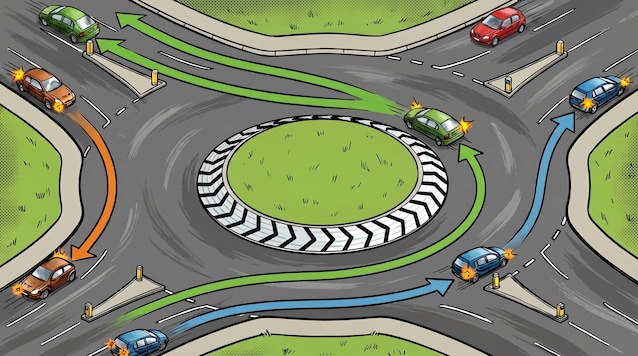
Despite the intervention of the Ministry, the issue has not been completely simplified, especially if we consider that the most complex roundabouts to navigate are also the busiest.
The issue of “French” and “Italian” roundabouts
To make things even more confusing there is another element: the priority rule at entry, depending on whether it is a “French roundabout” or an “Italian roundabout”.
It is once again the 2017 Ministerial Circular that clarifies the topic explicitly, recalling article 145 of the Highway Code: in the absence of the specific warning sign “give precedence” (the inverted triangle present in the photo below, usually placed in correspondence with the entries in the ring), the general rule of precedence to the right.
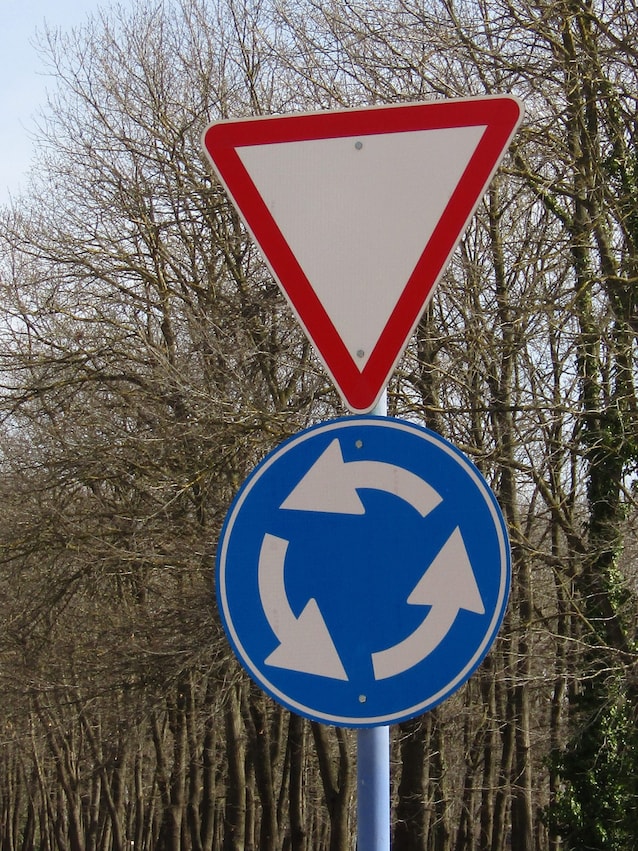
This means that, in the absence of signshas the Whoever enters takes precedence in the roundabout, because it comes from the right compared to the vehicles already circulating in the ring. This is the so-called roundabout “Italian style” (or “with internal precedence”): who he is already inside the roundabout and must stop and give priority to those entering from the right. A system which, in practice, often generates traffic jams and dangerous situations, because it goes against the intuition of most drivers.
There “French” roundabout instead it works the way it does opposite: at the entrance there is the signal to “give way”, which reverses the rule and requires those entering the ring to give way to vehicles already circulating on the ring. There precedencetherefore, it always belongs to those who already exist driving around the roundabout. It’s the model more widespread in Europe and the one adopted in the vast majority of Italian roundabouts, especially the newer ones.
The problem is that in Italy both systems coexist, often in the same city. A motorist may find himself traveling through a French roundabout (with the obligation to give priority to those in the ring) and, a few kilometers later, an Italian roundabout (where priority belongs to those entering the ring). The sign is the only element that distinguishes the two cases and is not always positioned clearly or visibly.
The result, therefore, is a vicious circle: the Highway Code does not regulate roundabouts specifically, the Ministerial Circular provides detailed but little-known rules, and the coexistence of two opposing priority systems fuels the confusion. If we add to all this the fact that the majority of motorists obtained their license before 2017 (and therefore before the clearer ministerial rules), we easily understand why, even today, navigating roundabouts in Italy remains a problem.
