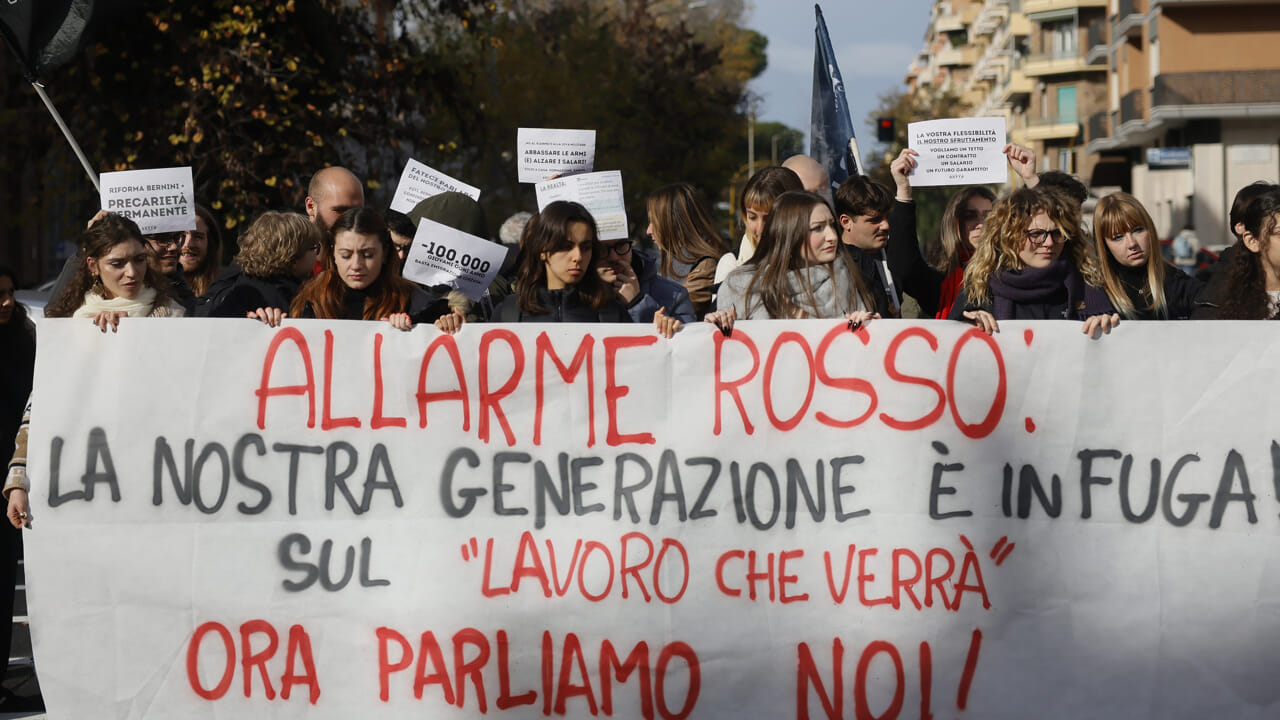
The transformation of the European labor market is no longer a gradual phenomenon, but a structural change accelerated by three major forces: the green transition, digitalisation and the increasingly pervasive presence of artificial intelligence. Processes that are changing entire economic sectors, making some skills obsolete and creating new ones.
This is why, in this context, the retraining of workers is becoming increasingly urgent in European policies, which must accompany millions of citizens through these transitions without generating new social and territorial fractures.
This is where European cohesion policy can come into play with a renewed function: not only reducing regional disparities, but actively supporting the transformation of work in the territories.
“At the end of the day, all jobs are local, we need to support people in their own realities,” he explains Emil Boc, mayor of the Romanian city of Cluj-Napoca and president of the Territorial Cohesion Policy and Budget (Coter) commission of the European Committee of the Regions, the assembly of local and regional representatives of the EU.
Because cohesion can be built by responding to the needs of the territories and offering concrete opportunities close to the place where people live.
Brain drain, an urgent challenge for European cohesion
The geography of work
When analyzing the European labor market, one of the most interesting factors that emerge is the strong local dimension of job search.
In other words, people tend to look for work close to where they live.
“The probability of looking for work outside your area decreases rapidly with distance”, explains Clara Krämer, researcher at the Technical University of Munich, speaking of a phenomenon linked to social, family and cultural factors, as well as economic ones.
Even in a single European market, mobility is not necessarily the main solution sought by workers to deal with major economic and employment transitions. Cohesion policy, in this sense, plays a fundamental role in making the so-called “right to remain” possible.
Investing in local skills, creating opportunities in the territories and supporting regional training systems means reducing the need to move not voluntarily but forcibly to find a job. “If we want to talk about true freedom in Europe, we must also guarantee the freedom to stay”, he confirms Boc. This approach also has political implications.
Territorial inequalities fuel mistrust in institutions and social tensions, while strengthening local opportunities “instead contributes to consolidating the European project”, adds the Romanian mayor and member of the European Committee of the Regions.
What Brussels can do
Cohesion policy fits precisely into this perspective, supporting the creation of quality jobs in the territories and strengthening local training systems. Traditionally, cohesion policy has been oriented towards reducing economic gaps between regions, through investments in infrastructure, innovation and regional development. Today its role is evolving to keep up with the new challenges of the job market.
A central aspect that allows this European policy to remain a cornerstone for responding to new challenges is the territory-based approach. This means that public policies must adapt to the specific characteristics of the regions, and not vice versa, because the effects of major transitions are not the same everywhere.
Some areas are particularly vulnerable to the green transition – just think of the decarbonisation of industries or the transition from energy production from fossil to renewable sources – others, however, are in an advantageous position.
European cohesion serves precisely to rebalance different dynamics between declining industrial areas, rural regions and dynamic urban centres, which in turn require different interventions.
If territorial inequalities do not depend only on physical capital or investments, but also on the distribution of skills, instruments such as the European Social Fund+ and the Just Transition Fund are increasingly used to finance training, retraining and work inclusion programmes.
Cohesion policy thus becomes a bridge between economic development and employment policies. It does not limit itself to supporting growth, but directly intervenes on people’s ability to participate in this growth, connecting job supply and demand at a territorial level.
European competitiveness starts from the territories
From professions to skills
“Knowledge and mastery of artificial intelligence makes workers more versatile and allows multiple functions to be combined in the same role.” Thus Stefaan Gruyaert, project manager at VAIA – Flanders AI Academy, explains how versatility is increasingly becoming a key objective of training policies, because it allows workers to adapt to rapidly changing contexts.
What is underway is a shift from a profession-based to a skills-based approach. While traditional employment policies tended to classify people based on their educational qualifications or work experience, today this model is proving to be too rigid.
Data-driven analyzes show that many professions require similar skills, even when they belong to different sectors. “Instead of looking at qualifications, we need to consider how these skills can be used in other jobs,” Gruyaert warns.
This approach opens up the possibility of more flexible transition paths, “based on what people can do, rather than what they have studied”.
Cohesion policy can support this transformation by funding continuous training systems and learning programs for workers.
The billions that come back: how European funds multiply Italian wealth
Change the model
The most effective experiences demonstrate that redevelopment works better when it involves a plurality of actors in the area. Collaboration between public institutions, businesses and training systems is essential to create coherent paths.
A concrete example of integration between local policies and European objectives is precisely what comes from Cluj-Napoca, the second city by number of inhabitants in Romania. To address the crisis of traditional industry, the city administration has invested in education, innovation and continuous training.
As Mayor Boc says, “we have moved the model from heavy industry to an economy based on knowledge, for example the technical one”. This change was also supported by European funds, which financed educational infrastructure and training programs.
The result is a more dynamic economic ecosystem, capable of retaining talent and attracting new ones. However, despite progress, workforce reskilling still has significant limitations.
Not all regions have the same opportunities, and not all workers can be easily relocated to growth sectors. As researcher Krämer observes, “it is not always efficient to train everyone for green jobs, quite simply because not all regions have the same supply of green jobs”.
In some contexts, therefore, it may be more realistic to focus on alternative sectors or those that respond more specifically to the local context, such as tourism or agriculture. Without forgetting that factors such as wages and working conditions strongly influence individual choices. “It’s not enough that a job is available, it must also be attractive,” warns the researcher.
Also in this sense, the distribution of European funds can be improved, to ensure a closer alignment between needs and resources in the area.
