
In Japan the number 4 it is considered a symbol of bad luck: this depends on its pronunciation, shi, which has the same sound as the word death. Ironically, there is also a strange football “curse” that haunts the Japanese national team: in its history Japan he never managed to go beyond the 4th match in a World Cup, and this evening at 7pm he will challenge the Brazil right in that fateful fourth match. A thrilling coincidence for Japanese fans, because in the country the number 4 it is one of the best-known examples of how a mathematically neutral element can be transformed into a symbol culturally charged with meaning – so much so that many private buildings, but also hotels and hospitals, skip the numbering of the fourth floor.
His association with the bad luck and death it is not the result of an isolated belief, but of a long historical and linguistic process that involves the formation of the written Japanese language, the influence of Chinese cosmology and the very structure of symbolic thought in East Asia. Understand this superstition, a fear called “tetraphobia”, means more generally wondering why Japan still today retains a particularly rich and stratified system of symbolic beliefs, despite the high level of modernization.
What does the number 4 mean in Japan: the genesis of the unlucky symbol
There main root from the superstition linked to the number 4 is linguistics. The character 四 (4) can in fact be read as shiwhich is homophone Of 死 (shi), “death“. This phonetic coincidence constitutes the original nucleus of the association with the symbol of bad luck.
However, reducing the phenomenon to a simple sound similarity would be misleading: what makes superstition socially effective is the process of cultural stabilization of homophony.
In cognitive linguistics, this process can be interpreted as a form of “semantic condensation”: a sound does not just refer to a meaning, but activates a network of emotional and cultural associations. In the Japanese case, the historical repetition of the use of shi in contexts related to death (Buddhist rituals, funerary and formal language related to death) has strengthened the connection between number and mortality.
This association gradually became institutionalized in daily life: the numbering of buildings, hospitals and rooms avoid 4 oftennot because it is imposed by official rules, but to respond to one shared social sensitivity. Superstition, therefore, is not a marginal residue, but a form of knowledge incorporated into the practical systems of society.
The historical spread of tetraphobia from China
There genesis of superstition cannot be understood without considering the process of “cultural sinicization” of Japan. Between the 7th and 12th centuriesin particular, during the Nara (710-794) and Heian (794-1185) periods, Japan imported from China not just the system writing (kanji), but also a complex philosophical and cosmological system. Even in China the pronunciation of the number 4 is almost identical to that of the word “death”.
Within classical Chinese thought, numbers, colors, cardinal points, and seasons were organized according to corresponding patterns such as Wu Xing (Five Elements). In this system, number was never purely quantitative, but part of a symbolic network that connected the cosmos to the social order.
The Japan he assimilated these modelsreworking them into local forms that have maintained the logic of symbolic association.
In this process, the number 4 has acquired one double negative value: on the one hand for his homophony with deathon the other for its clocation within a number system which tended to favor cosmic harmonies and symmetries considered “auspicious”. This historical stratification is fundamental to understanding why superstition is not episodic, but structural.
Because the Land of the Rising Sun has many superstitions: continuity, modernity and symbolic density
The question of number 4 opens up a broader question: because Japan still maintains a high level of symbolic beliefs and superstitions compared to other highly industrialized societies?
The answer is not simple, but can be analyzed through three main factors: cultural continuity, religious structure and mode of integration of modernity.
The first element is the strong historical continuity of symbolic forms. In Japan, the past is not perceived as something completely separate from the present, but as a set of layers that coexist. Beliefs are not necessarily eliminated, but reworked and integrated.
This applies to lo Shintowhich maintains a ritual dimension linked to the presence of the Kami, and for the Buddhismwhich preserves many practices related to death and memory.
The second element concerns the very nature of Japanese religiosityoften described as “non-exclusive” or “syncretic”. Religious practices are not rigidly dogmatic, but overlap at different levels of daily life. This allows the coexistence between technological rationality and symbolic thought without the perception of contradiction.
The third element is the modernity itself. Unlike a model in which modernization involves the removal of traditional beliefs, in the Japanese case modernity often has incorporated pre-existing symbolic elements, adapting them to new contexts.
Avoiding the number 4 in hospitals or hotels is not a “resistance to the modern”, but a form of cultural adaptation to social sensitivity.
From symbol to contemporaneity: between everyday life and global imagination
In contemporary Japanese society the issue 4 continues to be managed in a pragmatic and symbolic way at the same time. Many buildings avoid the fourth floor, some companies change the numbering of their products and in sensitive contexts it is preferred to use linguistic alternatives as yon (another way to pronounce and write the unlucky number) in order to reduce the association with death.
This shows that superstition is not static, but flexible and adaptive. It is part of a cultural system that continues to negotiate between tradition and modernity.
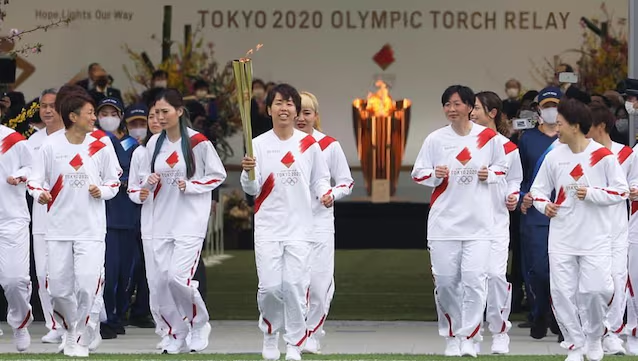
Even in global contexts, like the international sport or media narratives, numbers continue to be interpreted symbolically, as demonstrated by the tendency to read statistical sequences or “numerical barriers” in events like i World Cup or the Olympics.
Ultimately, the case of the number 4 in Japan is not just about a local belief, but illuminates a broader mechanism: the human capacity to transform language and numbers into complex symbolic systemsthrough which to interpret reality, risk and destiny.
Sources
Reader I. (1991). “Religion in Contemporary Japan”
Foster MD (2015). “The Book of Yokai: Mysterious Creatures of Japanese Folklore”
Hendry J. (2012). “Understanding Japanese Society”
Kitagawa J.M. (1990). “On Understanding Japanese Religion”
