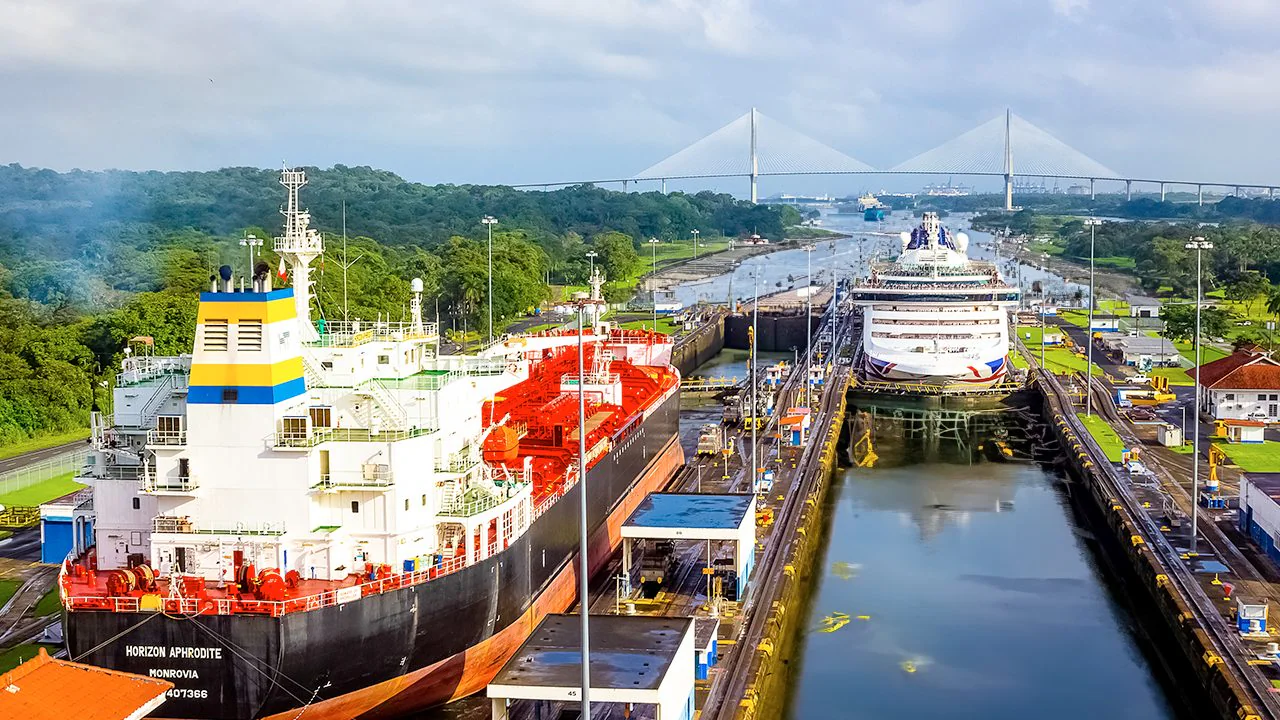
The Panama Canal runs on fresh water: El Niño weakens the humid flows coming from the Caribbean and causes greater drought in the belt, with the risk of blocking ships passing through the Canal and sending global trade into a tailspin.
When we think of a artificial canal which connects two oceans, the Atlantic and the Pacific, we instinctively imagine a gigantic trench filled directly with salty sea water.
In reality, the Panama Canal (about 82 km in length) works in a completely different way: it is a masterpiece of hydraulic engineering powered exclusively fromfresh rainwater. And it is precisely this structural characteristic that makes it extremely vulnerable to climate change and to natural meteorological oscillations, in particular to the phenomenon of El Niño.
According to a recent technical report published by US International Trade Commission (USITC), the intensification of episodes of drought in Central America represents today one of the main threats for the fluidity of global supply chains, transforming tropical weather into a major geopolitical and economic factor.
How does the Panama Canal work and why does it depend on rainfall?
To understand why the lack of rain can block global maritime trafficyou have to look at the geography and engineering of the Isthmus of Panama. The ships that transit between the two oceans do not sail at sea level, but come lift until 26 meters altitude through a system of monumental locks to cross the Gatun Lake (and the nearby Lake Alajuela), two immense artificial basins located inland.
The mechanism works by gravity:
- To fill the lock chambers and get every single ship on board up to lake level, they are used approx 200 million liters of fresh water.
- Once the step is completed, thiswater is discharged into the sea.
- For the system to remain operational, i lakes they must be constantly stocked up by the region’s abundant tropical rainfall.
In normal conditionsPanama enjoys a climate equatorial Very rainy. However, when this water balance is broken, the level of the basins drops rapidly, preventing the largest and heaviest ships (the so-called Neopanamax) from crossing the canal without risking running aground.
How El Niño affects the canal: the Central American “Dry Corridor”.
To trigger the water crises stricter in Panama is often El Niñothe warm phase of the ENSO climate oscillation (El Niño-Southern Oscillation) which consists of the anomalous warming of the surface waters of the central-eastern Pacific Ocean.
From the point of view weatherThis ocean warming alter there atmospheric circulation along the equator, changing the position of the ITCZ (Intertropical Convergence Zone, the intertropical convergence zone where the trade winds meet and the large tropical rains are generated).
During the episodes of El Niñothe ITCZ tends to remain shifted further south than normal and yes weaken wet flows coming from the Caribbean: on the Pacific side, where the mountain ranges of the isthmus already naturally create a drier leeward area known as Central American Dry Corridor (Central American Dry Corridor), thus descending air motions prevail (atmospheric subsidence) which dries out the air column, inevitably inhibiting the formation of storm clouds.
Climatological data show that, during the events of Moderate to strong El Niñothe precipitation on the river basin Panama Canal they can suffer a reduction between 15% and 30% compared to the seasonal average (with even more marked local peaks in the summer months between June and August).
At this rainfall deficit they add up air temperatures superiors of 1-2°C compared to normal, which further accelerate surface evaporation from Lakes Gatún and Alajuela.
When an intense El Niño episode overlaps with the underlying global warming trend, the season from the rains to Panama it gets shorter and becomes insufficient to recharge water basins before the arrival of the dry season (between January and April).
During the last major El Niño event between 2023 and early 2024Panama experienced one of the drier years since the surveys have existed (since 1950).
The level of Lake Gatun has dropped so much that the Panama Canal Authority (ACP) has been forced for months to cut daily steps (from approximately 36-38 ships per day to a minimum of 22-24) and to reduce the maximum draft. There were queues of over 150 ships at anchor and million-dollar auctions (up to 4 million dollars for a single priority passage) to skip the queue.
Traffic restrictions and consequences for world trade
The Panama Canal is a vital artery for the planetary economy: approximately 5% of world maritime trade (and over 40% of container traffic going between East Asia and the US East Coast).
When drought forces the Panama Canal Authority (ACP) to reduce the number of daily transits and to limit the maximum draft allowed to boats, the domino effect on global markets is immediate:
- Load reduction: container ships must travel lighter, leaving part of the goods on land or disembarking them to transport them by rail along the isthmus.
- Bottlenecks and delays: dozens of ships remain stuck at anchor for weeks waiting for a free berth, causing the costs of sea freight and auctions for priority passages to soar.
- Longer and more polluting alternative routes: many shipowners are forced to divert routes by circumnavigating South America (through the Strait of Magellan or Cape Horn) or passing through the Suez Canal, extending delivery times by 10-15 days and increasing CO₂ emissions.
There water crisis of the Panama Canal demonstrates in a plastic way how the stability of global strategic infrastructures no longer depends only on engineering or geopolitics, but also on the stability of local meteorological and climatic balances.
