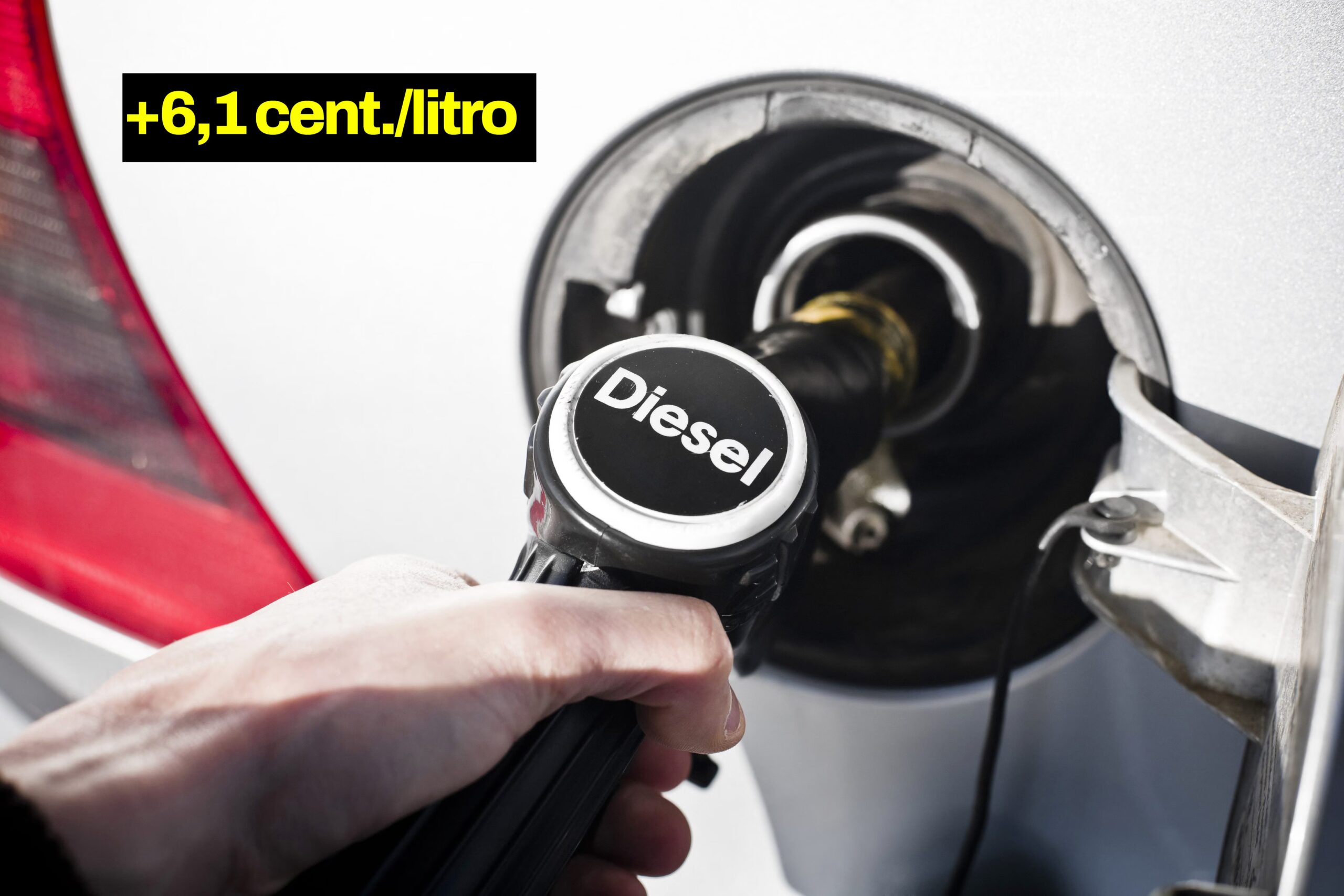
The price of diesel he returned to go out after the government has not extended the discount on excise taxes for diesel: consequently, it is skipped also the price cap of 2.19 euros per liter set by the oil company Eni (followed by others such as IP, Q8 and Tamoil, albeit with different thresholds), which confirmed that the price ceiling was «related to tax relief on the excise duties in force”.
For Italian motorists, i price increases at the petrol pump they were immediate: at Eni distributors the price of diesel rose by 6.1 cents, from 2.19 to 2.25 euros per litrewhile the price of gas remained at 1.99 euros per litre. At a national level, according to the Price Observatory of the Ministry of Business and Made in Italy, along the road network the national average price for the diesel to October 6th is €2,248 per litre. For the gashowever, the national average self-service price is €2,046 per litre.
But why hasn’t the excise duty discount been extended? From October 6, the government should have activated the mobile excise duties on fuelprecisely to replace the fixed discount on excise duties for diesel. The problem is that it was not published in the Official Journal no decree in this regard: excise duties on diesel have therefore automatically returned to 0.673 euros per litre, the same amount applied to petrol.
AND what are these mobile excise duties? As we all know, every time we fill up our car, in addition to the cost of fuel, we also pay excise dutiesestablished by law, andVATwhich is equivalent to 22% of the total price. The State collects both sums, but while the collection of excise duties remains the same regardless of how much the fuel costs (since they are taxes applied at a fixed rate), the collection from VAT becomes greater if the fuel costs more.
Mobile excise duties are a fiscal mechanism (already introduced in Italy in 2007) on the basis of which the State decides to use the increase in VAT revenue (due precisely to the increase in fuel prices) to finance a discount on excise duties. In other words, when gasoline and diesel prices are particularly high, the government can decide to use the “extra” revenues that arrive from VAT to cut excise dutieslowering the price of fuel at the pump. The basic idea is that the State “gives up” to collect that extra money and instead uses that extra profit to finance a reduction in the price paid by motorists.
At the moment, it is not clear whether the mobile excise duties will start soon: the deputy minister for the economy Maurizio Leo he declared, in fact, that the government is “thinking about it, there is no decision, let’s see, we are working on it”.
All this happens a few days after the decision G7 (emergency meeting on 2 October 2026 after strong pressure from US President Donald Trump) to unblock 100 million barrels of diesel and crude oil present in strategic reserves. The objective is to increase supply on the market, thus trying to cope with the surge in fuel prices.
On 15 and 16 October, however, a meeting of the European Council is scheduled, during which the heads of state or government of the 27 Member States could also discuss the cost of fuel and a possible ad hoc taxation on extra profits of oil and gas companies.
