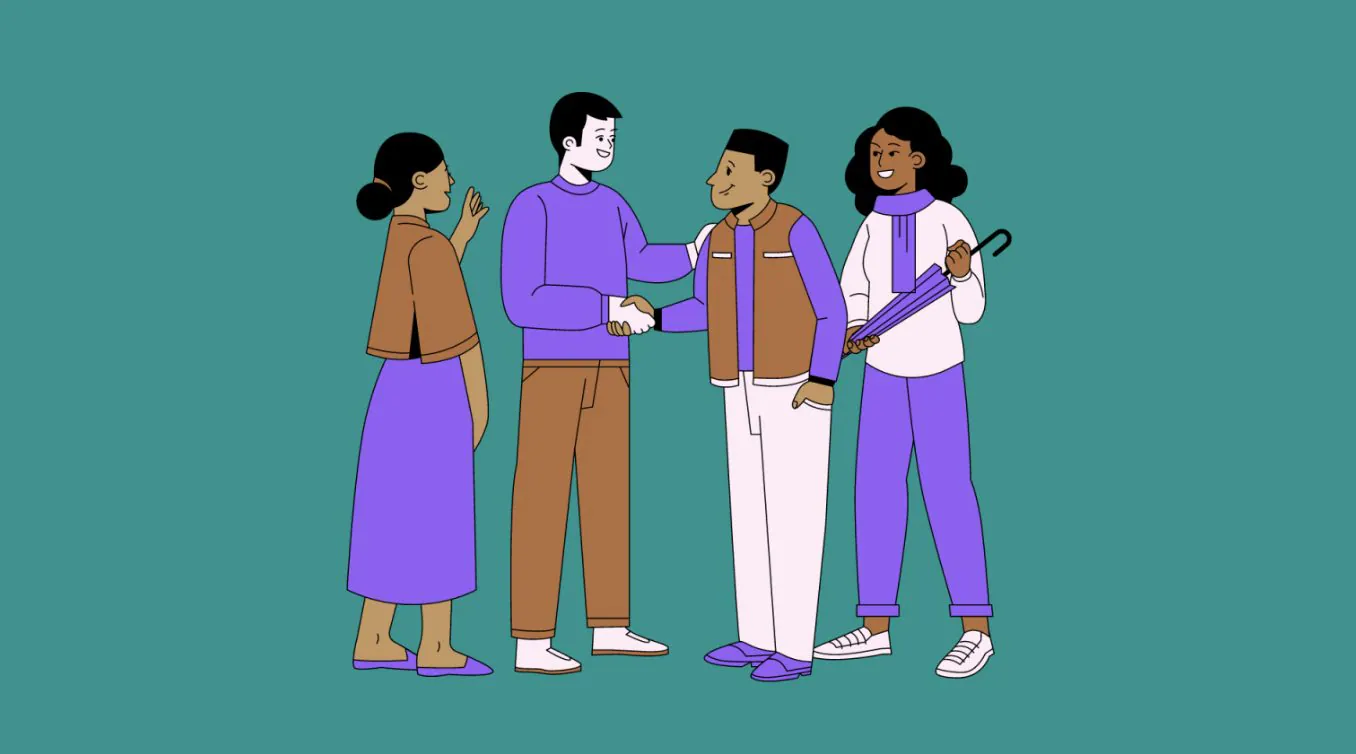
Almost in every family there is one “Uncle” which does not appear anywhere family tree. It is the parents’ friend who accompanied them to football matches, the neighbor who always offered an ice cream, the neighborhood shopkeeper who knew everyone by name: in short, that adult person who, since childhood, has been perceived as part of the family. No blood relationship, no documents, yet everyone called him “Uncle”. It is “fictive kinship”, a fictitious kinship, a social bond that unites people who do not have blood relations with each other. Today the word has also become a typical expression of youth slang: “Oh uncle!”, “Great uncle!”. But where do these uses come from that have nothing to do with kinship in the biological sense? The answer must be sought in the way in which human beings build relationships, define relationships of trust and, above all, decide to consider someone “one of one’s own”.
When kinship is a social construction: the theory of fictive kinship
For a long time, scholars assumed that kinship was a simple biological matter. In the twentieth century, however, anthropology gradually dismantled this belief.
Already Bronilslaw Malinowskiin his famous Argonauts of the Western Pacific (1922)observing the populations of the Trobriand Islands, showed how i family ties could not be explained exclusively through the genetic lineage. To follow Alfred Radcliffe-Brownin Structure and Function in Primitive Society (1952)And Meyer Forteswith Kinship and the Social Order (1969)highlighted that what makes a person “relative” is not just biology, but the system of mutual obligations, rights, responsibilities and expectations that a community builds around that relationship.
From these reflections the concept of fictitious kinship (fictive kinship), which is today one of the pillars of social anthropology. The expression indicates all those relationships that are experienced as family even though they are not founded either on blood or marriage. It’s a surprisingly universal phenomenon: godfathers and godmothers in the Christian tradition; The compadrazgo widespread in Latin America; blood brothers present in many African and Asian societies; the mutual aid networks created to guarantee solidarity, protection and belonging.
This perspective reaches one of its most innovative points with David M. Schneiderwhich, in the volume Critique of the Study of Kinship (1984), radically questions the Western idea according to which blood represents the natural foundation of kinship. According to Schneider, the same belief that i biological bonds are “truer” than social ones is a cultural construction typical of the West. In many other societies, in fact, it is coexistence, sharing food, mutual care or participation in daily life that define who one really is. “family”.
Why do young people say “uncle”: the brain turns strangers into relatives
There universal diffusion from the fictitious kinship suggests that behind this phenomenon there is not just a linguistic convention. Various disciplines, from evolutionary anthropology to social psychology, have attempted to explain why humans are naturally inclined to symbolically expand their family network.
According to the evolutionary anthropologist Robin Dunbarin Grooming, Gossip and the Evolution of Language (1996), the ability to create stable relationships beyond the biological core has been one of the main evolutionary innovations of our species.
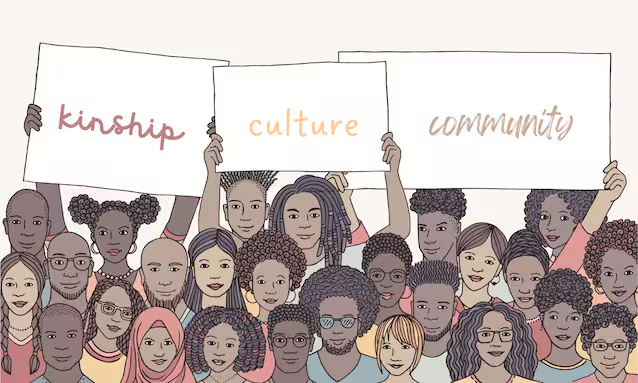
In human societiesthe cooperation it could not be limited to blood relatives: surviving means building alliances, developing trust and maintaining ever larger communities cohesive. Language played a decisive role in this process. To attribute a kinship term to someone, to call them “brother”, “sister”, “mother” or “uncle”is equivalent to symbolically reducing social distance, transforming a simple member of the community into a person they recognize moral obligations and expectations of reciprocity.
A completely different perspective is that of the sociologist Pierre Bordieu, that in Language and Symbolic Power (1991) describes language as a tool capable of producing social realities. Calling someone an “uncle” doesn’t simply mean describing an existing relationship: it means helping to build it. Words, in this sense, do not only reflect social ties, but actively participate in their formation, creating social capital, trust and sense of belonging.
The family we choose: an ancient need that still survives today
Contemporary anthropology tends increasingly to abandon a rigid definition of family, to focus on the practices through which people build meaningful relationships.
It is in this direction that the work of Marshall Sahlinswhich in the volume What Kinship Is-And Not (2013) proposes to understand kinship as one shape of mutuality of being: a condition in which people’s lives become mutually intertwined, regardless of the presence of a shared genetic heritage. What makes someone a family member is not so much biology, but the fact of sharing responsibilities, experiences, care and participation in each other’s lives.
Maybe this is precisely why we continue to call “uncle” those who are not uncles. Behind that word a very ancient social strategy survives: assign a specific place in our network of relationships to people we trust and with whom we share a sense of belonging.
The same mechanism continues today in digital communitieswhere expressions such as “bro”, “sis”, “fam”, “bestie” or “fratm” construct new forms of symbolic kinship. The words change, the contexts change, but the principle remains surprisingly unchanged: human beings have always needed to create families larger than those defined by biology, because it is often the culture, much more than DNA, decides who we feel really close to.
