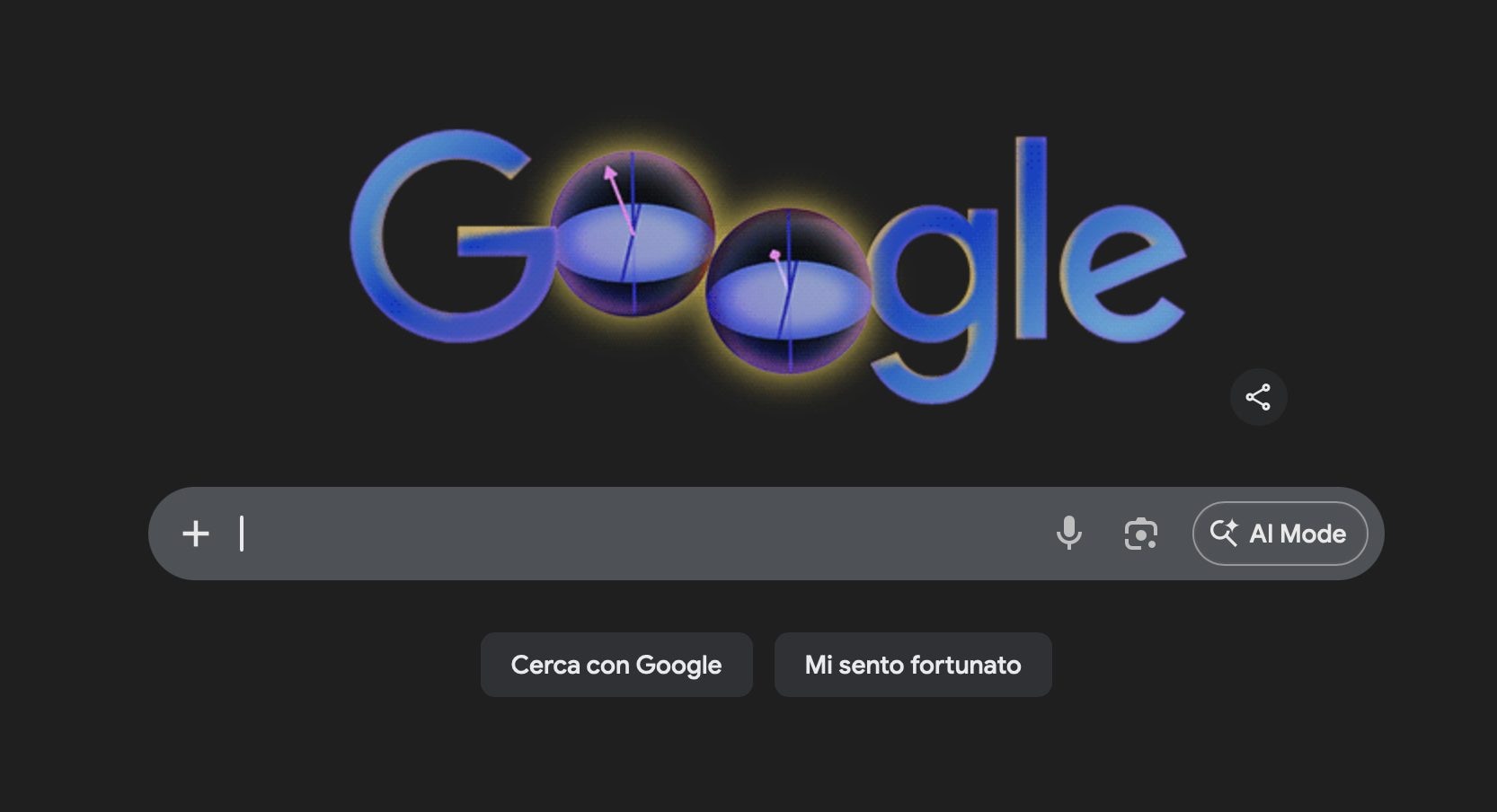
The World Quantum Dayor World Quantum Day, falls every year on April 14: in the American convention, this date recalls the value of the fundamental constant of quantum mechanicsintroduced by Max Planck. The Day is an anniversary born in 2021 which is celebrated throughout the world to raise awareness of the importance of quantum physics – which studies the behavior of matter on the scale of the infinitely small – has contributed decisively to the development of technologies we use every day: let’s think for example of atomic clocks that allow GPS satellites to provide us with our position in real time, or of magnetic resonance imaging, not to mention all electronics, which has its foundations in the quantum properties of semiconductors.
World Quantum Day is celebrated on April 14th: the date is not coincidental
There’s a reason why Quantum Day is celebrated today. But to understand this we must look at the fundamental constant of quantum mechanics, la Planck’s constantintroduced in 1900 by Max Planck, spiritual father of quantum physics. Precisely in the first year of the new century the German physicist found himself grappling with an apparently simple problem, but to which he could not give an answer: to describe from a physical point of view how bodies emit radiation depending on their temperature. All the experimental data eluded any attempt at theoretical description, until Planck, driven by desperation, formulated a very risky hypothesis: heated bodies emit radiation not as a continuous flow of energy, but in discrete “packets of light”.
Surprisingly, with this hypothesis Planck managed to perfectly explain the emission of bodies, and for this he even won the Nobel Prize for Physics in 1918. But at a price: his hypothesis overturned everything known about the behavior of matter on a microscopic scale. Planck’s work effectively started the quantum physics. In the world of the infinitely small, it seemed, some quantities can vary only with “taxes” discrete rather than continuously. To describe these “jumps”, Planck introduced a new physical constant – Planck’s constant, in fact – which today is considered one of the fundamental constants of nature as well as the foundation of quantum mechanics.
Ok, but what does all this have to do with the date of April 14? Planck’s constant is indicated by the letter h and is worth 6.626 · 10–34 J·s, but using a unit of measurement typical of particle physics we have h = 4.14 · 10–15 eV·s. Here, you see that 4.14? The idea of celebrating World Quantum Day on April 14th comes from there, because in the American convention this date is written 4/14.
What are quanta in physics
Imagine buying something at the store and having to pay a certain amount, let’s say 4.14 euro just to stay on topic. Then take out a certain amount of coins and pay your amount. There is not a continuous flow of cash currency, but rather “a certain amount of coins”: you cannot exchange monetary value except through discrete “packages” which in this case are precisely the coins. The same thing happens in the quantum world: in certain situations, energy can be transferred via very specific quantities linked to Planck’s constant.
For example, light is not like a continuous river of energy, but is made up of many photons, that is, quanta of lighteach of which carries a quantity of energy AND which depends on its frequency f according to the following formula:
AND = h · f
It is said that the energy of light is quantized. This property of light has made it possible to explain phenomena such asphotoelectric effectwhich had gripped physicists for decades: the one who did it was none other than Albert Einstein In the 1905with a scientific article that earned him the Nobel Prize for Physics in 1921. Well, quantum mechanics is called this precisely because it derives from the discovery that many quantities in the microscopic world are quantized: one of them, the energy of electrons in an atomic orbital.
The applications of quantum physics in everyday life
Quantum mechanics has opened the way to understanding a gigantic mass of phenomena and has allowed the birth of technologies that we might take for granted but are pervasive in our daily lives.
Let’s think about laserwhich make possible the optical fibers and they have a lot of applications in industry (cutting, welding, etc.) but also in medicine (think of laser surgery or tattoo removal).
Still in the medical field, quantum physics has so many applications that we talk about nuclear medicine. The MRI machine, for example, exploits the quantum behavior of the nuclear spins of the hydrogen atoms in your body.
When you use the GPS to navigate you are benefiting from atomic clocks mounted on board satellites which work by measuring the oscillations of certain atoms with extreme precision. Without these clocks, GPS would give us our location with an uncertainty of 11kmeffectively making this technology almost unusable.
The device on which you are reading this article is also a product of quantum mechanics. The transistors that make up the processor that powers yours device they work precisely thanks to the quantum properties of semiconductors.
