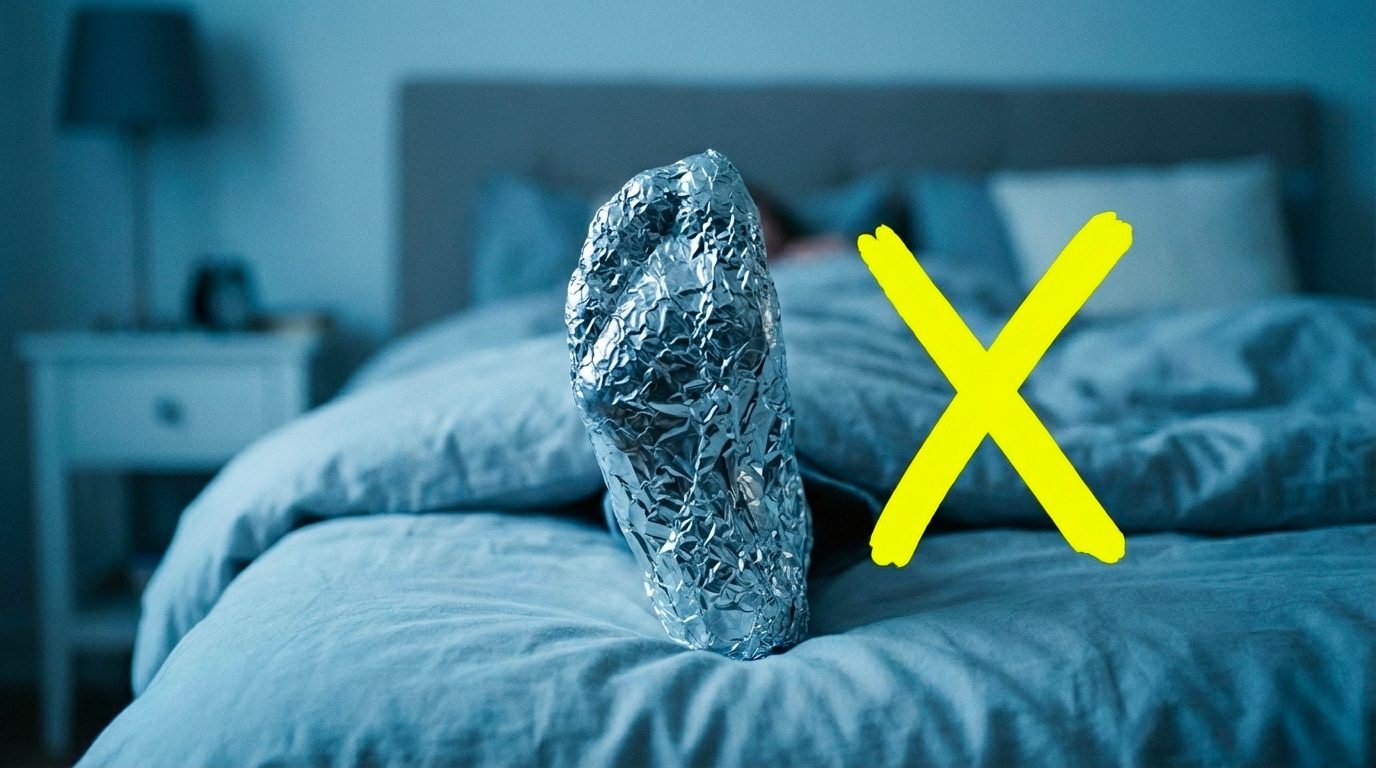
From radiators to freezers, right down to your feet: aluminum foil is often the protagonist of winter DIY tricks. But do they really work? If the trick of the reflective panel behind the radiator has a scientific basis, wrap your feet in foil to keep them warm – as many viral videos on TikTok suggest – is an idea that we would advise against. You can read everything online. The articles and videos promise that this method not only warms cold feet, but cures pains, tiredness, inflammation and even the cold. The truth? There is no scientific proof to support this home remedy. Let’s try to understand why.
First, aluminum is a metal and, consequently, it is a good one thermal conductornot an insulator. When our feet are frozen, our goal is isolate them from the outside colddo not wrap them in a material that risks conducting body heat, dispersing it into the environment. That’s right, aluminum reflects heat dissipated from the body by radiationbut the effect is probably largely compensated by the fact that it removes heat from the body by conduction. Sure, wrapping a foot in any material insulates the air heated by the foot itself, but if the material is insulating this heat won’t stay trapped there for long.
Wrapping your feet in aluminum can also be counterproductive. By blocking the perspiration it can create an ideal environment for the growth of bacteria and fungi. If you have felt relief with this trick it is most likely thanks to the famous one placebo effect for whom it is often enough to believe that a treatment works to feel better. All this without counting the inconvenience to have one foot wrapped in tin foil.
As for the alleged “healing” properties, science leaves no room for interpretation: there is no evidence that aluminum cures colds, pain or inflammation. Colds are caused by viruses and aluminum It does not have any antiviral properties. The same goes for toxinsour body purifies itself thanks to the liver and kidneys, not through the sweat of the feet, which is simply composed of water and mineral salts.
All things considered, it’s much better to rely on the old methods, quite a few of them wool socks (or even two, for those sensitive to the cold) and waterproof shoes win hands down. We leave the foil in the kitchen, where it’s really needed preserve foodsthus avoiding unnecessary waste. And – as a general rule – let’s avoid believing the “tricks” presented without a convincing scientific explanationespecially on social media.
