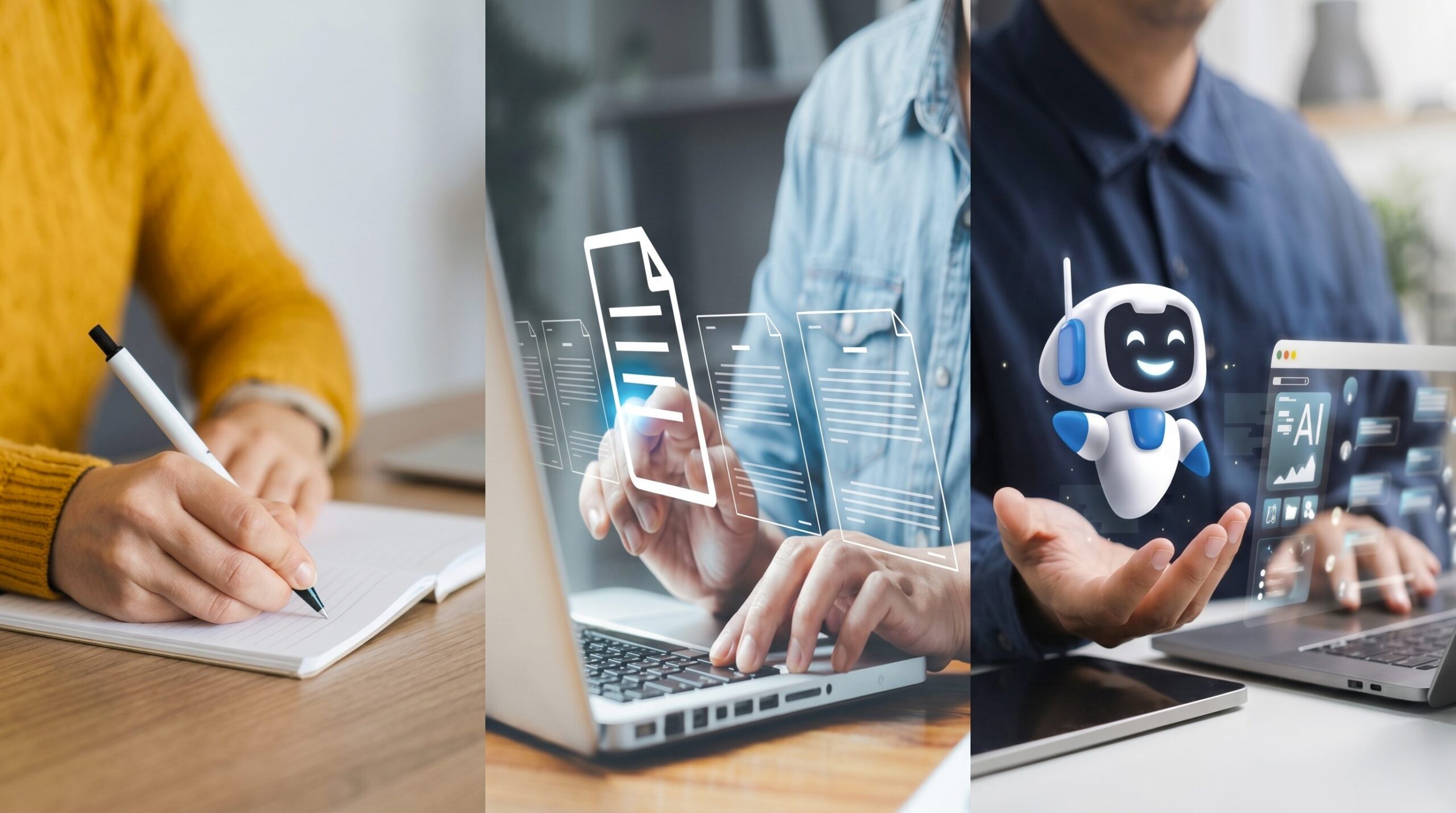
When was the last time you used a pen to take notes instead of typing on your smartphone or asking AI to draft an email? Technology has made us incredibly fast, but delegating writing to keyboards and artificial intelligence profoundly transforms the way in which brain we process information and construct our own knowledge. There handwriting it’s the best way to consolidate memory and rework conceptsrich as it is in sensory and motor elements; write with the keyboard improves speed, at the expense of storage and reprocessing. THE’AI it can instead help us organize information and brainstorm: its strength lies in its ability to be a “thought partner”.
Why manual writing helps us remember better: brain research
It may have happened to you: you write your shopping list on a post-it and then forget it at home. What a nuisance… and yet, you don’t even think about going home. And you are right, because once at the supermarket you discover that you remember almost everything from the list you wrote on the note. On the contrary, if you type it hastily on your smartphone, without the screen in front of you your mind seems to misfire. This happens because write by hand it is a profound act rooted in our bodycapable of leaving a complex “trace” in our memory. Neurologically, tracing letters requires complex coordination between fine motor skills, visual control and tactile perception.
The study of Norwegian University of Science and Technology and similar ones based on high-density EEG demonstrate that this physical activity activates broad brain connectivityparticularly in the parietal and central regions, stimulating brain waves (in the theta and alpha bands) that create the optimal conditions for memorization and learning. In practice, when we draw each single letter making a movement (like drawing an “A” with its slanted lines and crossbar), we give life to what researchers call “coding effect“: multisensory integration and motor effort they burn the information into our minds. In addition, manual writing physiologically slows our cognitive pace (it takes longer and requires a more complex movement to write the “A” by hand, rather than typing it), forcing us to mentally rework and paraphrase what we hear before putting it on paper. The writing experience therefore activates more “fine” circuits that dedicate themselves to details, and they do so by taking more time.
Writing on the computer speeds us up, but at what cost according to neuroscience
Today, most of us use our computer keyboard to take notes on the fly during a work meeting or college lecture. We type so fast that we can almost transcribe what the speaker says word for word. Yet, once finished, we often realize that we have only superficially understood the speech. The reason lies precisely in the intrinsic mechanics of typing. When we use a keyboard, we make repetitive finger movements which I am identical for every single letter: pressing the “A” key requires exactly the same motor effort as pressing the “B” key. This automatism drastically reduces the cognitive load linked to the creation of unique shapes, bypassing the profound sensorimotor integration that occurs when we hold a pen.
Neuroimaging, as explained by the study published on Frontiers in Psychologyconfirm that typing is engaging less extensive neural circuits and generates a connectivity clearly cerebral weaker compared to handwriting. Deprived of the effort of having to synthesize and “draw” words and concepts spatially, our brain adopts a passive strategy of literal transcription, that is, it passively records the information exactly as it receives it, without any reprocessing. As an inevitable result, the speed of text production increases, but information processing becomes superficial: ours short-term memory And less stimulated and our ability to apply concepts to answer complex questions tends to decline compared to those who use pen and paper.
By delegating to an AI like ChatGPT, we are becoming “lazy” thinkers: cognitive studies
The last frontier of our everyday life is the use of generative artificial intelligences like ChatGPT. We enter a short request (prompt) and, in a few seconds, we obtain a commercial email, a small essay or a seemingly perfect report. But what happens to our minds when we outsource the writing process altogether? Often a emotional and intellectual detachment: we feel that that text does not belong to us really and we even struggle to remember the key passages by heart. The most recent cognitive studies, such as that of researchers at the University of Nicosia, speak in this regard of “metacognitive laziness” and a clear decline in brain engagement. When we use an artificial intelligence to generate complex content, we download on it much of our cognitive loaddelegating to her in particular the executive functions related to strategic planning, logical structuring and working memory.
Research from MIT in Boston measured brain activity showing that those who intensively use advanced linguistic models to write have a much less coordinated interaction between neural networks. In practice, our mind relaxes excessively: since we don’t have to go through the effort of finding the right words or structuring our thoughts, activation of the frontal regions of the brain dedicated to executive control decreases dramatically. While AI reduces frustration and optimizes production times, it also produces the so-called “ghostwriter effect”. In this psychological state, even though we formally declare ourselves authors of the text produced, our sense of ownership of the result is very low, and our retention of concepts is highly compromised precisely because we did not actively participate in the effort of the creative genesis of information.
Is there a right balance?
Faced with this rapidly evolving scenario, it is completely normal to ask ourselves whether we should throw away computers and return to inkwells, or whether we should abandon ourselves completely to the convenience of algorithms. The scientific answer, fortunately, lies in the awareness of choose the right tool for the right goallearning to strategically manage the way our mind works.
The researchers’ advice is to adopt a hybrid approach calibrated to the result you want to obtain. If your primary goal is to study, long-term memorization of a complex concept or creative brainstorming, handwriting (whether traditional or via a digital stylus on a screen) remains absolutely the best and irreplaceable choice. Physical movementcombined with tactile feedback, will activate deep neural networks necessary to ensure solid learning and lasting understanding. If, however, your need is to respond to dozens of formal emails or transcribe information that only needs to be archived and processed quickly, the keyboard remains unbeatable for its mechanical speed. Finally, generative artificial intelligence should not be demonized at all, but used in an interactive and conscious way, avoiding passivity. Instead of asking theAI to magically do all the work for us, we can use it profitably as a “thought partner” to overcome writer’s block, to rework our drafts or to stimulate initial creativity.
Sources
Van der Weel & Van der Meer, 2024, Handwriting but not typewriting leads to widespread brain connectivity: a high-density EEG study with implications for the classroom. Kim et al., 2025, Exploring students’ perspectives on Generative AI-assisted academic writing. Van der Weel & Van der Meer, 2017, Only Three Fingers Write, but the Whole Brain Works†: A High-Density EEG Study Showing Advantages of Drawing Over Typing for Learning Ihara et al., 2021, Advantage of Handwriting Over Typing on Learning Words: Evidence From an N400 Event-Related Potential Index Marano et al., 2025, The Neuroscience Behind Writing: Handwriting vs. Typing-WhoWinstheBattle? Smoker et al., 2009, Comparing Memory for Handwriting versus Typing Al-Sharman et al., 2025, Exploring the impact of note taking methods on cognitive function among university students. Shibata & Omura, 2018, Reconsideration of the Effects of Handwriting: Comparing Cognitive Load of Handwriting and Typing Kosmina et al., 2025, Your Brain on ChatGPT: Accumulation of Cognitive Debt when Using an AI Assistant for Essay Writing Task Yin et al., 2024, ASurvey on Multimodal Large Language Models Georgiou, 2025, ChatGPT produces more “lazy” thinkers: Evidence of cognitive decline Wasi et al., 2024, LLMs as Writing Assistants: Exploring Perspectives on Sense of Ownership and Reasoning Nguyen et al., 2024, Human-AI collaboration patterns in AI-assisted academic writing
