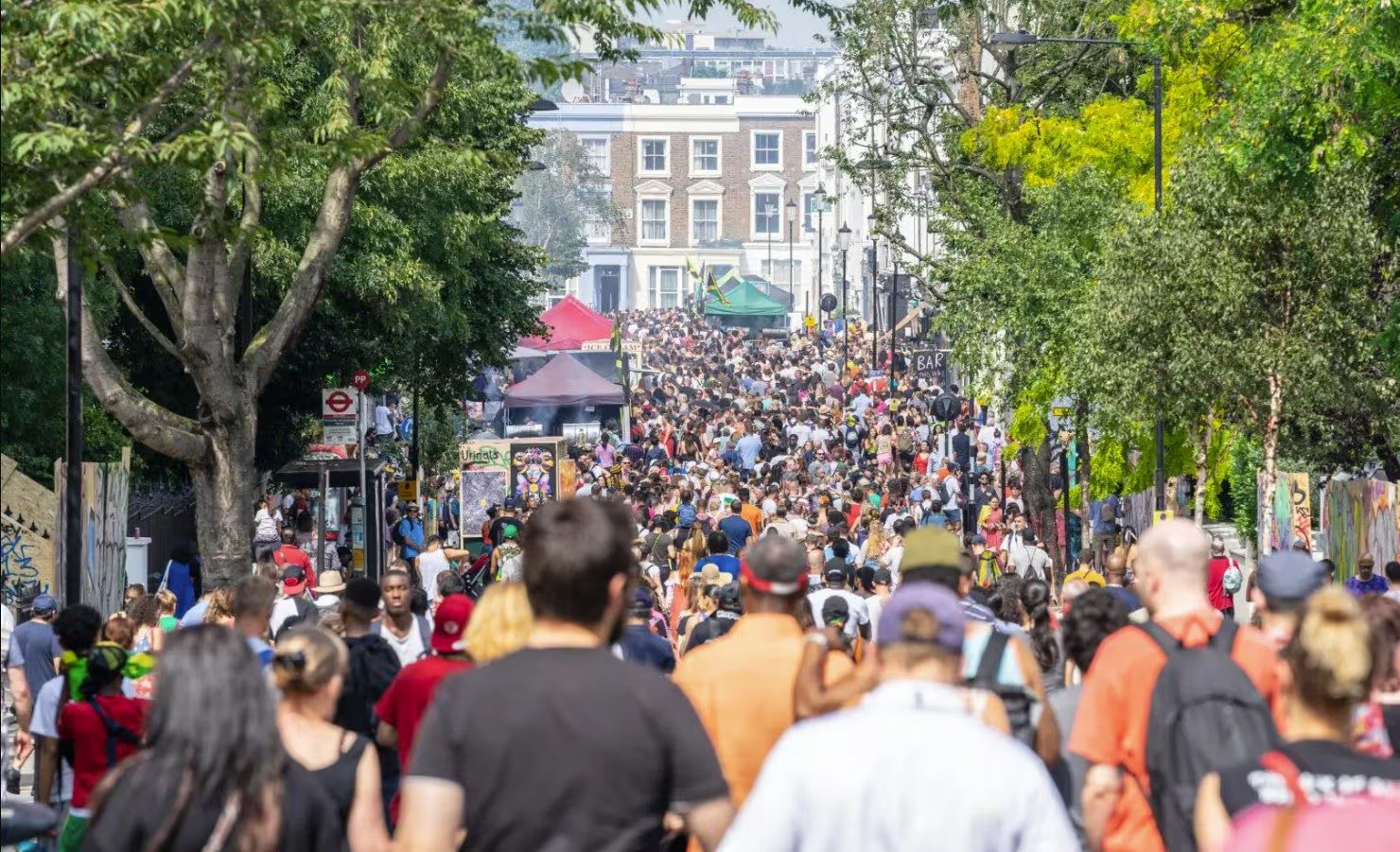
The summer of 2026 in Italy reopens a wound related to mass tourism that local administrations are struggling to heal. Rimini, Venice And Bolzano are confirmed as the Italian provinces most exposed toovertourism in the Overall Index of Tourist Overcrowding (ICST) developed byDemoskopika Institute – the most updated measurement tool available, built on ISTAT and ISPRA data. Behind them, in order, Livorno, Naples, Milan, Trento, Rome, Verona and Trieste: ten provinces in the “red zone” due to tourist pressure.
In the background, to complicate the picture, a European study of the JB.com platform published in June 2026 on Euronews places Italy between the three countries with the anti-tourism reaction most intense on the continent, together with Spain and France. And in Venice the new mayor has just announced the proposal to increase the entrance ticket up to 50 euros on the most critical days.
How to measure overtourism: Demoskopika’s ICST
THE’Overall Tourist Overcrowding Index it is not based on a single number, but on five variables which measure the real weight of tourism on a territory: tourist density, accommodation density, tourist intensity, gross utilization rate of accommodation facilities and share of urban waste attributable to the sector. Cross-referencing these indicators allows us to distinguish structurally different situations: a city can have many tourists in absolute terms but distribute them over a large area, or concentrate an enormous quantity in a few square kilometres.
The data collected highlights an unprecedented tourist concentration in specific areas of the country. Rimini is positioned at the top of the ranking with around 17,000 presences per square kilometre, highlighting a very strong gap compared to just 300 thousand permanent residents. It is placed immediately after Venicewhich records around 16,000 visitors per square kilometre, confirming itself as both desired and fragile. The real mountain surprise is represented by the province of Bolzanowhich is firmly among the places most exposed to the phenomenon of seasonal tourist excess.
It is worth remembering the explicit limitation of the ICST: the tool excludes hikers and overnight stays in second homescategories not quantified by official statistics. The real pressure on the territories is therefore systematically underestimated.
Venice at the center of the debate over the 50 euro ticket to enter the city
Simone Venturinielected mayor of Venice with the support of the center-right coalition, proposed to increase up to 50 euros the daily access fee. Currently the ticket costs 10 euros for those who pay for it four days before the arrival date, and 5 euros for those who book it in advance. The measure would apply only on the most critical days and would maintain existing exemptions for residents, workers, students and those who stay overnight in the city.
The starting point is a three-year experimental budget that the mayor considers insufficient. In the first ones 42 days of application of 2026up 514,710 contributions paid, 268,207 paid 10 euros And 245,503 paid 5 euros: the majority preferred not to book in advance, a sign that the current gap between the two rates does not work as a deterrent.
However, the proposal clearly divides. The director of the Venetian Hoteliers Association Daniele Minotto he said he was in favor, arguing that a mobile tariff with a higher ceiling could encourage the choice of less crowded periods. From the opposition, the Pd councilor Nicola Pellicani rejected the initiative, underlining that so far the ticket has not managed the flows or improved the lives of residents, and that to increase it to 50 euros a national law would still be needed.
Spain, Italy and France: the three European countries with the highest discontent
The Italian case is not isolated. Spain, Italy and France are the three European countries where reaction against mass tourism is strongeraccording to a study by the JB.com platform that analyzed the intensity of protests, media attention, tourist tax rates and the ratio of visitors to residents in 30 countries.
There Spain is in first place among the 30 countries analyzedwith anti-tourism protests taking place in over 40 cities from Barcelona to the Canary Islands. Similar protests were held in several Italian cities including Venice, Rome, Florence, Naples and Milan. In France the demonstrations mainly concerned Marseille, Nice and Paris.
The numbers behind this intolerance are concrete. In the first four months of 2026 the number of tourists in Spain increased by 3.4%. In June, Italy and France are expected to record an increase in flows of 12% and 2.6% respectively compared to the same period in 2025. The growth in flows, in the absence of effective distribution tools, translates directly into pressure on the same already overloaded areas.
Cyprus and Albania are the most welcoming European countries towards tourists, without documented protests. The difference lies not in the quantity of tourism, but in the ability – and willingness – to manage it.
The measures already in force in Italy: a patchwork without national direction
Beyond the Venetian case, Italy has accumulated a heterogeneous set of local measuresoften adopted in response to specific emergencies rather than as part of a coordinated strategy. Venice has an entrance ticketactive for 60 days in spring-summer 2026, from 8.30 am to 4.00 pm. Florence has progressively restricted licenses for short-term rentals in the historic center. Several art cities have increased the tourist tax. Others have limited hours and access to the most sensitive areas.
The result is a patchwork: each administration responds to its own urgency with the tools available, without there being a national framework capable of distributing flows, enhancing lesser-known destinations and protecting residents in a uniform way. Demoskopika suggests some directions: flow regulation during peak periods, deseasonalization of the offer valorising the traditionally empty months, diversification towards alternative destinations. These are indications that have been circulating in the debate for years. The difficulty is not identifying solutions, but building the political will – and administrative structures – to apply them on a national scale rather than emergency after emergency.
