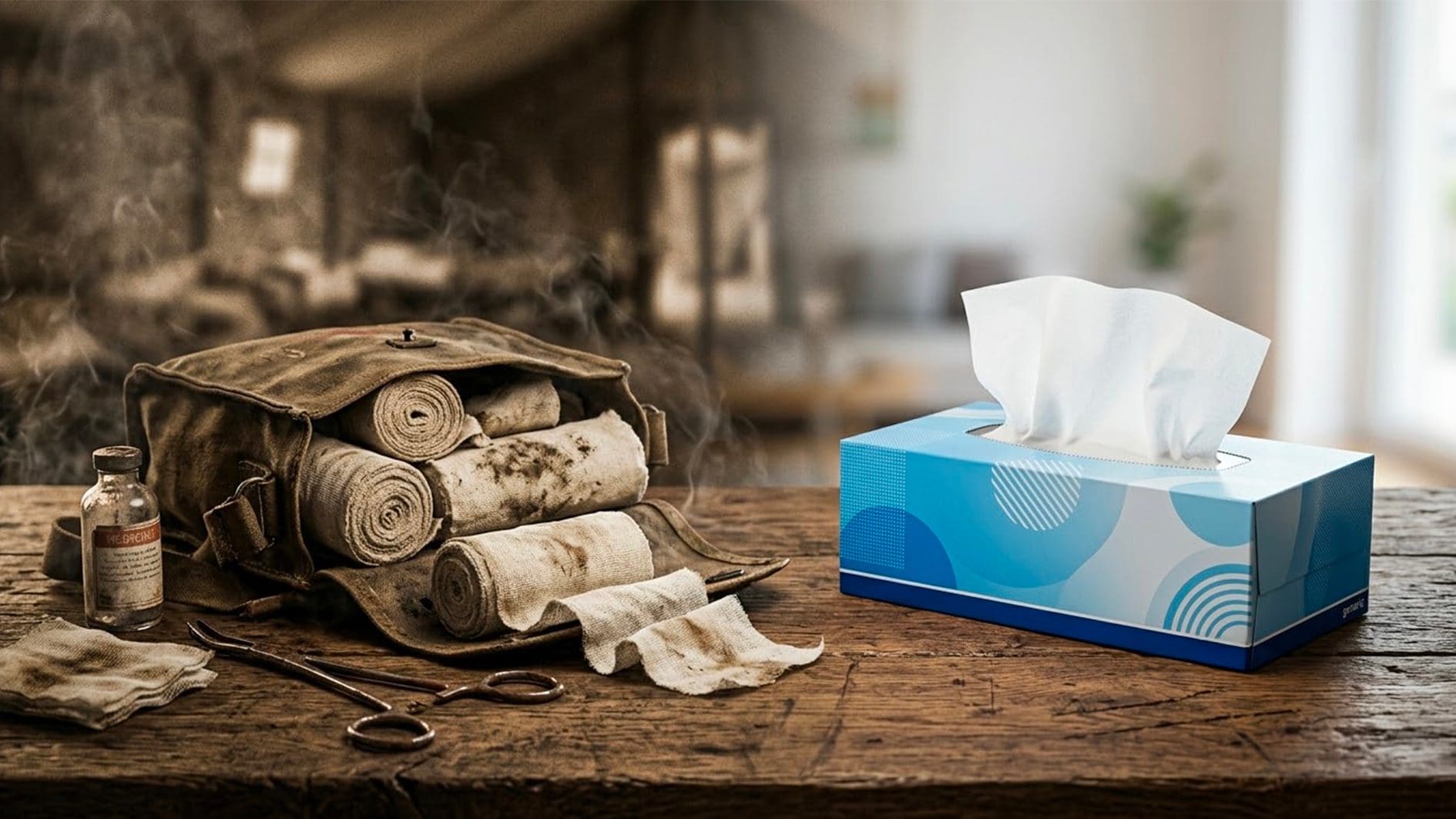
Among them tens and twenties of the twentieth centuryin conjunction with the First World War, some inventions were developed whose discovery was facilitated, in various ways, by the war context and the consequences linked to the war itself. In a context in which society was evolving rapidly and the technology was becoming more and more popular need to adapt to war led to the creation of many things that are widely used today.
Among these, the sanitary napkins born thanks to a material used for soldiers’ bandages; the ultraviolet lampswhich cured rickets due to famine; The pilatescreated to train during imprisonment and hospital stays; thestainless steelmade to prevent the weapons from bending and thedaylight saving timeintroduced to save on lighting and heating given the shortage of coal.
Inventions related to the First World War
1. Sanitary towels, created with the same material as soldiers’ bandages
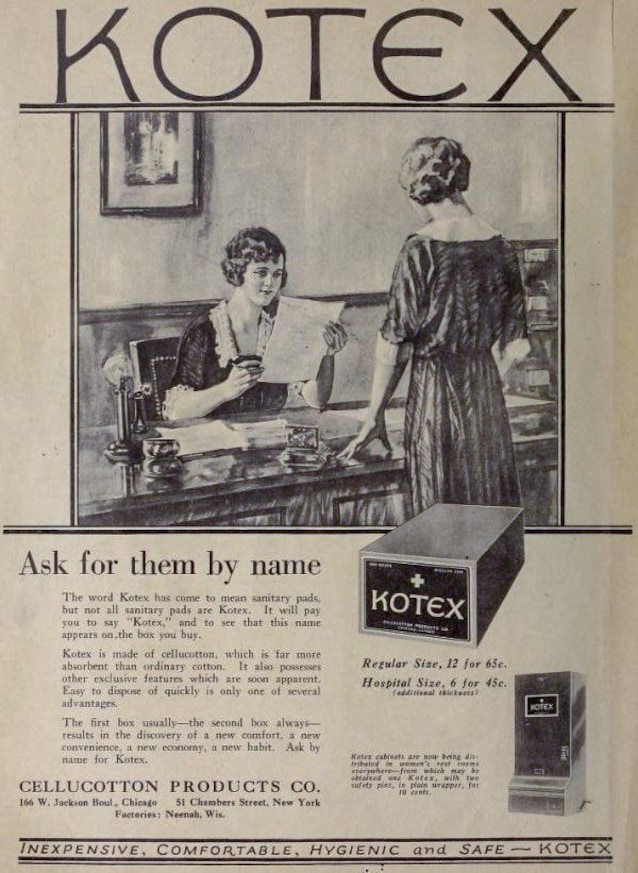
Before the start of the First World War, the American company Kimberly-Clark founded in 1872 – today a multinational leader in paper products such as sanitary napkins and toilet paper – discovered, during a trip to European paper mills, a material much more absorbent than cottonused up to that point. Kimberly-Clark began working on this cellulose-based element and created the Cellucotton: one of the first uses was for soldiers’ bandages, used in enormous quantities during the war in field hospitals.
It was precisely in this context that nurses began to use Cellucotton bandages as sanitary napkins: the company found this different use ingenious, also because with the end of the war it was no longer necessary to produce bandages in such large quantities. He then began producing i Kotexthe first truly highly absorbent female sanitary pads, sold to the public since 1920 and still on the market today.
Furthermore, Kimberly-Clark discovered that by pressing Kotex very thin and extremely resistant sheets of handkerchief were obtained, which were then marketed under the name, still used today, of Kleenex.
2. Ultraviolet lamps, used to strengthen the bones of stunted children
Kurt Huldschinskya German pediatrician, noticed that in the winter of 1918, at the end of the War, many children in Berlin suffered from ricketsa disease that causes weakening of bones and slow growth, and they were also very pale. The children were born, or were just a few years old, during the war and for about three years their diet had been poor and not very nutritious due to food rationing, famines and the difficult availability of food.
Huldschinsky therefore decided to experiment on some of the little onesultraviolet irradiationissued by one mercury lampto counteract the pallor and evaluate whether the absorption of the rays would have brought them any benefits.
The outcome was positive: the children’s bones actually became stronger and their overall health improved. This caused a real “hunt” for UV lamps – there are also stories of street lamps uprooted from the streets in order to expose themselves to the rays – until they discover that the vitamin Demitted by UV rays, is of fundamental importance for human health.
3. Pilates, created to strengthen the muscles of bedridden people
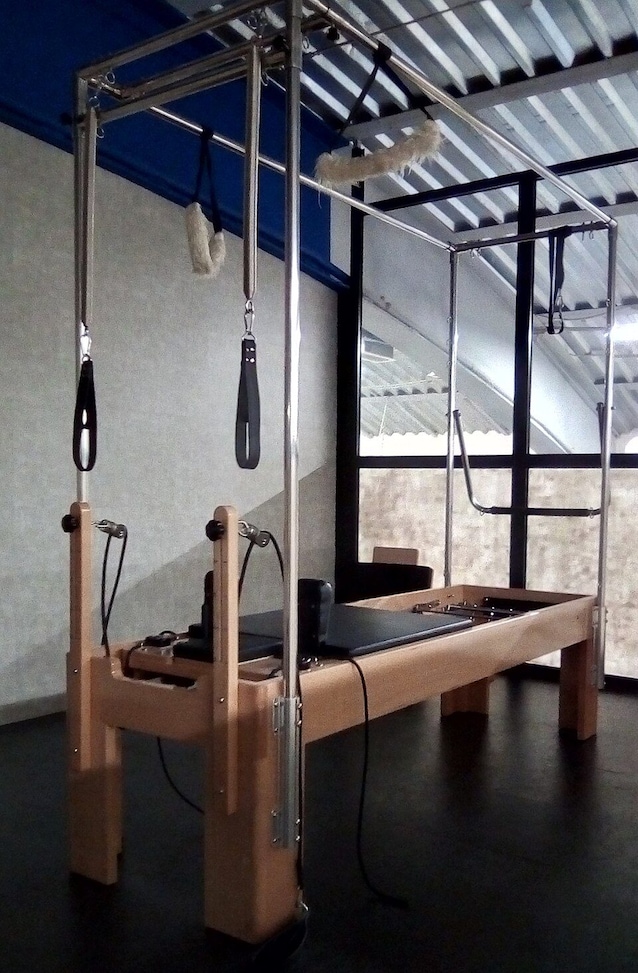
Joseph Hubertus Pilates was born in Germany in 1880: he was a frail child with numerous health problems who, as he grew up, decided to combat his frailty with numerous muscle strengthening exercises, until he was able to practice the bodybuildingmartial and circus arts, yoga and boxing. With the outbreak of the First World War, he was interned on the Isle of Man, an English territory: here, in the prison camp, he developed a series of simple but very effective movements with which to keep fit on a daily basis. He then had the opportunity to observe the state of many bedridden patients and thought of modify hospital beds with springs and straps that allowed you to practice even while lying down: this is how the pilates today so-called “Reformer”, which provides for theuse of an equipped cot. At the end of the conflict he moved to New York: here, in 1925, the first opened fitness studio which bore his name, today a famous discipline practiced throughout the world.
4. Stainless steel, discovered to prevent weapons from deforming with heat
THE‘stainless steel – alloy based on steel and chromium – it is a metal that does not oxidise, does not corrode and does not deform: the English army engineer Harry Brearley invented it in 1913 to improve the resistance to oxidation and deformation of weapons due to heat.
At first Brearley was not satisfied: he is said to have added chromium to the steel and then stacked his experiments in the yard. Precisely thanks to the “scrap metal” he realized that only where he had reached a certain quantity of chromium, the pieces remained intact: here he had found the turning point.
Stainless steel was immediately widely used in the imminent world conflict and also became famous for many other uses, such as cutlery and surgical instruments.

5. Summer time to save on coal use
It was Benjamin Franklinin 1784, who was the first to have the idea of moving the hands to make more use of the morning light from spring to autumn, consequently saving on candles to be used in the evening, but the proposal was not actually taken into consideration.
During the First World War coal was in short supply in Germany so the authorities decided that the idea of move the clock hands in a synchronized manner would have allowed save on both lighting and heating.
So it was that on 30 April 1916 at 11pm the hands were moved forward by an hour: after three weeks the solution was also adopted in Great Britain and, in short, all of Europe and the United States aligned. Once the war was over, the new time convention was abolished, only to be definitively reinstated given the obvious advantage.
