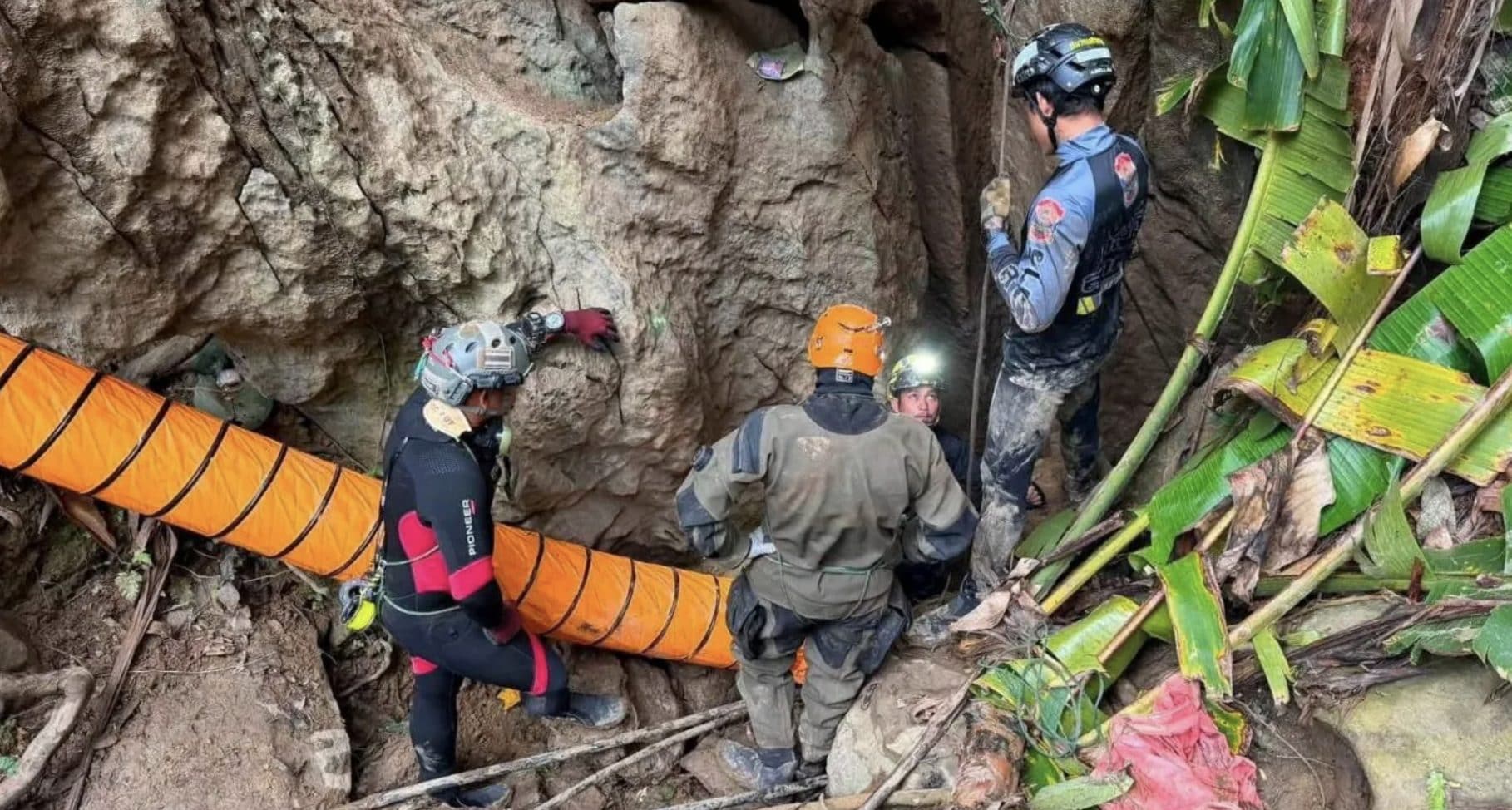
They were found five people of the remaining group trapped in a cave in Laos: last May 19th, eight inhabitants of the district of Longchengin central Laos, had in fact entered a cave to search for gold (a common activity in this South-East Asian country, one of the poorest). The torrential rains that afternoon, however, they had flooded the only way out, trapping seven of them in the darkness of the cavity, with the eighth man having managed to get out in time and raise the alarm.
At 4.30pm (local time, 11:30 in Italy) today 27 May, the Thai rescuer Kengkach Bangkawong declared that the 5 people are alive and safe: in the meantime, Thai and Laotian rescuers are continuing the search for the last two, fighting against persistent rains, tunnels barely wide 60 centimetres (as clearly visible in the video above) and an advancing water front, in one of the most complex karst landscapes in Asia.
The dynamics of the accident
As mentioned, seven inhabitants of the area have remained trapped inside one located cave in the district of Longcheng, in Xaisomboun province, after sudden torrential rains had blocked the exit. The group, initially made up of eight people in total, had entered on May 19 in search of gold, a very common activity in this area despite the authorities having repeatedly warned against the risks.
A detail that tells a lot about the local economic context: the average per capita income in Laos is between 2,000 and 2,500 dollars per year, among the lowest in South-East Asia, and in rural areas it is significantly lower. One of the eight, as reported by Luanglath Bounkham (head of the Rescue Volunteer for People organization in Laos) managed to get out before the heavy rains triggered the flood that blocked the exit, going so far as to raise the alarm to the authorities.
The other seven, however, remained trapped about 300 meters from the exit, managing to survive for more than a week, having found refuge in a non-flooded area that guaranteed a continuous flow of air.
Rescue operations
Inside the cave, the situation is serious complex: according to the Metta Tham Kalasin (MTK) coordination center, the tunnel to travel is approximately 340 meterswith some sections narrowing down to 60 centimetresmaking it necessary to advance on all fours.
For the rescue operations, the divers initially went about 100 meters into the flooded tunnel, and then pushed further and managed to actually reach 5 of the 7 trapped people: to speed up the time and try to save everyone, the Laotian authorities mobilized soldiers, police, medical personnel and local volunteers and are using pumps to drain water (with many difficulties due to persistent rain).
To reinforce the team, two cave diving experts based in Thailand – the Finnish – also arrived on site Mikko Paasi and the Thai Naset Palasingh – veterans of the 2018 Tham Luang rescue, when 12 boys were stuck in a cave with their teacher for 2 weeks.
The geology of Laos and its caves
To better understand the dynamics of this accident, it is important to understand the geology of the Laos. It is one of the most popular territories high karst density of South-East Asia, whose subsoil is dominated by limestonea sedimentary rock that forms in marine environments through the accumulation of shells and skeletons of organisms.
Over millions of years, rainwater slowly dissolved this rock from the inside, digging tunnels, tunnels and underground rooms even of enormous dimensions. The result, on the surface, is a landscape dominated by rocky towers, sinkholes and rivers that disappear underground; underground, an intricate network of cavitiesjust like the one in which the 7 people were trapped.
What makes these cavities dangerous, however, is not the structure, but thehydraulics. In karst areas, water can move through hidden channels, making underground conditions extremely unpredictable. When it rains heavily, as it happened on May 19 in Longcheng, water doesn’t just flow on the surface: it rapidly infiltrates the subsoil through invisible fractures and fills the lowest cavities with a speed that can be sudden and devastating.
The same rocks that trap, however, also hide riches. According to the Atlas of Mineral Resources of the ESCAP Region (a systematic inventory of the region’s mineral resources produced by the United Nations) Laos has numerous gold-bearing areas distributed across eight provinces. Gold is found both in primary deposits, in quartz veins associated with igneous rocks, and in the form of alluvial deposits in the sediments of rivers and tributaries: many tributaries of the Mekong River contain traces of it, and the sands of the Mekong itself contain it in several sections. The province of Xaysomboun, with its substratum of Paleozoic limestones raised and deformed by tectonic movements, fully fits into this framework.
