Next, the newsletter of Europa Today which every Monday morning tells you what will happen in the European week
Top of the agenda
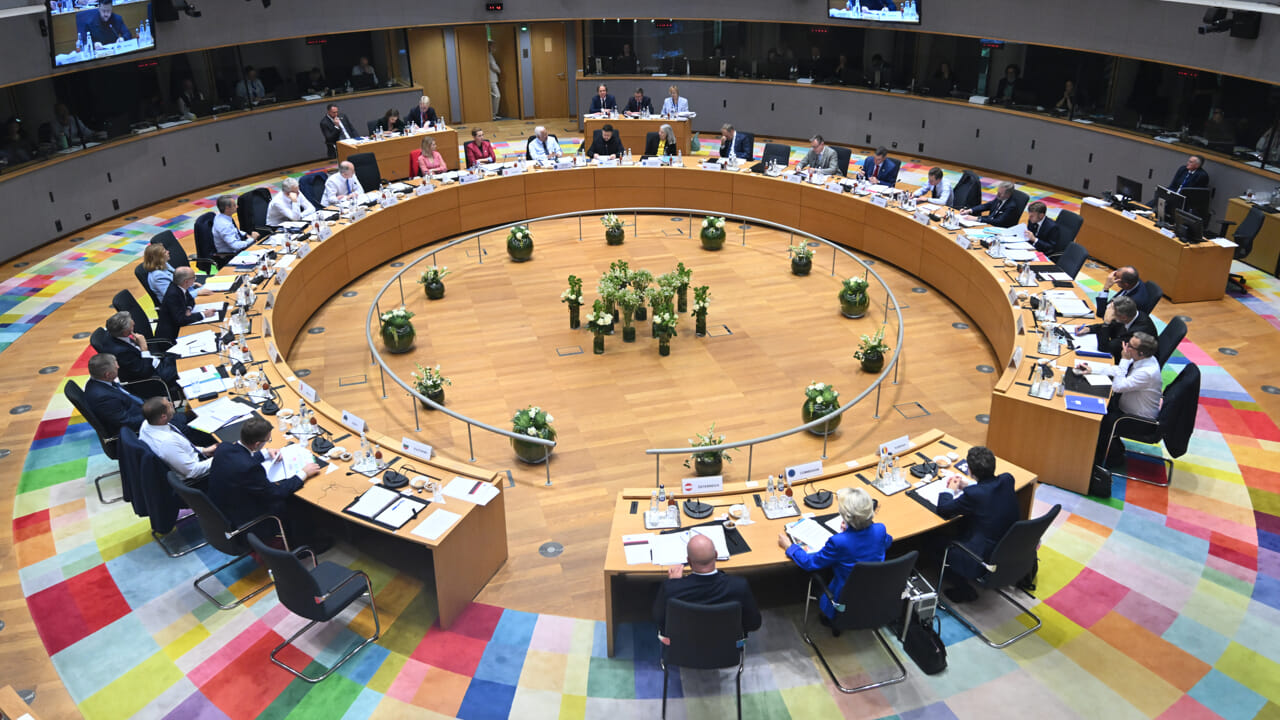
A (perhaps) decisive summit – All eyes are on the European Council which will open on Thursday 18th December and will almost certainly last all of Friday 19th (it would be the first time of a two-day summit under the presidency of António Costa). What will ignite the discussions between the 27 heads of state and government will be a topic that is as thorny as it is decisive for the short/medium term future: giving the green light to the use of frozen Russian assets for a loan to Ukraine that covers at least the most substantial part of the 135 billion euro budget hole expected for the two-year period 2027-2028.
What it’s about – From the European Council at the end of October onwards, the solution of a loan fueled by liquidity balances generated by Russian assets frozen in EU member countries has increasingly gained ground. In total, this amounts to around 210 billion euros, 185 of which are held by Euroclear (a Belgian financial services company), as well as around 25 billion tied up in commercial banks in France (18 billion) and Belgium (7 billion), 200 million in Germany, less than 100 million in Cyprus and 10 thousand euros in Sweden and Luxembourg. According to Brussels’ idea, Ukraine will have to repay the sum only when Russia has paid the war reparations to which Kiev is entitled.
The Commission’s proposal – Last December 3rd the European Commission presented a new package of measures to guarantee Kiev 90 billion euros in the two-year period 2026-2027, equal to two thirds of its financial needs. The first solution is a loan using frozen Russian assets through a new European instrument and with a whole series of guarantees, which would require the approval of a qualified majority. The second solution would instead be a loan to Ukraine with the guarantee of the EU budget, which however must be decided unanimously by the 27 members. AND
Who opposes – It is above all the Prime Minister of Belgium, Bart De Wever, who is slowing down – if not actually blocking – this process, being against the idea of using the Russian assets frozen in the Euroclear institute due to the legal and financial risks that the country could face if Russia wins an international appeal. For the Belgian Prime Minister the move could also jeopardize a possible peace agreement to end the conflict in Ukraine. However, France is also hiding behind the Belgian screen, increasingly under pressure for the 18 billion held in its commercial banks, and other EU members who share the fears of Brussels (understood as the capital of Belgium) on the peace negotiations.
Yet it moves – At the European Council, a framework will have to be found for at least a compromise solution, otherwise it will be necessary to declare failure to finance Ukraine from April 2026. This is why President Costa is already planning a two-day summit. However, it should be remembered that last December 12th the Council gave the green light by a qualified majority to the indefinite freezing of Russian assets – without having to unanimously renew the sanctions every six months – with the approval also from Belgium. This move is not directly connected to the loan to Ukraine, it should be remembered, but it still paved the way from possible obstacles of Hungarian vetoes, if the green light comes from the 27 leaders for the use of Russian assets.
The EU prepares 90 billion euros to finance Ukraine. Von der Leyen: “They will be taken from frozen Russian assets”
What else is on the table – As stated in the letter of invitation from the President of the European Council Costa to the 27 EU leaders, in addition to Ukraine and European security, the other crucial theme of the summit will be the EU’s Multiannual Financial Framework for the period 2028-2034, i.e. the Union’s next seven-year budget. The objective is to provide guidance for the negotiation phase between ministers and then with Parliament’s negotiators, to reach a final agreement by the end of 2026. The conclusions of the summit will then also include EU enlargement, the geoeconomic situation and implications for European competitiveness, the situation in the Middle East, migration and the implementation of decisions on defense and security.
The two preparatory meetings – Before the meeting of the 27 heads of state and government, preparations for the summit will take place during two ministerial meetings. On Monday 15 December the first, that of the Foreign Ministers, will have as its main theme the issue of the Russian war in Ukraine and the latest developments on the war front and on that of the ceasefire negotiations, including a videoconference discussion with the Ukrainian counterpart, Andrii Sybiha. The General Affairs Council on Tuesday 16 December will instead be almost entirely dedicated to the preparation of the final draft of the European Council conclusions, as well as the approval of the conclusions on enlargement, the legislative priorities for 2026, the next EU budget 2028-2034 and a working lunch on cohesion policy.
What really divides the US and the EU in the peace negotiations in Ukraine
Other hot topics
The summit with the Western Balkans – On the eve of the European Council, the 27 EU leaders will meet with their counterparts from the six Western Balkan countries (Albania, Bosnia and Herzegovina, Kosovo, North Macedonia, Montenegro and Serbia) to strengthen strategic relations through the annual high-level summit. In the discussions on the evening of Wednesday 17 December, issues relating to the region’s path towards joining the Union, the reform agendas of the Growth Plan and alignment in the field of foreign affairs and security will be addressed.
Housing package – To close 2025 with a package carefully watched by the European Parliament, the Commission should adopt three initiatives on housing on Tuesday 16 December: a review of the rules on state aid for services of general economic interest, a proposal for a Council recommendation on the new European Bauhaus (the interdisciplinary EU project linking the European Green Deal with the built environment) and a strategy for housing. The package should stimulate the promotion of sustainable and affordable housing through investments, regulatory changes and support for local efforts, focusing on renovation, skilled labor, new construction and addressing rent.
The Commission’s continuous delays – In the last few weeks of meetings of the College of Commissioners, a clear tendency has emerged towards the postponement of the most thorny legislative dossiers. This was the case of the environmental rules simplification package (finally presented last December 10th), but above all of the highly anticipated ‘automotive package’ – which should lead to greater flexibility to the already approved rules on the ban on registering cars with internal combustion engines from 2035 – and of the implementation package of the Clean Industrial Pact, both expected last week.
Good week? – According to the latest agenda of the College, both initiatives should be presented on Tuesday 16 December in Strasbourg. The automotive package with its four pillars (review of CO2 emission standards for cars and vans, a strategy for strengthening batteries, the Automotive Omnibus for legislative simplification, and a proposal to make company fleets more eco-friendly). What remains of the Clean Industrial Pact implementation package is the strengthening of the carbon border adjustment mechanism (CBAM, Carbon Border Adjustment Mechanism) and the temporary support mechanism, while the law for industrial acceleration has disappeared. We will talk about it again in January.
Health package – On the same day, the Commission will also present a ‘health package’ made up of four initiatives: a biotechnology law, targeted simplification of EU rules on medical devices and in vitro diagnostics, an EU cardiovascular health plan and a food and feed simplification package.
The environment in Europe – The 27 Environment Ministers will approve the conclusions on Tuesday 16 December on “The Environment in Europe – Building a more circular and resilient Europe”, a document that recognizes the urgency of promoting climate resilience and the transition towards a circular economy to address climate and environmental challenges such as pollution, biodiversity loss and resource scarcity.
Berlin supports Kiev – The 88th German-Ukrainian Economic Forum will be held on Monday 15th in Berlin, an important platform for dialogue between Germany and Ukraine on economic resilience and bilateral cooperation, focusing on post-war reconstruction, the transformation of industries and the role of the private sector. The event will be attended by the German Chancellor, Friedrich Merz, and the Ukrainian Prime Minister, Yulia Svyrydenko, together with other high-level representatives of the two countries.
Babiš returns prime minister – On Monday 15th the new government of the Czech Republic will officially take office in Prague led by the Euro-sceptic populist Andrej Babiš, a 71-year-old magnate and leader of the Ano party, appointed prime minister by President Petr Pavel after his victory in the October elections and the coalition agreement with two right-wing forces. Babiš, already head of government from 2017 to 2021, returns to power with a coalition that includes parties critical of the EU’s climate policies and support for Kiev.
Galileo takes off – Kourou is scheduled to launch two new Galileo satellites with the Ariane 6 rocket on Wednesday 17th. The operation strengthens the European satellite navigation system, strategic for the technological autonomy of the EU and for civil and security applications, in a context of growing global competition in space. The ambitious Galileo program is considered crucial both for civil applications (transport, telecommunications, digital services) and for uses related to security and defense, while Ariane 6, with its payload capacity and operational flexibility, is becoming the cornerstone of European space launches.
The ECB is testing rates – The European Central Bank will hold its monetary policy press conference on Thursday 18th in Frankfurt after the last Governing Council meeting of the year. The markets are carefully following Christine Lagarde’s moves to understand whether the interest rate will continue to be kept stable or whether there are signs that justify further adjustments. In a context in which inflation in the euro area has shown signs of slowing down but still remains above medium-term objectives, the December conference will be interpreted as a test of the ECB’s future strategy and growth prospects.
From the European Parliament
The European Parliament meets for the last plenary session of the year in Strasbourg, where the ‘Venezuela majority’, the alliance of the EPP with the forces of the right, even radical, of the Community Assembly, is preparing to take the field once again. The group led by Manfred Weber will betray the coalition that officially supports the von der Leyen executive to pass the Omnibs I simplification package, which socialists, Greens and the radical left criticize because it cuts reporting obligations on environmental sustainability and due diligence for 85% of companies that would be subject to it today.
In the Plenary we will also vote on the safeguard clauses for agri-food products of the free trade agreement between the EU and Mercosur, some parts of the European rearmament plan, on the mobility of European armies, the so-called “military Schengen”, on the stop to Russian gas and President Metsola will symbolically hand over the Sakharov Prize to the journalists Andrzej Poczobut and Mzia Amaglobeli, imprisoned respectively in Belarus and in Georgia.
Continue reading other news from the EU Parliament plenary on Europa Today
